
For commuters who want to make the most of their travel time, handheld gaming has become a go-to escape. Whether it’s a 30-minute subway ride or an hour-long train journey, having the right device can turn dead time into immersive play sessions. Two leading contenders dominate this space: the Nintendo Switch Lite and the Valve Steam Deck. Both offer portable gaming, but they cater to very different needs and expectations. Choosing between them isn’t just about specs—it’s about how you play, what you play, and how you commute.
Portability and Design: Fitting Into Your Daily Routine
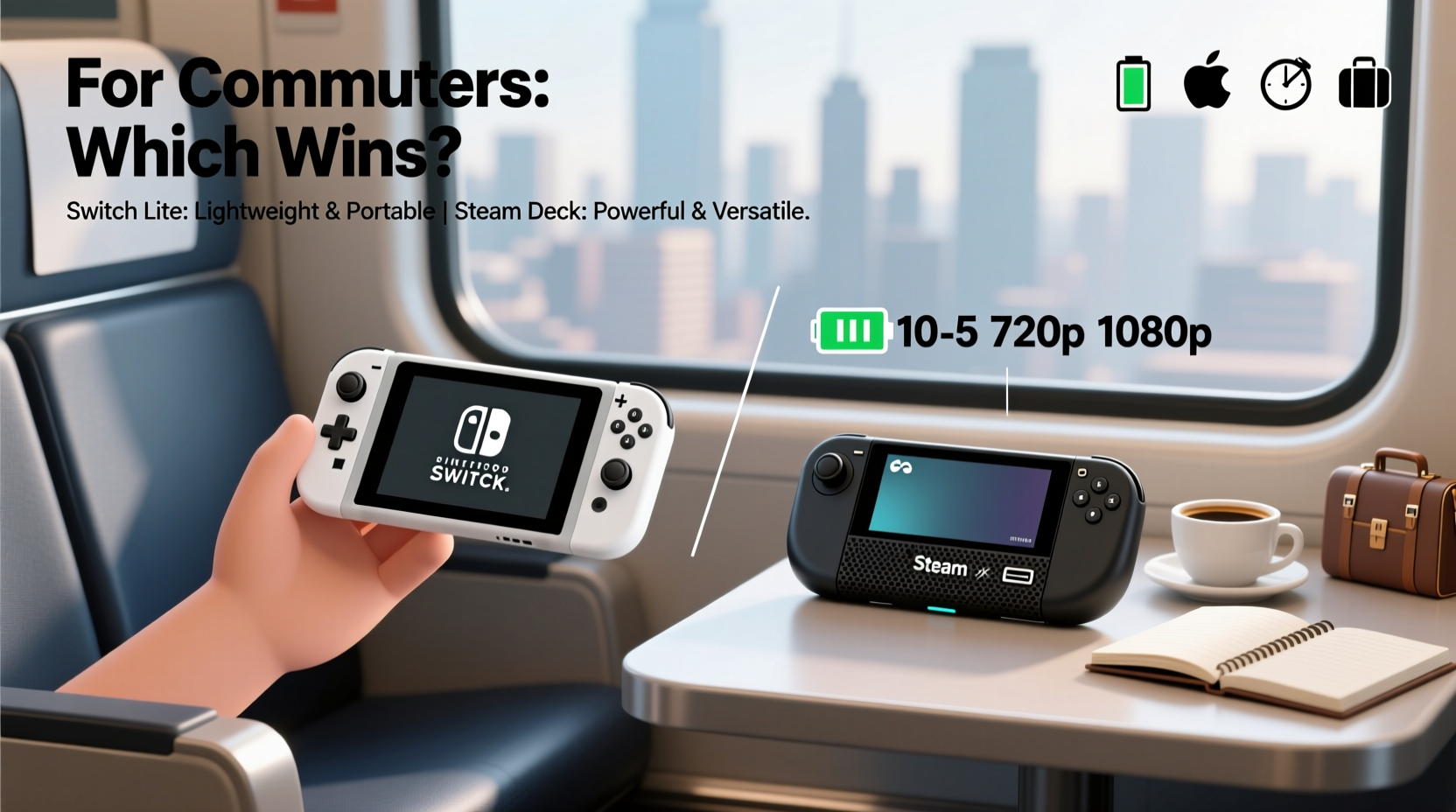
The first consideration for any commuter is how easily a device fits into daily life. Size, weight, durability, and ease of access all matter when you're navigating crowded stations, tight seats, or bumpy rides.
The **Switch Lite** weighs just 275 grams (about 9.7 ounces) and measures 208 x 91 x 13.9 mm. Its compact, lightweight design makes it ideal for slipping into a coat pocket or small bag. The integrated controls mean no extra parts to lose, and its solid build resists minor bumps—common during transit. It’s built like a traditional handheld, reminiscent of older Game Boys, which means fewer moving parts that could fail over time.
In contrast, the **Steam Deck** is significantly larger and heavier. The base model clocks in at 669 grams (nearly 1.5 pounds) and measures 288 x 117 x 49 mm. While not unwieldy, it demands more space—more akin to carrying a small tablet than a dedicated handheld. This bulk becomes noticeable after extended use, especially if you’re standing on a train or balancing other items.
The Steam Deck’s clamshell design protects the screen and controls when closed, offering peace of mind in a backpack. However, opening it mid-commute requires both hands and a stable surface, which isn’t always available. The Switch Lite, meanwhile, powers up instantly and can be played one-handed—ideal for quick sessions during short rides.
Game Library and Compatibility: What Can You Actually Play?
This is where the two devices diverge most dramatically. Your choice hinges largely on the kind of games you enjoy and whether you value curated experiences or open-ended freedom.
The **Switch Lite** is limited to Nintendo’s ecosystem. It plays only digital or physical Switch cartridges, and notably lacks docked mode—it’s handheld-only. But within that boundary, it delivers exceptional access to some of the best first-party titles in gaming: *The Legend of Zelda: Breath of the Wild*, *Super Mario Odyssey*, *Splatoon 3*, and *Metroid Dread*. These are polished, optimized, and designed specifically for portable play.
However, the Switch Lite cannot run emulated games officially, nor does it support PC games, indie titles outside the eShop, or backward compatibility beyond original Switch software. If your tastes lean toward AAA exclusives and family-friendly adventures, this isn’t a limitation—it’s a strength.
The **Steam Deck**, by contrast, runs a Linux-based version of SteamOS and gives full access to your entire Steam library. That includes thousands of PC games—from retro indies to modern blockbusters like *Elden Ring*, *Cyberpunk 2077*, and *Hades*. With Proton compatibility layers, many Windows-only titles run smoothly, even without native Linux support.
Additionally, users can install alternative operating systems like Windows, enabling broader software use, including emulators, web browsers, and productivity tools. For tech-savvy commuters, this transforms the Steam Deck into a mini-laptop with gaming superpowers.
“Valve designed the Steam Deck not just as a console, but as a gateway to the full breadth of PC gaming—anywhere.” — Ian Hamilton, Gaming Industry Analyst
But there’s a catch: not all Steam games are optimized for handheld play. Some require mouse-and-keyboard precision, have poor touchscreen support, or demand high performance that drains the battery quickly. Commuters must curate their library carefully to ensure smooth, enjoyable experiences on the go.
Battery Life and Charging Practicality
Commute length and charging availability are critical. No one wants their game cut short halfway through a trip.
The **Switch Lite** shines here. Under typical use—playing well-optimized titles like *Animal Crossing* or *Mario Kart 8 Deluxe*—it delivers between 3 to 7 hours of battery life. Lighter games extend closer to the upper end, making it reliable for multiple commutes on a single charge. It charges via USB-C and reaches full power in about 3 hours with a standard 5V/1.5A charger.
More importantly, Nintendo’s optimization ensures consistent performance without sudden drops. Even as the battery depletes, frame rates remain stable, and heat output is minimal.
The **Steam Deck** varies widely depending on usage. Playing less demanding games like *Stardew Valley* or *Dead Cells* might yield 4–6 hours. But running graphically intense titles such as *Doom Eternal* or *Control* can drain the battery in under two hours. Performance throttling helps manage heat and power draw, but compromises visual fidelity and responsiveness.
It also generates more heat during sustained gameplay, which can be uncomfortable during long sessions in warm environments. While it supports fast charging, a full recharge takes around 2.5 to 3 hours with a capable USB-C PD charger.
For irregular or unpredictable travel schedules, the Switch Lite’s reliability offers peace of mind. The Steam Deck rewards planning—knowing your game’s power demands and bringing supplemental charging options.
Performance and Controls: How They Feel in Motion
Playing while moving introduces challenges: shaky hands, limited visibility, and distractions. How a device handles these conditions affects enjoyment.
The **Switch Lite** features responsive capacitive buttons and analog sticks tailored for Nintendo’s control schemes. Games are fine-tuned for its hardware, resulting in intuitive, lag-free input. The 5.5-inch LCD screen (720p) may lack sharpness compared to modern smartphones, but it’s bright enough for indoor lighting and performs well in low-light subway cars.
Its fixed controls mean no drifting joysticks from third-party accessories—a common issue with detachable Joy-Cons. However, the smaller stick size can feel cramped for players with larger hands, especially during extended sessions.
The **Steam Deck** boasts superior raw power: a custom AMD APU with 4 CPU cores and 8 GPU compute units. This allows it to render complex 3D environments at playable frame rates. Its 7-inch LCD (also 720p) provides more screen real estate, beneficial for UI-heavy games like RPGs or strategy titles.
Controls include full analog sticks, trackpads, rear triggers, and programmable buttons—offering depth for advanced players. The inclusion of gyro aiming adds precision in shooters like *Portal* or *Half-Life: Alyx* (via streaming). But the sheer number of inputs can overwhelm newcomers, and accidental presses occur more frequently in tight spaces.
| Feature | Switch Lite | Steam Deck |
|---|---|---|
| Weight | 275g | 669g |
| Battery Life (avg) | 3–7 hours | 2–6 hours |
| Screen Size | 5.5\" | 7.0\" |
| Resolution | 720p LCD | 720p LCD |
| Storage Options | 32GB (expandable via microSD) | 64GB eMMC / 256GB NVMe / 512GB NVMe |
| Game Library | Nintendo Switch titles only | Full Steam library + emulators |
| Price (starting) | $199 | $399+ |
Real-World Use Case: A Week of Commuting with Both Devices
Consider Alex, a software developer with a 45-minute train commute each way. He enjoys narrative-driven games and occasional retro titles. One week, he uses only the Switch Lite; the next, the Steam Deck.
With the **Switch Lite**, Alex plays *Xenoblade Chronicles: Definitive Edition*. The game runs smoothly, battery lasts the full round trip, and the compact form lets him pause and stow it quickly when exiting. He appreciates the instant resume function and never worries about overheating or crashes.
The following week, he loads *Disco Elysium – The Final Cut* onto his Steam Deck. The experience is immersive—voice acting, expansive dialogue trees, and atmospheric world-building fill the larger screen beautifully. But by Thursday, he notices the battery struggles to last both ways without a top-up. He begins carrying a power bank, adding bulk. On Friday, a system update interrupts his session—something that rarely happens on the Switch’s simpler OS.
By week’s end, Alex realizes the Switch Lite suits his lifestyle better: predictable, hassle-free, and perfectly tuned for mobility. The Steam Deck impressed him creatively, but introduced logistical friction.
Which Should You Choose? A Decision Checklist
To help you decide based on your personal commute and preferences, consider this checklist:
- I mostly play Nintendo exclusives → Switch Lite
- I want access to my full Steam library → Steam Deck
- My commute exceeds 1 hour one-way → Evaluate battery needs (Lean toward Switch Lite unless charging available)
- I carry minimal gear and value lightness → Switch Lite
- I’m comfortable managing settings, updates, and performance tuning → Steam Deck
- I play emulated retro games or indie titles from non-Nintendo platforms → Steam Deck
- Budget is under $250 → Switch Lite
- I want one device for gaming, media, and light browsing → Steam Deck
Frequently Asked Questions
Can the Steam Deck replace my laptop for basic tasks during commutes?
Yes, to an extent. With desktop mode enabled, you can browse the web, check email, edit documents, and stream videos. However, the small screen and on-screen keyboard limit productivity compared to a real laptop. It’s best suited for light multitasking alongside gaming.
Is the Switch Lite obsolete with the OLED model available?
Not necessarily. While the Switch OLED offers better screen quality and audio, it’s bulkier and more expensive. The Switch Lite remains the most affordable and truly portable option in Nintendo’s lineup, especially for those who don’t need TV output.
Can I use Bluetooth headphones with both devices?
Yes, both support Bluetooth audio. However, the Switch family only added official Bluetooth audio support in later firmware updates, and latency can be higher. The Steam Deck generally offers better Bluetooth peripheral integration out of the box.
Final Verdict: Purpose Over Power
The “better” device depends entirely on your definition of a good commute. If your goal is seamless, joyful gameplay with zero setup and maximum reliability, the **Switch Lite** is unmatched. It’s a refined, focused tool built for one thing: playing great games anywhere, anytime.
If you crave versatility, deeper customization, and the thrill of playing nearly any PC title in your library, the **Steam Deck** opens doors no dedicated console can. But it comes with trade-offs: weight, shorter battery in demanding scenarios, and a steeper learning curve.
For most commuters—especially those with packed schedules, limited space, or inconsistent access to charging—the Switch Lite delivers a smoother, more consistent experience. The Steam Deck appeals to enthusiasts willing to invest time and effort for expanded capabilities.




 浙公网安备
33010002000092号
浙公网安备
33010002000092号 浙B2-20120091-4
Comments
No comments yet. Why don't you start the discussion?