
In an era where gaming hardware often converges toward high-resolution graphics and expansive open worlds, two handheld consoles stand apart by embracing entirely different philosophies: the Nintendo Switch OLED and the Playdate. One is a mainstream powerhouse with rich multimedia capabilities and blockbuster franchises; the other is a minimalist curiosity with a crank-driven interface and a focus on experimental indie games. Choosing between them isn't just about specs or screen size—it's about what kind of joy you seek in your gaming experience. Is it comfort, familiarity, and polish? Or surprise, novelty, and tactile delight?
This comparison doesn’t aim to declare a “winner” in traditional terms. Instead, it explores how each device creates moments of genuine fun, discovery, and emotional connection—what we might call \"gaming joy\"—and who will find deeper satisfaction in each.
The Design Philosophy Behind the Joy
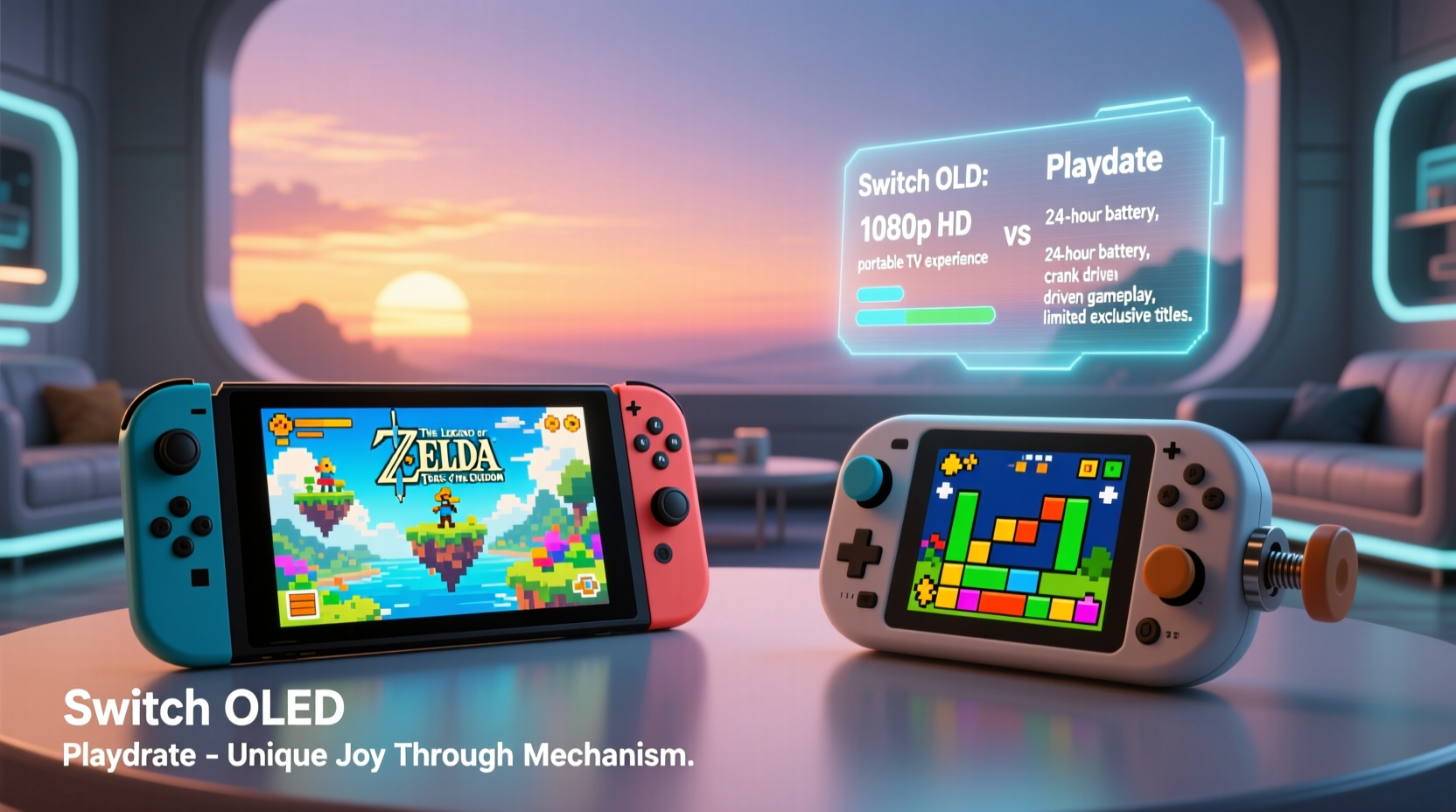
Nintendo has long built its identity around accessibility and intuitive design. The Switch OLED reflects this legacy. Its sleek, vibrant OLED screen (7 inches), improved audio, and sturdy kickstand make it ideal for both couch co-op and on-the-go play. It feels familiar, like a natural evolution of the original Switch. The controls are standard, the UI is polished, and the system integrates seamlessly with modern life—TV mode, handheld mode, tabletop mode. It’s designed to be used everywhere, by everyone.
In contrast, the Playdate looks like no other console ever made. Its bright yellow casing, tiny 2.7-inch black-and-white screen, and signature side-mounted crank evoke a sense of playful absurdity. Designed by Panic, the company behind software tools like Nova and Transmit, the Playdate was never meant to compete on power. Instead, it embraces limitations as creative fuel. The absence of color, backlighting, and analog sticks forces developers—and players—to think differently. Every interaction feels deliberate, almost meditative.
“Playdate isn’t trying to be the best at gaming. It’s trying to be the most interesting.” — Cabel Sasser, Co-founder of Panic
Their divergent designs reflect fundamentally different ideas of what gaming can be: one celebrates versatility and broad appeal, the other champions curiosity and constraint.
Gaming Libraries: Blockbusters vs. Experiments
The Nintendo Switch OLED runs the full library of Switch games, including critically acclaimed titles like *The Legend of Zelda: Tears of the Kingdom*, *Super Mario Odyssey*, *Hades*, and *Stardew Valley*. These are polished, expansive experiences that reward time investment. The strength of the Switch lies in its ability to deliver consistent, high-quality entertainment across genres—from action-adventure to rhythm games to multiplayer party titles.
The Playdate takes a radically different approach. Instead of a vast digital store, it offers seasonal game deliveries—curated sets of short, original games released weekly over several months. Each season includes around 24 titles, many designed specifically to use the crank or the monochrome aesthetic. Games like *Crankin’s Time Travel Adventure* (where you turn the crank to move through time) or *Reunion* (a minimalist puzzle-platformer with emotional depth) aren’t trying to fill weekends—they’re aiming for five-minute bursts of wonder.
The Switch gives you mastery—hours spent leveling up characters, unlocking secrets, perfecting combos. The Playday offers epiphanies—those sudden smiles when a mechanic clicks, or a simple animation tugs at your heart.
Portability and Real-World Use
Both devices are handhelds, but they serve different lifestyles.
| Feature | Switch OLED | Playdate |
|---|---|---|
| Screen | 7\" OLED, full color, touch-enabled | 2.7\" LCD, black-and-white, no backlight |
| Battery Life | 4.5–9 hours (game-dependent) | Up to 10 days (with typical seasonal use) |
| Weight | Approx. 320g (with Joy-Cons) | Approx. 208g |
| Connectivity | Wi-Fi, Bluetooth, USB-C, HDMI out | Wi-Fi, USB-C (no Bluetooth, no TV output) |
| Durability | Moderate (screen vulnerable to scratches) | High (simple build, no moving parts beyond crank) |
The Switch OLED excels as a hybrid device. You can play it on your TV, pass it around at a party, or take it on a flight. But its size and battery demands mean it’s not always the most convenient pocket companion. The Playdate, meanwhile, fits easily in a coat pocket or small bag. Its e-Ink-like screen is readable in direct sunlight, and because the games are lightweight and non-backlit, battery drain is minimal. You could forget it’s in your bag for weeks, pick it up, and still have charge.
For commuters or those who want a distraction-free gaming snack, the Playdate is unmatched. For families, travelers, or gamers who want one device to do everything, the Switch OLED remains the more practical choice.
A Mini Case Study: Two Gamers, Two Experiences
Sophie, 34, graphic designer and parent: Sophie bought a Switch OLED primarily for her kids, but found herself hooked on *Animal Crossing: New Horizons* during early morning coffee breaks. She loves playing with her daughter in handheld mode before school. The shared excitement of catching bugs or designing outfits creates bonding moments. When friends visit, they pull out *Overcooked! 2* and laugh until their sides hurt. For Sophie, gaming joy means connection, relaxation, and shared laughter. The Switch OLED fits seamlessly into her life.
Jamal, 28, indie developer and artist: Jamal backed the Playdate on Kickstarter out of curiosity. He didn’t expect to use it daily—but he does. He keeps it on his desk and plays a new episode from the current season during lunch. He describes finishing *Whitewater Wipeout*—a surfing game controlled entirely by the crank—as “the most unexpectedly joyful three minutes of my week.” The limitations inspire him creatively. He even prototyped a small game idea using the crank mechanic. For Jamal, joy comes from surprise, simplicity, and tactile feedback the world has forgotten.
Their stories illustrate a key truth: gaming joy isn’t universal. It’s deeply personal, shaped by lifestyle, expectations, and emotional needs.
Unique Features That Spark Delight
What makes each console uniquely joyful?
- Switch OLED: HD Rumble, motion controls, local multiplayer with detachable Joy-Cons, seamless transitions between modes, and access to online services like Nintendo Switch Online (with N64 and SNES classics).
- Playdate: The crank—a physical dial that rotates 360 degrees and clicks into place. It’s used for winding clocks, steering vehicles, adjusting radio frequencies, or rewinding time. This tactile element adds a layer of physical engagement missing from touchscreens and buttons.
Consider *Loop Hero* on Switch: a strategic deck-building roguelike with atmospheric music and deep mechanics. It rewards patience and planning. Now consider *Pepper Grinder* on Switch: fast-paced, precision platforming with inventive mechanics. Both are excellent, but they deliver joy through complexity and challenge.
On Playdate, *Milkmaid of the Milky Way* tells a sci-fi folk tale through point-and-click puzzles and hand-drawn art—all in stark black and white. The lack of color focuses attention on storytelling. Another title, *Game & Worries*, uses the crank to represent anxiety—turning it faster increases stress, slowing down brings calm. The metaphor becomes part of the gameplay. Here, joy emerges from meaning, minimalism, and mechanical poetry.
“The crank isn’t a gimmick. It’s a doorway to interactions you didn’t know you wanted.” — Indie Game Developer, speaking at GDC 2023
Practical Considerations: Who Should Choose Which?
Below is a checklist to help you decide based on your priorities:
Choose the Switch OLED if you:
- Want access to AAA and major indie titles
- Enjoy multiplayer gaming with friends or family
- Value high-quality visuals and sound
- Use your console both at home and on the go
- Prioritize ease of use and broad compatibility
Choose the Playdate if you:
- Appreciate minimalist design and tactile interfaces
- Enjoy experimental or narrative-driven games
- Prefer short, focused play sessions
- Are inspired by creative constraints
- Want a device that feels like a piece of art or conversation starter
Frequently Asked Questions
Can the Playdate replace my Switch?
Not if you're looking for a primary gaming device. The Playdate lacks backward compatibility, third-party support, and multimedia features. It’s best seen as a complementary experience—an antidote to sensory overload rather than a replacement.
Is the Switch OLED worth upgrading to from the original Switch?
If you play primarily in handheld mode, yes. The brighter screen, improved speakers, and better build quality make a noticeable difference. However, if you mostly use docked mode, the upgrade is less impactful.
Do Playdate games get old quickly?
Some users report finishing a season within a few weeks. But the intentional pacing—receiving one game per week—creates anticipation and prevents burnout. Many return to favorite titles months later, discovering new nuances. The experience is closer to reading a serialized story than binge-playing a game.
Conclusion: Defining Your Own Gaming Joy
The Nintendo Switch OLED and the Playdate represent two poles of handheld gaming. One offers breadth, power, and social connection. The other offers depth, novelty, and introspective charm. Neither is objectively “better.” The question is not which console is superior, but which aligns with your personal definition of joy.
If you find happiness in epic quests, cooperative challenges, and visually rich worlds, the Switch OLED will bring you lasting satisfaction. If you light up at clever mechanics, quirky aesthetics, and the tactile pleasure of turning a tiny crank, the Playdate might become your secret treasure.
Interestingly, owning both isn’t indulgence—it’s balance. The Switch feeds the appetite for adventure; the Playdate satisfies the hunger for wonder. In a world where games grow increasingly complex, sometimes the simplest interactions remind us why we started playing in the first place.




 浙公网安备
33010002000092号
浙公网安备
33010002000092号 浙B2-20120091-4
Comments
No comments yet. Why don't you start the discussion?