
If you're still using a Galaxy S10e in 2024, you're likely due for an upgrade — but is jumping to the S21 truly worthwhile? The S10e was a compact powerhouse in its time, praised for its balance of size, price, and performance. But nearly four years later, the tech landscape has evolved. The Galaxy S21, while no longer Samsung’s flagship, still delivers modern capabilities that the S10e simply can't match. This isn’t just about newer hardware; it's about whether those improvements translate into meaningful daily benefits.
This article breaks down the key differences between the two devices across critical categories: performance, display, camera, software support, and overall user experience. We’ll also consider cost, longevity, and real-world usage to determine if the upgrade path makes sense today — not just on paper, but in your pocket.
Performance: A Generational Leap
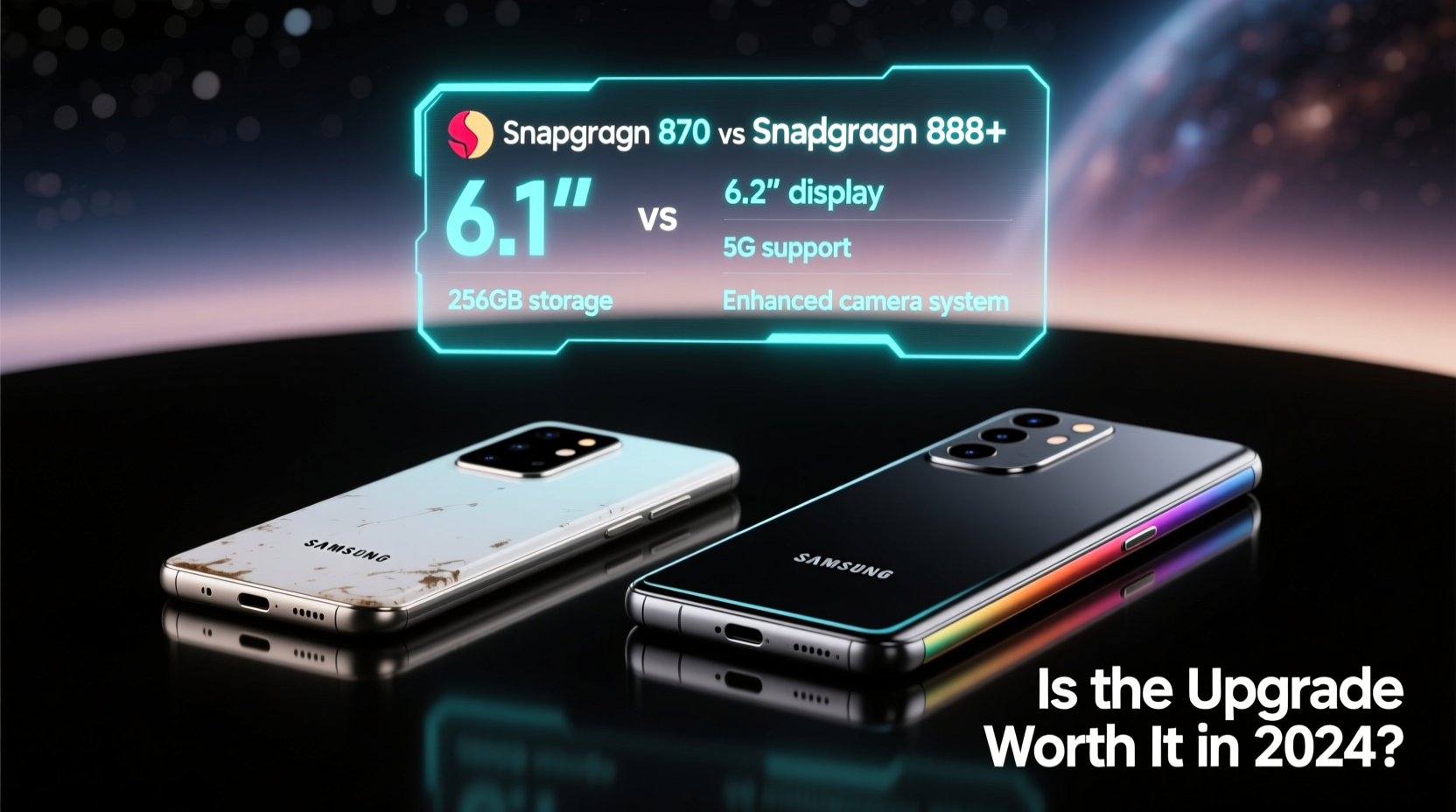
The most significant difference lies under the hood. The Galaxy S10e launched with Qualcomm’s Snapdragon 855 (or Exynos 9820 outside the U.S.), which was top-tier in 2019. By 2024 standards, it’s serviceable but shows its age, especially when multitasking or running intensive apps like video editors or high-end games.
In contrast, the S21 uses either the Snapdragon 888 or Exynos 2100, depending on region. Both are substantially faster, with better CPU and GPU performance. Benchmarks show up to 30–40% gains in processing speed and double the graphics performance. This means smoother animations, quicker app launches, and more reliable handling of future software updates.
Beyond raw power, the S21 supports faster Wi-Fi 6 and Bluetooth 5.2, offering better connectivity in crowded networks and lower latency with wireless earbuds. For users working remotely or relying on cloud services, this subtle upgrade enhances reliability without being overtly flashy.
Display and Design: From Compact to Modern Minimalism
The S10e stood out for its manageable 5.8-inch flat OLED display — rare among flagships even today. Its smaller footprint made one-handed use effortless. However, the screen resolution is 1080x2280 at 522 PPI, and it maxes out at 60Hz refresh rate.
The S21 moves to a larger 6.2-inch Dynamic AMOLED 2X panel with a 120Hz adaptive refresh rate. While slightly bigger, the design is more streamlined, with slimmer bezels and a centered punch-hole camera. The higher refresh rate makes scrolling, gaming, and general UI interaction feel significantly smoother — arguably one of the most noticeable upgrades in day-to-day use.
Design-wise, the S21 trades the S10e’s polycarbonate frame and glass back for a more premium-feeling matte plastic (on base models) or optional Phantom finishes. It lacks the S10e’s IP68 rating consistency in some regions due to material changes, but water resistance remains intact.
“High refresh rate displays have become a baseline expectation. Once you experience 120Hz, going back feels jarring.” — David Kim, Mobile UX Analyst at TechInsight Labs
Camera Comparison: More Than Just Megapixels
The S10e featured a capable dual-camera setup: 12MP main + 16MP ultra-wide. It took solid photos in daylight but struggled in low light and lacked telephoto zoom.
The S21 improves on all fronts. It retains a 12MP main sensor but adds laser autofocus and improved pixel binning. The ultra-wide is also 12MP, offering better dynamic range. Most importantly, it introduces a 64MP telephoto lens with 3x hybrid zoom and up to 30x digital zoom — a major advantage for capturing distant subjects.
In practical terms, this means sharper close-ups, better night mode results, and greater creative flexibility. Video recording jumps from 4K@30fps on the S10e to 8K@24fps on the S21, though most users will benefit more from improved stabilization and HDR10+ support.
| Feature | Galaxy S10e | Galaxy S21 |
|---|---|---|
| Main Camera | 12MP, f/1.5-2.4 | 12MP, f/1.8, Dual Pixel AF |
| Ultra-Wide | 16MP, f/2.2 | 12MP, f/2.2, 120° FoV |
| Telephoto | None | 64MP, f/2.0, 3x Hybrid Zoom |
| Front Camera | 10MP, f/1.9 | 10MP, f/2.2, Auto Framing |
| Video Max | 4K@30fps | 8K@24fps / 4K@60fps |
While casual photographers may not exploit all these features, the S21 offers more consistent results across lighting conditions and shooting styles.
Software and Longevity: Future-Proofing Your Device
This is where the upgrade calculus becomes clearer. The Galaxy S10e received three major Android OS updates (up to Android 12) and four years of security patches, ending in 2023. As of 2024, it no longer receives official updates, leaving it vulnerable to emerging threats and incompatible with newer app requirements.
The Galaxy S21, however, was part of Samsung’s expanded update policy. It shipped with Android 11 and is eligible for updates up to Android 14, with security patches continuing through at least 2025. This extra year or two of support ensures access to new features, better app compatibility, and enhanced privacy tools.
Additionally, the S21 integrates more deeply with Samsung’s ecosystem — SmartThings, Samsung DeX, and multi-device sync work more reliably. If you use Galaxy Buds, a Galaxy Watch, or a Windows PC, the seamless handoff experience is far superior on the S21.
Real-World Example: Sarah’s Upgrade Decision
Sarah, a freelance graphic designer in Austin, used her S10e since 2019. By late 2023, she noticed apps crashing, slow cloud syncs, and difficulty editing client videos on mobile. After testing an S21 at a store, she was struck by how quickly Adobe Express loaded and how smoothly she could preview high-res mockups.
She upgraded in January 2024 and reported that the 120Hz screen reduced eye strain during long work sessions, and the improved camera allowed her to shoot product photos with less post-processing. “It wasn’t just faster,” she said. “It felt like a tool built for how I work now, not five years ago.”
Cost-Benefit Analysis: Is the Upgrade Justified?
In 2024, both phones are available secondhand or through trade-in programs. The S10e now sells for $100–$150 used, while the S21 ranges from $200–$275 depending on condition and storage.
Spending an extra $100–$150 buys you:
- A significantly faster processor
- 120Hz adaptive display
- Better camera system with telephoto zoom
- At least one additional year of software support
- Improved connectivity (Wi-Fi 6, Bluetooth 5.2)
- Better integration with modern Samsung ecosystem services
For many users, this represents strong value — especially if you plan to keep the phone for another 2–3 years. The S21 won’t get the latest AI features coming to the S24 series, but it handles current demands capably.
Upgrade Checklist: Are You Ready for the S21?
- ✅ Your S10e is experiencing slowdowns or app instability
- ✅ You want a smoother, more responsive display
- ✅ You value better photo and video quality
- ✅ You rely on Samsung ecosystem devices
- ✅ You plan to keep your next phone for 2+ years
- ✅ Security updates matter to you
If four or more apply, the S21 is a logical next step.
Frequently Asked Questions
Can the S21 still run modern apps smoothly in 2024?
Yes. Despite not being the latest model, the Snapdragon 888 and 8GB RAM configuration handle everyday tasks, social media, streaming, and even demanding games like Genshin Impact at medium settings without issue. Only sustained heavy workloads may cause thermal throttling.
Is the battery life better on the S21?
The S10e has a 3100mAh battery; the S21 has 4000mAh. In practice, this translates to about 1.5–2 hours more screen-on time. However, the 120Hz display and 5G can drain power faster. With adaptive refresh and good settings, the S21 typically lasts a full day for moderate users.
Should I wait for a newer model instead?
If budget allows, the S23 or S24 offer better efficiency, longer update commitments (up to 7 years), and AI features. But for value-conscious buyers, the S21 strikes a sweet spot between cost and capability in 2024.
Final Verdict: Yes, the Upgrade Makes Sense
Moving from the Galaxy S10e to the S21 in 2024 isn’t about chasing specs — it’s about reclaiming responsiveness, reliability, and relevance. The improvements in display fluidity, camera versatility, and software support add up to a noticeably better experience.
You don’t need to be a power user to appreciate faster app launches, crisper video calls, or the peace of mind that comes with ongoing security patches. For under $250 on the used market, the S21 delivers a modern smartphone experience that the aging S10e can no longer provide.
If your current device is holding you back, or you simply want a more capable companion for work, creativity, and connection, the upgrade is justified — not as a luxury, but as a practical investment in your digital life.




 浙公网安备
33010002000092号
浙公网安备
33010002000092号 浙B2-20120091-4
Comments
No comments yet. Why don't you start the discussion?