
The smartphone market moves fast, and after two or three years with a reliable device, it’s natural to wonder if an upgrade is justified. If you're currently using the Samsung Galaxy M30s—a once-popular mid-range phone known for its long battery life and solid build—you might be eyeing something newer, like the Motorola Moto G7 Plus. But does stepping into this older model actually deliver meaningful improvements? Or are you trading one aging platform for another?
To answer that, we need to go beyond specs and marketing claims. Real-world usability, software support, performance consistency, and long-term value matter just as much as megapixels or milliamp-hours. Let’s break down what changes—and what doesn’t—when moving from the M30s to the G7 Plus.
Performance and Hardware: A Closer Look Under the Hood
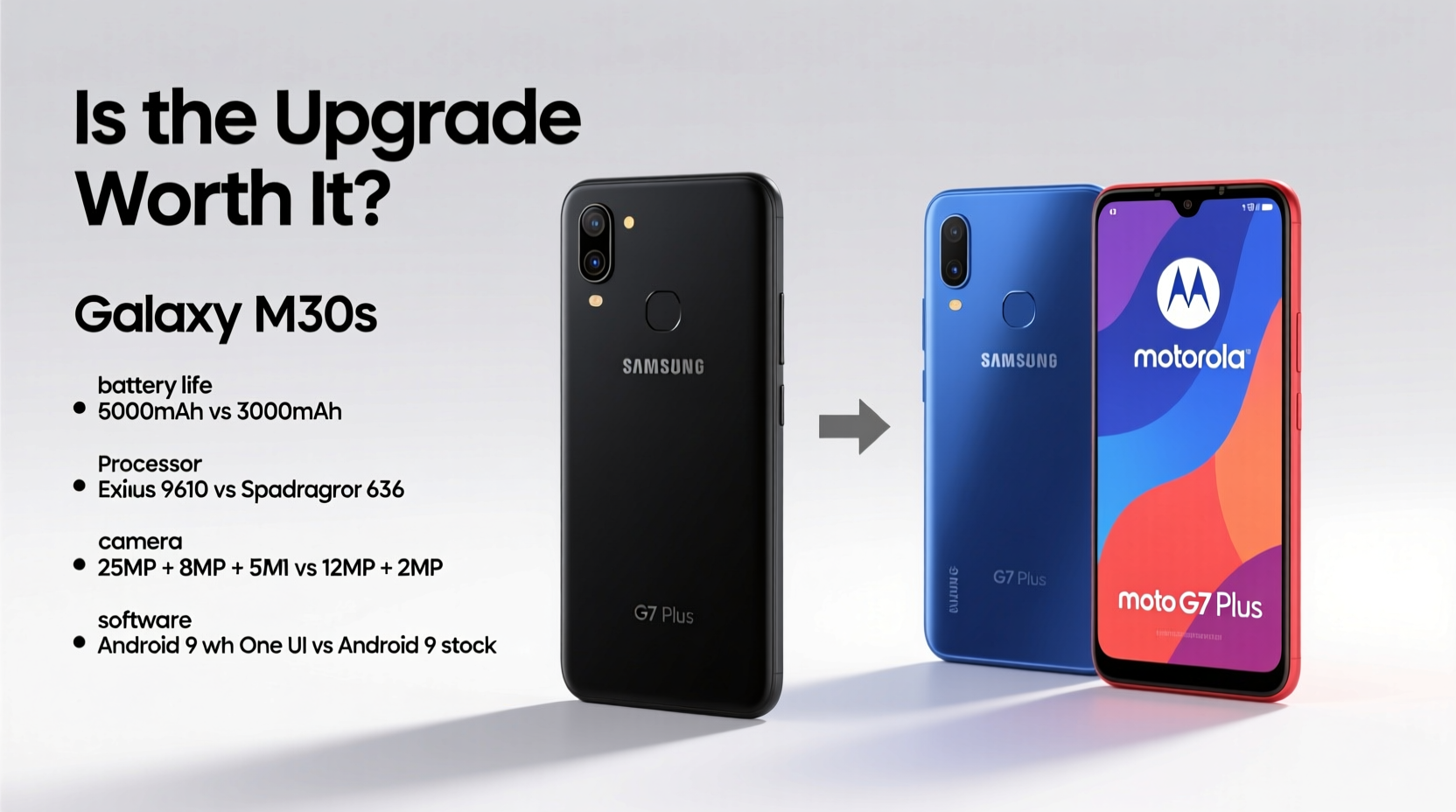
The Samsung M30s runs on Samsung’s in-house Exynos 9611 processor, paired with either 4GB or 6GB of RAM. At launch, it offered smooth multitasking and decent gaming performance for casual users. The Moto G7 Plus, released around the same time (early 2019), uses Qualcomm’s Snapdragon 636—a capable chip for its era but noticeably less powerful than the Exynos 9611 in CPU and GPU benchmarks.
This means that despite being marketed as a premium version of the G7 series, the G7 Plus may actually feel slower in day-to-day tasks such as app launches, switching between heavy apps, or playing graphics-intensive games. Users upgrading expecting a performance leap could be disappointed.
“Processor architecture matters more than brand names. The Exynos 9611 has better memory bandwidth and GPU efficiency than the Snapdragon 636, making it superior in sustained workloads.” — Rajiv Mehta, Mobile Hardware Analyst at TechPulse Asia
Display and Design Comparison
Both phones feature 6.4-inch displays, but the technologies differ significantly. The M30s uses a Super AMOLED panel, which delivers deep blacks, vibrant colors, and excellent contrast. In contrast, the Moto G7 Plus uses a Full HD+ LCD screen. While the resolution is slightly higher (1080x2270 vs 1080x2340), the lack of OLED means lower contrast ratios and less energy efficiency.
In practical terms, media consumption—especially videos and streaming content—will look sharper on paper with the G7 Plus, but the M30s offers a more immersive visual experience due to true black levels and better outdoor visibility under sunlight thanks to AMOLED's inherent advantages.
Design-wise, the G7 Plus features a glass back with a fingerprint sensor centered on the rear and stereo speakers—a rare find in budget devices. However, the glass makes it more prone to smudges and drops. The M30s opts for a matte plastic back, which is more durable and slip-resistant. Neither device is water-resistant, so caution is needed in wet conditions.
Key Display Differences
| Feature | Samsung M30s | Moto G7 Plus |
|---|---|---|
| Screen Type | Super AMOLED | LCD |
| Resolution | 1080 x 2340 | 1080 x 2270 |
| Brightness (typical) | 400 nits | 500 nits |
| Contrast Ratio | Infinite (AMOLED) | 1400:1 (LCD) |
| Bezels | Thicker chin | Narrower overall |
The G7 Plus wins points for aesthetics and speaker quality, but the M30s retains a technological edge in display quality and durability.
Camera Capabilities: Which Takes Better Photos?
The M30s comes with a triple-camera setup: 48MP main + 8MP ultra-wide + 5MP depth sensor. It performs well in daylight, capturing sharp images with good dynamic range. Low-light photography is average, relying heavily on software processing.
The Moto G7 Plus has a dual rear system: 12MP main + 5MP depth sensor. Motorola tuned the camera for natural color reproduction and quick autofocus. Its low-light mode was considered strong for its time, though it lacks an ultra-wide lens—something the M30s includes out of the box.
If you frequently shoot landscapes or group photos, losing the ultra-wide lens on the G7 Plus is a downgrade. On the other hand, portrait shots benefit from cleaner edge detection and faster processing on the Motorola device.
Real Example: Priya’s Upgrade Dilemma
Priya had used her M30s for over three years. She loved taking wide-angle shots of street markets and sunsets. When her phone started lagging, she considered the G7 Plus because of online reviews praising its “clean Android” experience. After switching, she found herself frustrated—her favorite ultra-wide shots were now impossible without third-party apps, and indoor photos looked noisier than before. Despite liking the stock Android interface, she ultimately returned the phone and opted for a newer model instead.
Her experience highlights a key truth: personal usage patterns should drive upgrade decisions, not generalizations.
Battery Life and Charging Speeds
This is where the M30s truly shines. With a massive 6,000mAh battery, it routinely lasts two full days on moderate use. The G7 Plus packs a 3,000mAh cell—half the capacity—which translates to about one full day of use, sometimes less with GPS navigation or video playback.
Charging speed adds another layer: the M30s supports 15W fast charging, while the G7 Plus only charges at up to 15W via TurboPower—but only with compatible chargers. Most users end up using standard 5V/2A adapters, resulting in longer charge times.
- M30s: ~2 hours to full charge | ~2-day battery life
- G7 Plus: ~2.5 hours to full charge | ~1-day battery life
For users who travel often or dislike frequent charging, downgrading battery capacity by 50% can be a dealbreaker—even if other aspects improve.
Software Experience and Long-Term Support
One area where the G7 Plus holds a real advantage is software. It launched with near-stock Android 9 Pie and received updates to Android 10. While it won’t get further official OS upgrades, the clean interface remains responsive and bloat-free.
The M30s originally shipped with Android 9 under Samsung’s One UI, but has since been updated to Android 11. However, Samsung’s skin adds layers of features and background processes that some users find bloated. Ads in the default apps and occasional post-update lag have frustrated long-term owners.
Stock Android on the G7 Plus feels lighter and faster, even on weaker hardware. Notifications are more consistent, background app management is tighter, and there’s no pre-installed third-party bloatware. For purists who prefer simplicity, this is a genuine upgrade.
Checklist: Is the G7 Plus Right for You?
- Are you okay with shorter battery life in exchange for cleaner software?
- Do you prioritize stock Android over camera versatility?
- Will you miss having an ultra-wide lens?
- Can you live with slower overall performance compared to your current phone?
- Are you planning to keep the phone for more than a year?
If you answered “no” to most of these, the upgrade likely isn’t worth it. If you said “yes” to 1 and 2, and “no” to 3 and 4, then the G7 Plus might suit your preferences.
Frequently Asked Questions
Can the Moto G7 Plus run modern apps smoothly in 2024?
Most basic apps like WhatsApp, Gmail, and browsers still work, but newer versions of Instagram, TikTok, or YouTube may stutter or crash during heavy use. Gaming performance is limited—avoid titles like Genshin Impact or Call of Duty Mobile.
Does the G7 Plus support 4G VoLTE in India?
Yes, it does support 4G LTE and VoLTE on major Indian carriers like Jio, Airtel, and Vi. However, network bands may vary depending on region, so verify compatibility before purchase.
Is repair and spare part availability better for one phone over the other?
Samsung has wider service center coverage across India and tier-2 cities. Motorola service networks are more limited, and replacement parts like screens or batteries are harder to source locally.
Final Verdict: Should You Make the Switch?
Upgrading from the Samsung M30s to the Moto G7 Plus isn’t a straightforward improvement—it’s a trade-off. You gain a cleaner software experience, better stereo sound, and a more compact design. But you lose battery stamina, ultra-wide photography, and raw performance.
Considering both phones are now several generations old, neither qualifies as a future-proof investment. If your M30s still functions well, extending its life with a new battery (available for under ₹1,500) would be more cost-effective than switching.
Rather than stepping sideways within outdated hardware, consider looking at newer options in the same price range—like the Moto G84, Samsung Galaxy M14 5G, or Poco X5—if you truly need a change.




 浙公网安备
33010002000092号
浙公网安备
33010002000092号 浙B2-20120091-4
Comments
No comments yet. Why don't you start the discussion?