
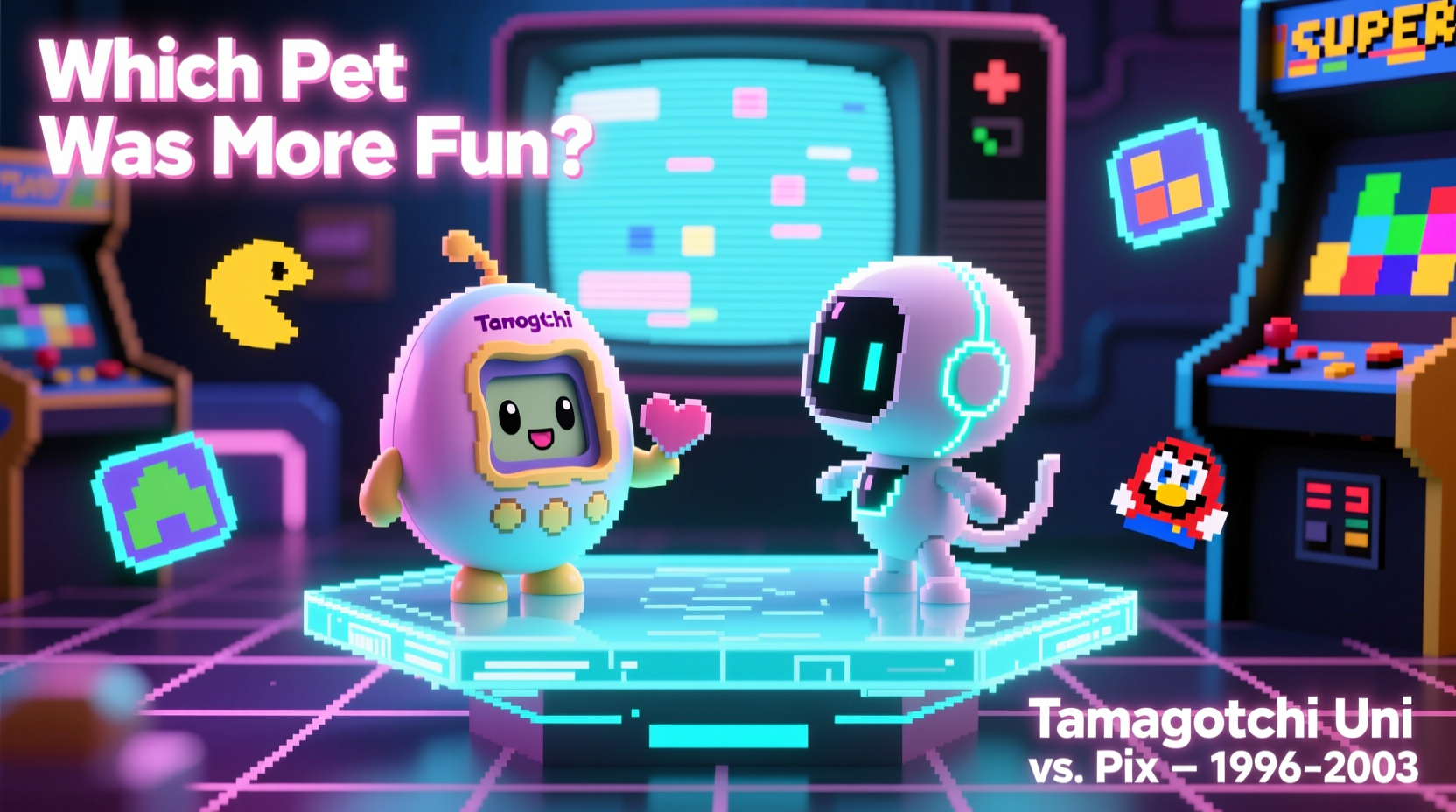
The revival of Tamagotchi in the 2020s brought a wave of nostalgia for millennials while introducing a new generation to the joys—and stresses—of digital pet care. Among the latest entries, the Tamagotchi Uni and Tamagotchi Pix emerged as two distinct approaches to the classic formula. While both stem from the same lineage of pixelated companionship, they diverge significantly in design, interaction, and overall experience. One embraces augmented reality and physical play; the other sticks to tradition with subtle modern upgrades. So, which truly offered more fun?
For those who grew up feeding, disciplining, and mourning pixelated creatures on tiny keychain screens, the answer isn’t just about features—it’s about emotional resonance, engagement, and how each device reimagines what a virtual pet can be in a world where smartphones dominate entertainment.
A Brief Evolution of the Virtual Pet
The original Tamagotchi, launched by Bandai in 1996, was revolutionary. It introduced millions to the concept of digital responsibility—a creature that lived, ate, played, got sick, and could die based on your attention. Its success spawned countless imitators and iterations, but none matched its cultural impact until the retro resurgence of the late 2010s.
The Tamagotchi Uni (released in 2021) and Tamagotchi Pix (2022) arrived during this revival, each representing a different philosophy. The Uni focused on portability, simplicity, and global connectivity through QR codes. The Pix, meanwhile, took a bold leap into interactive play using AR-style mechanics via its built-in camera and screen projection.
These aren’t just toys—they’re time capsules wrapped in innovation, appealing to adults reliving childhood memories and kids experiencing virtual pets for the first time.
Design and Interface: Tradition vs. Innovation
The Tamagotchi Uni maintains the iconic oval shape and button layout fans remember. It features a monochrome LCD screen with soft pastel backlighting, preserving the minimalist charm of earlier models. Navigation relies on three buttons—menu, select, and reset—making it intuitive for users familiar with vintage versions.
In contrast, the Tamagotchi Pix introduces a larger, vertically oriented color screen with touch-sensitive areas and a front-facing camera. Instead of raising a pet confined to the screen, the Pix projects your creature onto real-world surfaces using “projection mapping.” You interact with it by moving objects around in its environment—like placing a toy near the device so the pet can \"play\" with it.
| Feature | Tamagotchi Uni | Tamagotchi Pix |
|---|---|---|
| Screen Type | Monochrome LCD with backlight | Color TFT LCD with projection capability |
| Interaction Method | Button-based menu system | Sensor-based + motion detection + camera |
| Pet Environment | On-screen only | Projected into real space |
| Battery Life | Approx. 6 months (CR2032) | Approx. 4–5 months (AAA x 2) |
| Connectivity | QR code sharing | No external connectivity |
| Portability | High (keychain-sized) | Moderate (larger footprint) |
The Uni feels like a refined version of the classic experience—lean, efficient, and emotionally engaging through routine. The Pix, however, aims to blur the line between digital and physical, turning playtime into an active, immersive event. But does novelty translate to lasting enjoyment?
Gameplay Depth and Longevity
At their core, both devices require feeding, cleaning, discipline, and play. Neglect leads to illness or death; consistent care unlocks evolution paths and happy endings. However, the depth of these systems varies.
The Tamagotchi Uni expands on legacy mechanics with a global twist: players generate QR codes to visit other Tamagotchis worldwide, exchange gifts, or even breed pets. This feature adds social dimension without requiring internet access—cleverly sidestepping privacy concerns for younger users. There are over 100 possible characters across multiple generations, encouraging replayability.
The Pix, while visually impressive, limits long-term progression. Pets don't evolve in complex ways, and there's no online or QR-based sharing. Instead, the focus is on moment-to-moment interaction: guiding your pet through obstacle courses made from household items, playing hide-and-seek using shadows, or watching it react to light changes. These moments are delightful but often short-lived.
“With the Uni, I felt responsible again—the anxiety of forgetting to feed it before school brought back real memories. The Pix was fun for a weekend, then gathered dust.” — Daniel Reyes, millennial collector and retro tech reviewer
The Uni rewards patience and consistency. Its branching life paths create emotional stakes. Will your pet become a musician, astronaut, or grumpy old hermit? These outcomes depend on your choices over days or weeks. The Pix excels in immediate joy but lacks narrative weight. Once the novelty of projection wears off, engagement drops.
User Experience: Who Is Each Device For?
The Tamagotchi Uni appeals to purists and collectors. It replicates the rhythm of care that defined the '90s experience while adding meaningful modern touches. The QR code mechanic fosters community—even if indirect. Sharing a code at school or online becomes a small act of connection.
It also suits adults seeking mindful digital detox. Unlike smartphone games demanding constant taps and notifications, the Uni operates on its own timeline. You check in periodically, reinforcing presence rather than distraction.
The Pix targets younger children and families looking for shared play. Setting up a cardboard maze for your projected pet or dancing in front of the sensor to make it laugh turns caregiving into collaborative theater. It encourages creativity and movement, making it ideal for early learners developing empathy and motor skills.
Yet, for older users or those seeking deeper attachment, the Pix can feel gimmicky. The lack of generational continuity—no breeding, limited evolution—diminishes long-term investment. As one parent noted: “My daughter loved it for two weeks. Then she went back to her tablet.”
Step-by-Step: Maximizing Fun on Each Device
- Start fresh: Replace batteries and begin a new game to avoid inherited neglect from demo mode.
- Set reminders: Use phone alarms during first few days to stay on schedule with feeding and bedtime.
- Track moods: Note how actions affect behavior—overfeeding causes obesity, ignoring discipline leads to tantrums.
- Unlock connections (Uni only): Generate QR codes weekly to expand your pet’s social circle and unlock rare offspring.
- Create environments (Pix only): Use books, toys, or flashlights to build dynamic spaces for your pet to explore.
- Document journeys: Take notes or photos of milestones—first steps, evolutions, final forms—to enhance emotional connection.
- Rotate devices: Alternate between Uni and Pix to enjoy both structured care and imaginative play.
Case Study: Two Siblings, Two Devices
When 32-year-old Maya bought both models for her 8-year-old brother Liam and herself, she expected to bond over shared nostalgia. She chose the Uni for its authenticity; he picked the Pix for its lights and sounds.
Within days, Maya was deeply invested. She named her Tamagotchi “Nori,” tracked its sleep cycles, and scanned QR codes from international forums. She felt genuine grief when Nori passed away at age 112 (in pet years) after a long, happy life as a teacher.
Liam adored the Pix initially. He spent hours building ramps and tunnels, laughing as his pet bunny hopped across the kitchen table via projection. But after ten days, interest waned. Without goals or growth, the interactions felt repetitive. He returned to Roblox.
Still, the Pix sparked something unexpected: family playtime. Their mom joined in, helping design obstacle courses. Their dad filmed “adventures” set to music. Though less enduring, the Pix created shared memories rooted in physical play—an outcome hard to measure but valuable nonetheless.
Expert Insight: What Makes a Virtual Pet \"Fun\"?
Dr. Lena Cho, a developmental psychologist specializing in digital play, explains: “Fun isn’t just about excitement. It’s about meaning, challenge, and emotional payoff. The best virtual pets simulate real relationships—with consequences, growth, and loss.”
“The Tamagotchi Uni succeeds because it mirrors real caregiving: delayed rewards, occasional failure, and deep satisfaction from consistency. The Pix prioritizes instant delight, which is important for young kids—but doesn’t sustain engagement alone.” — Dr. Lena Cho, Child Development Researcher
She adds that emotional resilience is built through managing small digital losses—like losing a pet due to neglect. These experiences teach responsibility without real-world cost. The Uni supports this learning loop far more robustly than the Pix.
Comparison Checklist: Which Should You Choose?
- ✅ Do you want a nostalgic, authentic Tamagotchi experience? → Choose Uni
- ✅ Are you looking for interactive, screen-free play with a child? → Choose Pix
- ✅ Do you enjoy collecting, breeding, or connecting with others? → Choose Uni
- ✅ Is short-term novelty more important than long-term engagement? → Choose Pix
- ✅ Do you prefer portability and battery efficiency? → Choose Uni
- ✅ Do you value visual appeal and creative play over deep mechanics? → Choose Pix
Frequently Asked Questions
Can you connect the Tamagotchi Uni and Pix together?
No, the devices are not compatible. The Uni uses QR codes for connectivity, while the Pix has no external linking features. They operate as entirely separate ecosystems.
Which is better for kids under 10?
The Pix is more accessible for younger children due to its visual feedback and playful interactions. However, parental guidance enhances the Uni experience, turning it into a teaching tool for responsibility.
Do either of them require Wi-Fi or apps?
Neither device needs Wi-Fi, Bluetooth, or companion apps. All functions are self-contained, preserving privacy and reducing screen dependency—a deliberate design choice by Bandai.
Final Verdict: Which Offered More Fun?
\"Fun\" depends on context. The Tamagotchi Pix delivers bursts of imaginative, tactile joy. It transforms a countertop into a stage and invites participation. But its magic fades quickly without deeper mechanics to sustain interest.
The Tamagotchi Uni, by contrast, offers slow-burn fulfillment. It rebuilds the emotional arc that made the original so powerful: anticipation, attachment, regret, triumph. Its integration of QR-based global interaction adds modern relevance without sacrificing soul.
If measured by longevity, emotional depth, and replay value, the **Tamagotchi Uni** edges ahead. It honors the spirit of the franchise while evolving thoughtfully. The Pix is a creative experiment—one that dazzles briefly but doesn’t endure.
Ultimately, the Uni feels like a true successor. The Pix feels like a spin-off—a charming detour, but not the main journey.




 浙公网安备
33010002000092号
浙公网安备
33010002000092号 浙B2-20120091-4
Comments
No comments yet. Why don't you start the discussion?