
For years, OLED has reigned supreme in the premium TV market. Its perfect blacks, infinite contrast, and pixel-level precision made it the go-to choice for cinephiles and home theater enthusiasts. But with the rise of advanced Mini LED technology—particularly in models like the TCL QM8—many are asking: is Mini LED now a better option for most viewers than OLED? When comparing the TCL QM8 and the LG C3, two flagship models from competing display technologies, the answer isn't as clear-cut as it once was.
The TCL QM8 represents the cutting edge of Mini LED, leveraging thousands of tiny LEDs and dense local dimming zones to rival OLED’s contrast while delivering far higher peak brightness. Meanwhile, the LG C3 continues the legacy of OLED excellence with superior viewing angles, faster response times, and unmatched motion handling. So which technology truly wins for everyday use?
Brightness and HDR Performance: Where Mini LED Shines
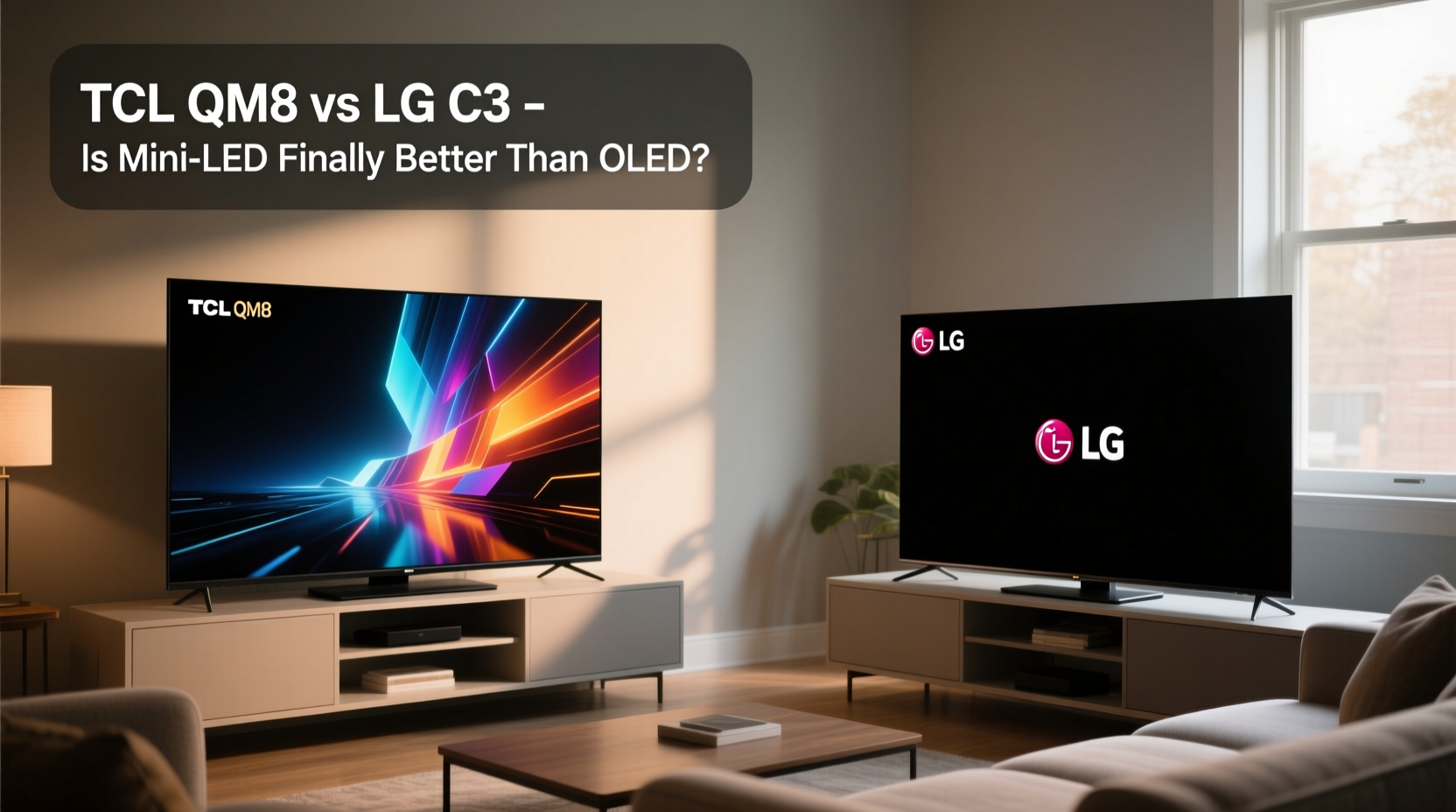
One of the most decisive advantages of the TCL QM8 over the LG C3 is peak brightness. The QM8 can reach up to 2,400 nits in small highlights, thanks to its full-array Mini LED backlight and aggressive local dimming. This makes a dramatic difference in high dynamic range (HDR) content, especially in well-lit rooms or when watching bright, sun-drenched scenes in movies and shows.
In contrast, the LG C3, while capable of excellent HDR, maxes out at around 800–900 nits. That's still impressive, but it pales next to the QM8’s ability to make specular highlights pop. Whether it’s sunlight reflecting off water, explosions in action films, or vibrant colors in nature documentaries, the extra luminance gives Mini LED a tangible edge in realism and immersion under typical room lighting.
Contrast and Black Levels: OLED Still Holds an Edge
OLED remains unmatched in true black reproduction. Each pixel on the LG C3 turns off completely when displaying black, resulting in infinite contrast and zero light bleed. This creates a sense of depth and clarity that even the best Mini LED TVs struggle to match—especially in dark-room settings.
The TCL QM8 uses sophisticated local dimming with hundreds of zones to minimize haloing and improve black uniformity, but it still suffers from blooming—where bright objects on dark backgrounds create faint glows around their edges. While firmware updates have reduced this issue significantly, it remains noticeable in low-light scenes with small bright elements, such as starfields or subtitles on black bars.
“OLED’s per-pixel control delivers the most natural contrast we’ve seen in consumer displays. For film purists, it’s still the gold standard.” — David Lee, Display Analyst at Rtings.com
Lifespan and Burn-in Risk: A Turning Point?
One of the long-standing concerns with OLED technology is burn-in—the permanent discoloration caused by static images displayed for extended periods. Gamers, news channel watchers, and users of UI-heavy streaming apps are particularly vulnerable. While LG has implemented multiple safeguards (pixel refresh, logo dimming, scrolling), the risk remains, especially over multi-year ownership.
Mini LED, on the other hand, doesn’t suffer from burn-in. The TCL QM8 uses a traditional LED backlight with LCD filtering, meaning it ages more like conventional TVs. While backlight degradation occurs over time, it happens slowly and uniformly. For users who leave their TVs on for hours daily or use them as PC monitors, this durability advantage could be decisive.
This shift marks a turning point: for many consumers, longevity and peace of mind may outweigh the slight contrast deficit of Mini LED.
Real-World Example: The Home Theater vs. Family Room Dilemma
Consider Sarah, a working parent who recently upgraded her living room TV. She wanted something great for weekend movie nights but also used daily for YouTube, kids’ cartoons, and weather updates. She initially leaned toward the LG C3 due to glowing reviews. But after six months, she noticed slight retention around the CNN ticker during morning news.
She returned the TV and switched to the TCL QM8. Though the blacks weren’t quite as deep, she found the overall picture brighter and more engaging in her sunlit living room. More importantly, she no longer worried about leaving educational videos on loop for her children. For her lifestyle, Mini LED wasn’t just competitive—it was more practical.
Feature Comparison: TCL QM8 vs LG C3
| Feature | TCL QM8 (Mini LED) | LG C3 (OLED) |
|---|---|---|
| Peak Brightness | ~2,400 nits (HDR highlights) | ~850 nits |
| Black Level Quality | Very good (with minor blooming) | Perfect (true black, no glow) |
| Viewing Angles | Moderate color/brightness shift off-axis | Excellent, consistent from wide angles |
| Burn-in Risk | Negligible | Potential with prolonged static content |
| Gaming Performance | Faster VRR, high brightness | Faster response time, lower input lag |
| Lifespan | Longer, no pixel degradation | 7–10 years with moderate use |
| Price (65” model) | $1,499 | $1,799 |
Gaming and Motion Handling: A Close Call
Gamers benefit from both technologies, but in different ways. The LG C3 offers near-instantaneous pixel response (0.1ms), eliminating motion blur and ghosting. Combined with HDMI 2.1, 120Hz support, and G-Sync/FreeSync, it remains one of the best gaming panels available.
The TCL QM8 isn’t far behind. It supports 144Hz refresh rates, variable refresh rate (VRR), and has strong input lag performance. Its higher brightness enhances visibility in bright game environments, such as open-world titles or racing games in daylight. However, its slower pixel response can cause slight smearing in fast-paced first-person shooters.
For competitive gamers, the C3 still holds a narrow lead. For casual and immersive gamers who value visual pop, the QM8 is increasingly compelling.
Actionable Checklist: Choosing Between QM8 and C3
- ✅ Do you watch in a bright room? → Prioritize TCL QM8 for brightness.
- ✅ Do you leave static menus or logos on screen for hours? → Avoid OLED; choose QM8.
- ✅ Is your viewing distance close and seating centered? → LG C3’s viewing angles won’t matter as much.
- ✅ Do you mostly watch movies in a dark room? → LG C3’s contrast will shine.
- ✅ Are you budget-conscious? → TCL QM8 offers premium features at a lower price.
- ✅ Do you play fast-paced games competitively? → LG C3’s response time gives an edge.
FAQ
Is Mini LED better than OLED in 2024?
It depends on your priorities. Mini LED excels in brightness, longevity, and resistance to burn-in, making it ideal for bright rooms and heavy daily use. OLED still leads in contrast, viewing angles, and motion clarity, especially in dark environments. For most average users, Mini LED is becoming the more practical choice.
Can you see the difference between QM8 and C3 on a store floor?
Yes—but context matters. In brightly lit retail stores, the TCL QM8 often looks more impressive due to its higher brightness and vivid HDR. However, in a controlled dark room, the LG C3’s deeper blacks and cleaner gradients become apparent. Always test under conditions similar to your home.
Will Mini LED eventually replace OLED?
Not entirely, but it’s closing the gap. OLED will likely remain the preferred choice for high-end cinema experiences and professional color grading. However, for mainstream consumers, Mini LED’s durability, brightness, and improving contrast are making it the default upgrade path.
Final Verdict: Who Should Choose What?
The TCL QM8 and LG C3 represent two philosophies in display engineering. The QM8 is built for resilience, brightness, and real-world usability. The C3 is engineered for purity of image, cinematic fidelity, and pixel-perfect motion.
For most people—those watching in mixed lighting, using their TV throughout the day, or concerned about long-term wear—the TCL QM8 offers a smarter, more future-proof investment. Its Mini LED panel delivers stunning HDR, avoids burn-in, and performs reliably year after year.
But if you’re a movie buff with a dedicated media room, or someone who values the absolute best black levels and silky-smooth motion, the LG C3 remains a compelling choice. OLED hasn’t been dethroned—it’s just facing its most credible challenger yet.




 浙公网安备
33010002000092号
浙公网安备
33010002000092号 浙B2-20120091-4
Comments
No comments yet. Why don't you start the discussion?