
Choosing a custom sofa cover is one of the most effective ways to refresh your living space, protect your furniture, or accommodate pets and children. However, even the highest-quality fabric will disappoint if the measurements are off. A poorly fitting cover can bunch, stretch, or leave gaps—undermining both comfort and aesthetics. Accurate measurement isn’t just helpful; it’s essential. This guide walks you through every detail, tool, and technique needed to get your sofa dimensions exactly right, ensuring a tailored fit that looks professionally installed.
Why Precise Measurements Matter
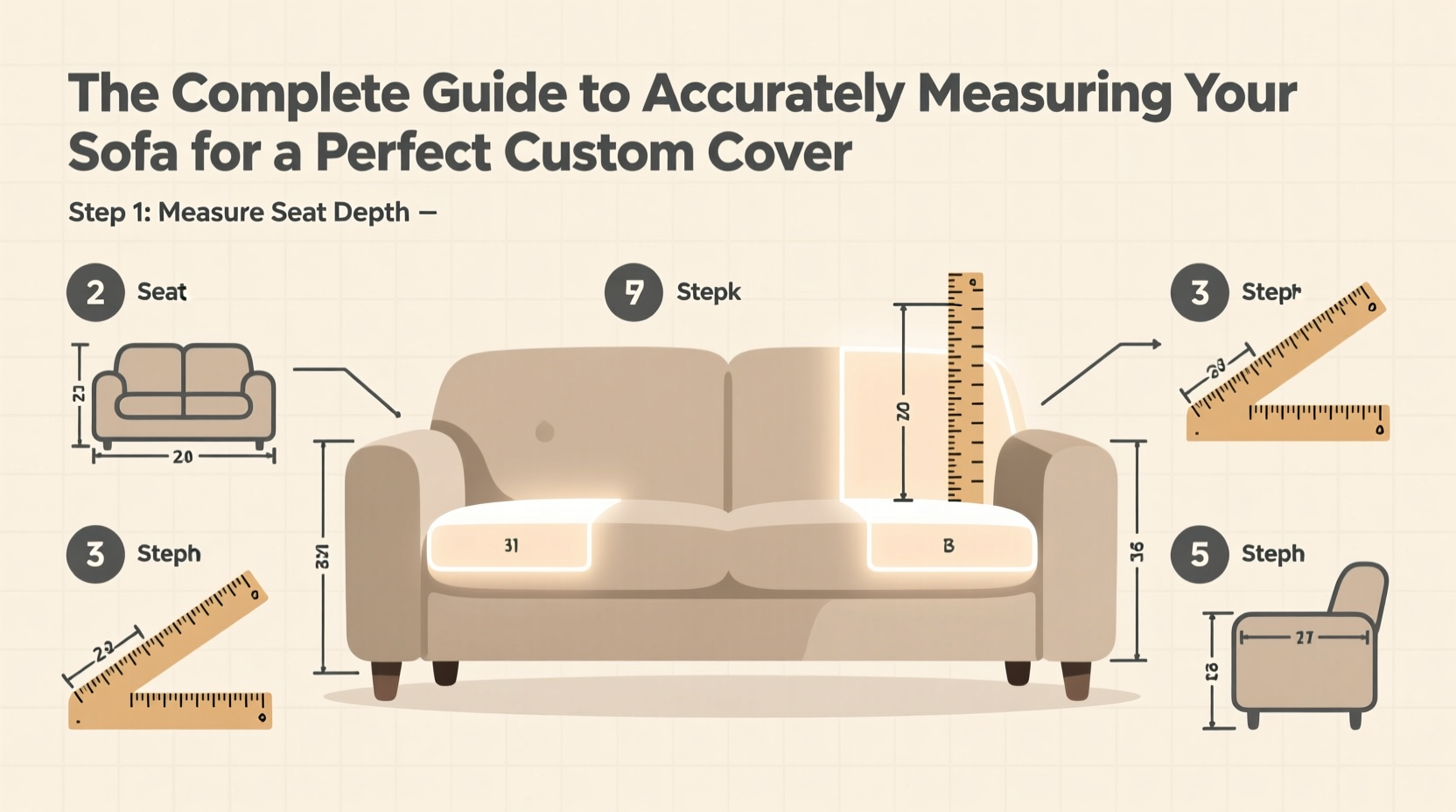
A custom-fit sofa cover should mirror the contours of your furniture like a second skin. Unlike universal or stretchable slipcovers, custom options are cut and sewn to match your sofa’s exact shape. Even a 1-inch discrepancy can result in loose draping or excessive tension on seams. Over time, ill-fitting covers wear out faster, shift during use, and may damage delicate upholstery. Precision ensures durability, comfort, and visual harmony with your interior design.
“Custom furniture protection only works when the fit is flawless. Measure twice, order once.” — Lena Reyes, Interior Textile Designer at Homewell Design Co.
Tools You’ll Need Before You Begin
Accurate measuring requires more than just a tape measure. Using the right tools eliminates common errors caused by flexibility, parallax, or misalignment.
- Flexible tape measure (at least 120 inches) – Ideal for curves and corners.
- Rigid ruler or yardstick – For straight edges and depth checks.
- Notebook and pen – Record each dimension immediately.
- Masking tape – Mark key points on the sofa without damaging fabric.
- Digital camera or phone – Take reference photos from multiple angles.
Step-by-Step Guide to Measuring Your Sofa
Follow this sequence to capture all necessary dimensions. Work slowly and systematically, labeling each measurement clearly.
- Clear and prepare the sofa – Remove cushions, throws, and decorative pillows. Ensure the frame is visible and accessible.
- Measure overall length – From the outer edge of one armrest to the other, along the front. Do not include decorative legs or skirts unless they extend beyond the frame.
- Measure overall height – From the floor to the highest point of the backrest. If your sofa has rolled arms or a curved back, measure at the center peak.
- Measure seat depth – From the front edge of the seat cushion to the back of the seat (where the cushion meets the backrest). Exclude the backrest itself.
- Measure total depth – From the front of the sofa (including arms) to the back. This includes seat depth plus backrest depth.
- Measure arm height – From the floor to the top of the armrest. Take separate readings if arms are asymmetrical.
- Measure arm width – From the outer edge of the arm to the inner edge where it meets the seat.
- Record cushion dimensions – Note the length, width, and thickness of each seat and back cushion for removable covers.
- Check for unique features – Chaise extensions, corner units, tufting, or skirted bases require additional notes and photos.
Special Considerations for Sectionals and Loveseats
If your sofa is modular or L-shaped, treat each section independently. Label them clearly (e.g., “Left Chaise,” “Middle Unit”) and note how they connect. Include angle measurements if applicable—for example, whether the sectional forms a 90-degree or open-angle configuration.
| Measurement Type | Where to Measure | Common Mistake to Avoid |
|---|---|---|
| Overall Length | Outer arm to outer arm | Including decorative side tables or adjacent furniture |
| Seat Depth | Front seat edge to base of backrest | Measuring to the top of the back cushion instead of the frame |
| Arm Height | Floor to top of armrest | Forgetting to check both left and right arms if uneven |
| Total Depth | Frontmost point to rearmost point | Not accounting for rear legs that extend behind backrest |
Checklist: Final Verification Before Ordering
Before submitting your measurements to a manufacturer or designer, run through this checklist to ensure completeness and accuracy.
- ✅ All dimensions recorded in inches (or centimeters, depending on supplier).
- ✅ Photos taken from front, side, back, and diagonal angles.
- ✅ Labels assigned to each section (especially for multi-piece sofas).
- ✅ Arm heights checked on both sides.
- ✅ Cushion specs included if removable covers are desired.
- ✅ Furniture style identified (e.g., Lawson, Tuxedo, Track Arm) for reference.
- ✅ Skirted base or exposed legs noted in comments.
Real Example: How One Family Avoided a Costly Mistake
The Thompsons ordered a custom linen cover for their 8-foot sectional, excited to upgrade their family room. When it arrived, the back panel was too short and gapped at the top. After reviewing their process, they realized they’d measured from the floor to the top of the cushion, not the actual back frame. The error was just 3 inches—but enough to ruin the fit. They contacted the supplier, resubmitted corrected measurements with side-view photos, and received a replacement within two weeks. Their lesson? Always measure structural elements, not soft components.
Expert Tips for Tricky Sofa Styles
Some sofas present unique challenges due to shape, padding, or construction. Here’s how to handle them.
- Tufted backs: Measure from the frame beneath the tufts, not the protruding buttons. Note the number and spacing of tufts for accurate pattern matching.
- Roll-arm sofas: Measure the height at the center crest of the roll, and the width from outer to inner edge of the rolled fabric.
- Low-back or apartment-sized sofas: Pay extra attention to leg placement—some have front legs set forward, altering the visual profile.
- Sofas with skirts: Specify whether the cover should tuck under the skirt or replace it entirely.
“On roll-arm and English-style sofas, we see the highest return rates due to incorrect arm depth measurement. Customers often forget to account for the inward curve.” — Marcus Lin, Production Manager at CoverCraft Solutions
Frequently Asked Questions
What if my sofa has no removable legs?
Measure from the lowest structural point of the base. If the legs are fixed, include them in height and depth measurements. Most manufacturers expect this unless specified otherwise.
Should I add extra inches for seam allowance or shrinkage?
No. Reputable custom cover makers build in seam allowances and account for minor fabric variance. Providing raw, exact measurements ensures the best outcome. Adding inches leads to oversized, baggy fits.
Can I measure a sofa in place, against a wall?
Yes, but pull it slightly forward if possible to access the back. Use a level or ruler to project the back height downward if direct measurement is blocked. Take photos to confirm alignment.
Conclusion: Fit Starts with Precision
A perfectly fitted custom sofa cover transforms both function and style. It protects your investment, enhances comfort, and reflects thoughtful attention to detail. But none of that matters without accurate measurements. By following this guide—using the right tools, capturing every critical dimension, and double-checking your work—you eliminate guesswork and ensure a seamless result. Whether you're refreshing a well-loved heirloom or safeguarding a new purchase, take the time now to measure with care. The difference will be visible—and felt—every day.




 浙公网安备
33010002000092号
浙公网安备
33010002000092号 浙B2-20120091-4
Comments
No comments yet. Why don't you start the discussion?