
A well-fitted tissue box cover enhances the look of any space—be it a living room, office, or bathroom. But nothing ruins the aesthetic faster than a cover that's too tight, too loose, or misaligned. The key to a flawless fit lies not in guesswork, but in precise measurement. Whether you're crafting a custom fabric cover, ordering online, or repurposing a decorative box, accurate dimensions are essential. This guide walks you through every step of measuring your tissue box correctly, avoiding common pitfalls, and ensuring a snug, professional finish.
Why Accurate Measurement Matters
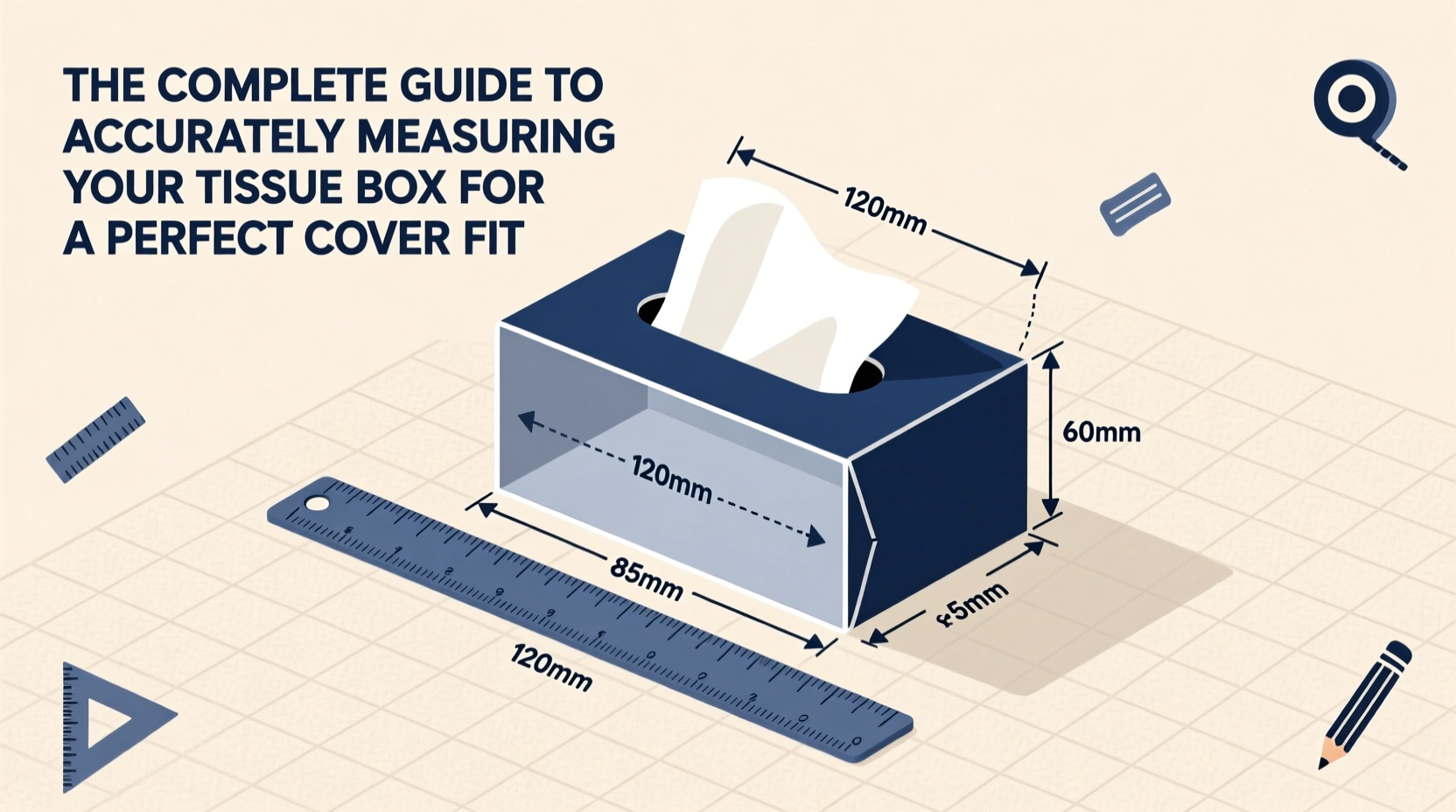
Tissue boxes come in a wide range of sizes, even within standard categories. A \"standard\" facial tissue box from one brand may differ by nearly half an inch from another. These small discrepancies can make the difference between a clean, tailored appearance and a sagging, ill-fitting cover. Custom covers, especially handmade or sewn ones, require exact measurements to avoid wasted materials and frustration.
Moreover, a poorly fitting cover can hinder function—making it difficult to pull tissues out smoothly or causing the box to shift inside. Precision ensures both form and function are preserved.
“Even a 0.25-inch error can result in a cover that puckers or won’t stay in place.” — Dana Reyes, Home Textile Designer
Step-by-Step Guide to Measuring Your Tissue Box
Follow this clear, five-step process to capture all necessary dimensions. Use a rigid metal ruler or retractable tape measure for best accuracy.
- Remove the Tissue Roll (If Applicable): Some tissue boxes have inner cardboard sleeves or plastic inserts. Remove these to measure the outer shell only.
- Measure the Length: Place the ruler along the longest side of the top surface, from one edge to the opposite. Record the measurement in inches or centimeters.
- Measure the Width: Measure the shorter side of the top surface. This is typically perpendicular to the length.
- Measure the Height: Stand the box upright and measure from the bottom to the top edge. Be sure to include the full height—even if the cover will only go partway down.
- Check for Tapering: Many tissue boxes are slightly tapered—wider at the top than the bottom. To confirm, measure the length and width at both the top and bottom edges. If there’s a difference, note both values.
Accounting for Design Features and Fit Preferences
Not all tissue boxes are simple rectangles. Some have rounded corners, embossed patterns, or built-in dispensing flaps that affect how a cover fits. Consider these factors when measuring:
- Rounded Corners: If the box has curved edges, the cover may need seam allowances or stretchy fabric to conform properly.
- Dispensing Openings: Ensure the cover includes a correctly positioned slit or opening aligned with the box’s tissue slot.
- Stretch vs. Non-Stretch Fabrics: Knit or spandex-blend fabrics can accommodate slight size variations, while cotton or linen require exact measurements.
- Cover Style: Decide whether you want a full-wrap cover (covers all sides) or a sleeve-style (slips over the top). Each requires different seam allowances.
Recommended Seam Allowances
| Fabric Type | Seam Allowance | Notes |
|---|---|---|
| Cotton, Linen | ½ inch (1.27 cm) | No stretch; precision critical |
| Knit, Jersey | ¼ inch (0.64 cm) | Stretch compensates for minor errors |
| Denim, Canvas | ⅜ inch (0.95 cm) | Thicker fabric needs moderate allowance |
| Polyester Blend | ⅜ to ½ inch | Depends on stiffness |
Common Measurement Mistakes to Avoid
Even experienced crafters make errors when rushing through measurements. Here are the most frequent issues—and how to prevent them.
- Measuring Only the Top: Failing to check tapering leads to covers that bulge at the base or gape at the top.
- Ignoring the Height: Assuming all boxes are the same height results in covers that don’t fully encase the box or are too short.
- Using a Flexible Tape Incorrectly: Curving the tape around the box gives inaccurate linear measurements. Keep it straight and flush against the surface.
- Forgetting the Tissue Roll: In boxes with internal cores (like pocket packs), the roll adds thickness. Measure with it in place if the cover will be used that way.
- Estimating Instead of Measuring: “It looks like a regular box” is not a measurement. Always use tools.
Real-World Example: Measuring a Decorative Tissue Box
Sarah purchased a beautiful wooden tissue box for her guest bathroom, designed to resemble a vintage trunk. Excited to make a custom linen cover, she measured only the top surface—assuming it was square and uniform. After sewing, the cover wouldn’t fit. Upon re-measuring, she discovered the box was 0.4 inches wider at the top than at the base due to its arched lid design.
She corrected her pattern by averaging the top and bottom widths and adding elastic to the hem for flexibility. The second cover fit perfectly, hugging the contours without strain. Sarah learned that even non-cardboard boxes require careful assessment.
Checklist: How to Measure Your Tissue Box Like a Pro
Use this checklist before starting your next cover project:
- ☐ Remove any internal components (plastic liners, tissue rolls)
- ☐ Use a metal ruler or rigid tape measure
- ☐ Measure length and width at both top and bottom
- ☐ Measure full height from base to top edge
- ☐ Check for tapering, curves, or special features
- ☐ Note dispensing slot location
- ☐ Add appropriate seam allowance based on fabric
- ☐ Double-check all numbers before cutting or ordering
FAQ
What if my tissue box isn’t rectangular?
For oval, round, or uniquely shaped boxes, take multiple circumference points and map the outline. Consider using stretch fabric or creating a multi-panel cover for complex shapes.
Do I measure with tissues inside?
No—measure the empty box. Tissues compress and vary in fullness, which affects consistency. Design for the container, not its contents.
Can I use the packaging to get dimensions?
Sometimes. Manufacturer packaging often lists approximate sizes, but actual production models can vary. Always verify with direct measurement.
Final Tips for a Perfect Fit
Accuracy begins with attention to detail. Treat each tissue box as unique—even if it appears identical to others. Environmental factors like humidity can cause cardboard to expand or warp slightly over time, so measure the specific box you intend to cover.
If ordering online, provide exact measurements in the notes section. Reputable sellers will adjust patterns accordingly. For DIY projects, consider making a mock-up with scrap fabric first. It saves time, money, and disappointment.
“The best covers aren’t just pretty—they disappear into the design because they fit so well.” — Marcus Tran, Interior Stylist
Take Action Today
Grab your ruler, find your tissue box, and measure it with confidence. With the right approach, you can create or choose a cover that looks tailor-made. Whether you’re refreshing your home decor, crafting gifts, or upgrading office aesthetics, precision is your secret tool. Share your success story or ask questions in the comments—let’s help others achieve the perfect fit too.




 浙公网安备
33010002000092号
浙公网安备
33010002000092号 浙B2-20120091-4
Comments
No comments yet. Why don't you start the discussion?