
Deleting a Facebook page you created may seem straightforward, but the process involves more than just clicking a button. Whether you’re removing an outdated business profile, closing a personal project, or consolidating your digital presence, understanding the full implications—and executing the steps correctly—is essential. Once a page is deleted, all content, followers, messages, and insights are permanently lost. This comprehensive guide walks you through every phase of deletion, highlights critical precautions, and offers real-world advice to ensure you make an informed decision.
Why Delete a Facebook Page You Created?
There are many valid reasons to delete a Facebook page. Perhaps the brand or initiative it represented has ended. Maybe you launched a test page that never gained traction, or you’ve decided to shift your marketing efforts elsewhere. Some users discover they accidentally created a public page instead of a personal profile and wish to correct the error. Whatever the reason, Facebook allows creators to remove their pages—but only if certain conditions are met.
It’s important to distinguish between deleting a page and simply deactivating or unpublishing it. A deactivated page can be restored; a deleted one cannot. Before proceeding, confirm that removal is truly your goal.
Step-by-Step Guide to Deleting Your Facebook Page
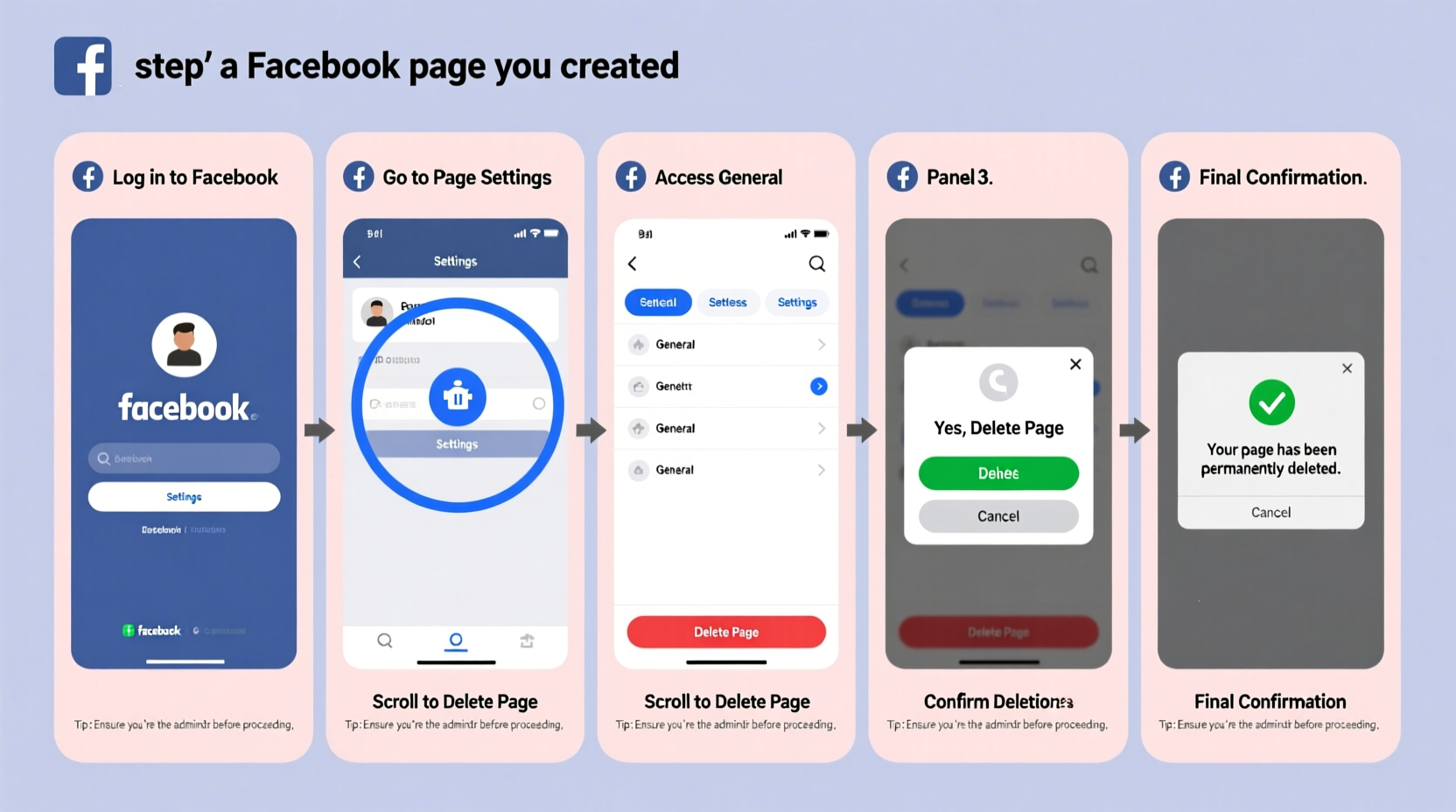
The deletion process must be completed from a desktop browser. Mobile apps do not support full page deletion. Follow these steps carefully:
- Log in to Facebook using the account that created or administers the page.
- Navigate to facebook.com/pages or go directly to your page via search.
- Click on the page you want to delete to open it.
- In the top-right corner, click Settings.
- In the left-hand menu, select General.
- Scroll down to the section labeled “Remove Page.”
- Click Delete Page.
- Review the warning message detailing what will be lost (photos, likes, messages, etc.).
- Confirm your identity by entering your password if prompted.
- Click Delete Page again to finalize.
After confirmation, Facebook begins processing the deletion. The page enters a 14-day grace period during which it can still be restored. After this window, it is permanently erased from Facebook’s servers.
“Once a page is deleted beyond the recovery window, there’s no way to retrieve its data. Always back up critical content before initiating deletion.” — Jordan Lee, Digital Strategy Consultant
What Happens After Deletion?
When a page is deleted, several irreversible changes occur:
- All posts, photos, videos, and comments are permanently removed.
- Likes, followers, and engagement metrics vanish.
- Messages sent to the page are no longer accessible.
- The page username (e.g., facebook.com/yourbusiness) becomes available for others to claim.
- Insights and analytics data are wiped.
Note: While the page content disappears, any content shared externally (such as links posted on other websites) may remain indexed in search engines until manually removed or deindexed.
Checklist: Before You Delete Your Facebook Page
- ✅ Back up all important photos, videos, and posts
- ✅ Export your page’s Insights and analytics
- ✅ Save or respond to unread messages
- ✅ Notify followers in advance (if appropriate)
- ✅ Confirm you are the admin or creator of the page
- ✅ Ensure no active ads are running on the page
- ✅ Consider unpublishing instead, if uncertain
Common Mistakes to Avoid
Many users regret deleting their pages due to avoidable oversights. Below is a comparison of recommended actions versus common errors.
| Do’s | Don’ts |
|---|---|
| Download your page’s archive using Facebook’s Data Download tool | Assume you can recover content after deletion |
| Wait out the 14-day grace period to confirm your decision | Delete without informing team members or co-admins |
| Unpublish the page first to test the impact | Confuse page deletion with account deletion |
| Cancel any scheduled posts or ad campaigns | Delete a page with ongoing customer interactions |
Mini Case Study: Recovering from a Hasty Deletion
Sarah, a freelance graphic designer, created a Facebook page for her branding services two years ago. After shifting focus to Instagram and LinkedIn, she decided to clean up her online presence. In a moment of haste, she deleted her Facebook page without backing up her portfolio images or client testimonials. Two weeks later, a potential client asked for examples of her past work, but the page was gone. Though Sarah had some files saved locally, she lost dozens of high-quality project images hosted exclusively on Facebook. She now advises others: “Always export your content first. Even if you think you won’t need it, future opportunities might depend on it.”
Frequently Asked Questions
Can I restore a deleted Facebook page?
Yes, but only within 14 days of deletion. During this grace period, log into the admin account, go to Settings > General > Remove Page, and look for the option to restore. After 14 days, restoration is impossible.
What’s the difference between unpublishing and deleting a page?
An unpublished page remains in your account but is hidden from public view. It retains all content, likes, and messages. You can republish it anytime. Deletion removes everything permanently after the 14-day window.
I’m not the admin anymore—can I still delete the page?
No. Only current admins or the original creator can delete a page. If you’ve lost admin access, you’ll need to regain it or ask another admin to remove the page.
Alternative Options to Full Deletion
If you’re hesitant about permanent removal, consider these alternatives:
- Unpublish the Page: Go to Settings > Page Visibility and switch to \"Unpublished.\" The page won’t appear in searches or to the public, but you retain full access.
- Transfer Ownership: Assign the page to another admin if you no longer wish to manage it.
- Archive Content: Use Facebook’s “Download Your Information” tool to save everything before making any changes.
- Rebrand Instead: Update the name, profile picture, and content to reflect a new direction rather than starting over.
These options preserve your history while giving you control over visibility and management.
Final Thoughts and Action Steps
Deleting a Facebook page is a significant action—one that should follow careful consideration and preparation. The platform has been a key tool for personal branding, small businesses, and community building, but not every page needs to exist forever. Knowing how to responsibly decommission a page protects your digital footprint and prevents confusion among followers.
Before hitting delete, ask yourself: Have I backed up everything valuable? Is this page still serving a purpose? Could it be repurposed instead? Taking even 20 minutes to evaluate these questions can save hours of regret later.
“Digital minimalism isn’t about deleting everything—it’s about keeping what matters and letting go of what doesn’t, intentionally.” — Lena Patel, Social Media Wellness Coach




 浙公网安备
33010002000092号
浙公网安备
33010002000092号 浙B2-20120091-4
Comments
No comments yet. Why don't you start the discussion?