
Smartphones are packed with apps—some useful, many forgotten. Over time, unused applications clutter your device, consume storage, drain battery life, and slow down performance. Whether you're using an iPhone or an Android phone, knowing how to efficiently delete apps is essential for maintaining a clean, fast, and organized mobile experience. This comprehensive guide walks you through the exact steps for both platforms, shares expert tips, and helps you avoid common mistakes.
Why Deleting Unused Apps Matters
Every app installed on your phone takes up space—even if you never open it. Background processes, cached data, and automatic updates silently use system resources. According to Apple, iOS devices can lose up to 15% of available storage over six months due to app bloat alone. Google reports similar findings for Android, noting that background app activity contributes significantly to battery drain.
Deleting unnecessary apps does more than free up space. It enhances security by removing outdated software that may no longer receive updates. It also simplifies navigation, reduces distractions, and improves overall device responsiveness.
“Regular digital decluttering is just as important as physical organization. Removing unused apps can extend your phone’s usable lifespan by over a year.” — Dr. Lena Torres, Mobile Device Optimization Specialist
How to Delete Apps on iPhone (iOS)
iOS offers multiple ways to remove apps, depending on your iPhone model and iOS version. The process is consistent across devices running iOS 14 and later, including iPhone SE, iPhone 11 through iPhone 15 series.
Method 1: From the Home Screen (Standard Method)
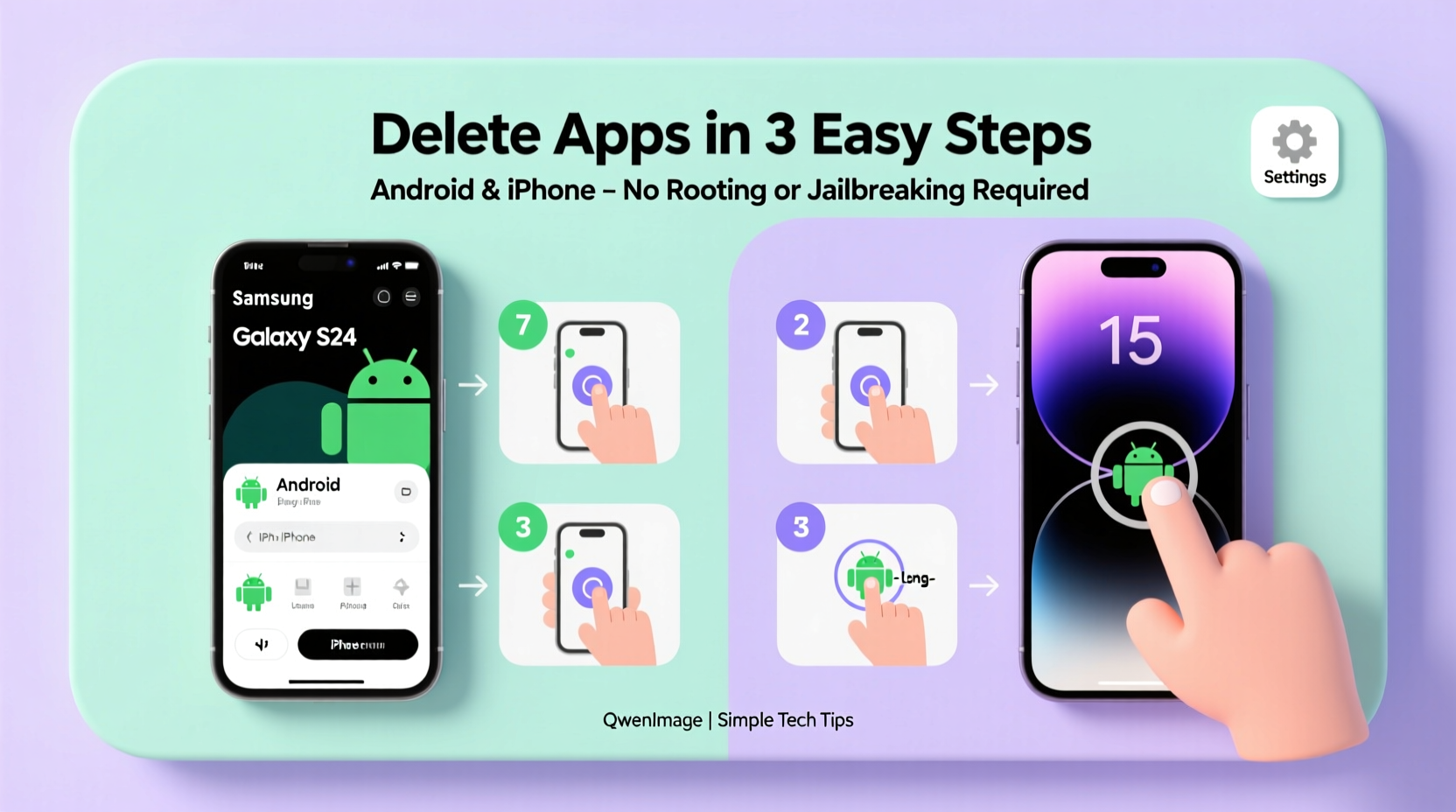
- Press and hold any app icon on your home screen until all icons begin to wiggle.
- A small “X” or minus sign will appear in the corner of some apps. Tap it.
- Confirm deletion when prompted. The app and its data will be removed.
Note: Some pre-installed Apple apps (like Weather, Stocks, or Voice Memos) don’t show an “X,” but you can still remove them. They’ll disappear from the home screen and won’t take up space after deletion.
Method 2: Using Settings (For Hidden or Stubborn Apps)
If an app doesn’t have a visible delete option on the home screen:
- Open Settings.
- Tap General > iPhone Storage.
- Wait for the list to load. Apps are sorted by size.
- Select the app you want to delete.
- Tap Delete App, then confirm.
This method shows exactly how much space each app uses and includes recommendations like “Offload Unused Apps,” which removes the app but keeps its documents and data.
How to Delete Apps on Android Phones
Android provides flexible options for uninstalling apps, though the interface varies slightly between manufacturers like Samsung, Google Pixel, OnePlus, and others. The core functionality remains the same.
Method 1: Long-Press on Home Screen or App Drawer
- Locate the app you want to delete.
- Press and hold the app icon.
- Drag it to the top of the screen where “Uninstall” appears (on most devices).
- Release the icon. The app will be uninstalled immediately.
On older Android versions or certain launchers, you may see a “Remove” or “Uninstall” option appear when you long-press. Dragging to uninstall is supported on Android 7 and above.
Method 2: Through Settings (Recommended for System Apps)
To manage apps more precisely:
- Go to Settings.
- Tap Apps or Apps & notifications.
- Find the app in the list and tap it.
- Select Uninstall. If unavailable, tap Disable instead (for preloaded apps).
Disabling system apps prevents them from running and hides them from the app drawer, even if you can’t fully uninstall them.
Method 3: Using Google Play Store
You can also remove apps remotely via the Play Store:
- Open the Play Store app.
- Tap your profile icon in the top-right corner.
- Select Manage apps & device.
- Under “Installed,” find the app and tap Uninstall.
This method is useful if the app isn’t visible on your home screen.
App Deletion: Do’s and Don’ts
| Do’s | Don’ts |
|---|---|
| Check app size before deleting to prioritize large space-hogs. | Don’t assume deleted apps always remove all data—some leave folders behind. |
| Back up important data (photos, login info) before removal. | Don’t disable critical system services like Google Play Services without research. |
| Use built-in storage tools to identify rarely used apps. | Don’t repeatedly install and delete the same app—it fragments storage. |
| Review permissions to understand what access apps had. | Don’t ignore update prompts for apps you plan to keep—they often include security fixes. |
Mini Case Study: Maria Clears 8GB in One Evening
Maria, a freelance designer in Austin, noticed her iPhone 12 was slowing down and showing “Storage Almost Full” warnings. She hadn’t deleted any apps in over a year. Using the iPhone Storage menu, she discovered a social media aggregator app she’d tried once was using 1.2GB. Another old game took up 900MB. After spending 20 minutes reviewing and deleting seven unused apps, she freed up 8.3GB. Her phone felt noticeably faster, and she re-enabled iCloud Photo optimization without anxiety about space.
Her approach? She sorted apps by size, tested whether she missed any after deletion, and used offloading for borderline cases. Within a week, her battery life improved by nearly 15%, likely due to fewer background processes.
Essential Checklist: How to Safely Delete Apps
- ✅ Back up important data (contacts, photos, documents) linked to the app.
- ✅ Check how much storage the app uses before deletion.
- ✅ Sign out of accounts (especially banking or email apps) before removing.
- ✅ Disable two-factor authentication apps only after transferring recovery codes.
- ✅ Restart your phone after deleting multiple apps to clear residual cache.
- ✅ Review app permissions post-deletion to ensure no lingering access.
Frequently Asked Questions
Can I recover a deleted app?
Yes. On both iPhone and Android, you can reinstall previously downloaded apps without repurchasing. On iPhone, go to the App Store and tap your profile icon to view \"Purchased.\" On Android, open the Play Store, tap your profile, and select \"Manage apps & device\" > \"Not installed.\"
Why can’t I delete certain apps?
Some pre-installed system apps (e.g., Phone, Messages, Google apps) cannot be uninstalled on most devices. However, you can usually disable them to stop background activity and hide them from view. On Android, disabling is found in Settings > Apps. On iPhone, deletion may be restricted by parental controls or MDM (Mobile Device Management) profiles.
Does deleting an app log me out of my account?
Generally, yes—the app data stored locally is removed. However, your account remains active on the service’s servers. You’ll need to log back in when you reinstall. For sensitive apps like banking or password managers, manually logging out before deletion is safer.
Take Control of Your Digital Space
Your smartphone should serve you—not slow you down with digital clutter. Deleting unused apps is a simple yet powerful habit that boosts performance, protects privacy, and restores peace of mind. Whether you’re on iOS or Android, the tools are built in and easy to use. Start with one screen, sort by size, and work your way through the backlog. You might be surprised how much lighter your phone feels—both physically and mentally—after a thorough cleanup.




 浙公网安备
33010002000092号
浙公网安备
33010002000092号 浙B2-20120091-4
Comments
No comments yet. Why don't you start the discussion?