
Diamonds have captivated humanity for centuries—valued not only for their brilliance but also for the extraordinary conditions under which they form. Whether forged over billions of years deep within the Earth or synthesized in weeks using cutting-edge science, diamonds represent one of nature’s and engineering’s most remarkable achievements. Understanding both natural and lab-grown diamond creation offers insight into geology, technology, ethics, and personal choice when selecting a gemstone.
Natural Diamond Formation: The Earth’s Hidden Alchemy
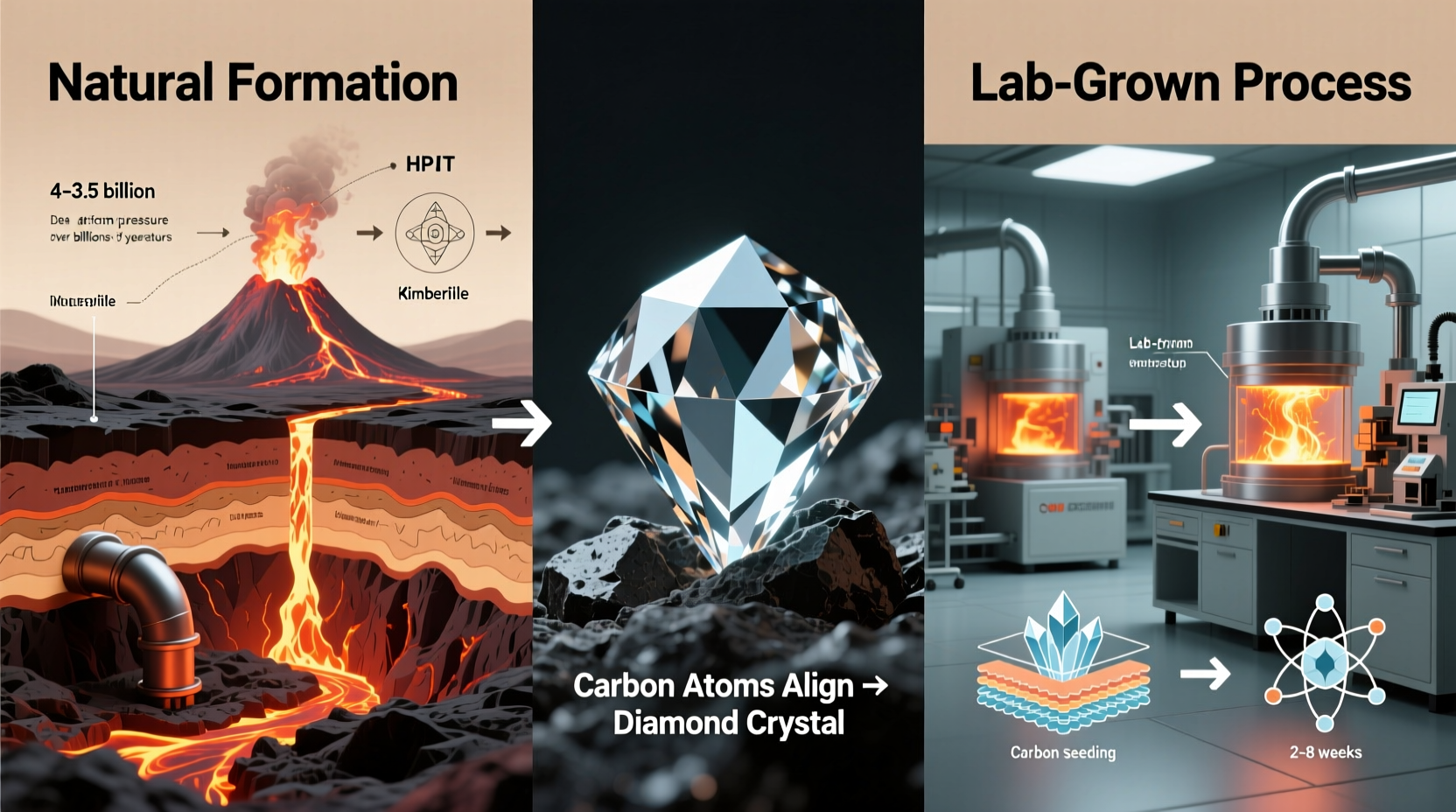
Natural diamonds begin their journey roughly 90 to 120 miles beneath the Earth's surface, in the upper mantle. Under extreme heat (around 2,200°F or 1,200°C) and immense pressure (45–60 kilobars), carbon atoms crystallize into the densest and hardest known natural material. This process typically requires at least 1 billion years, though some diamonds may be as old as 3.5 billion years.
The primary source rocks for natural diamonds are kimberlite and lamproite—volcanic pipes that originate deep in the mantle. When ancient volcanic eruptions occurred, these molten rocks rapidly ascended through the crust, carrying diamond-bearing fragments with them. Because diamonds would otherwise convert to graphite during slow cooling, it is this rapid eruption and solidification that preserves their structure.
Once brought near the surface, diamonds are mined either from primary sources (kimberlite pipes) or secondary deposits (riverbeds and alluvial plains where erosion has carried them). Major producers include Botswana, Russia, Canada, and Angola.
Lab-Grown Diamonds: Science Mimicking Nature
Since the mid-20th century, scientists have successfully replicated the conditions necessary for diamond growth in controlled environments. Today, two dominant methods produce high-quality synthetic diamonds: High Pressure High Temperature (HPHT) and Chemical Vapor Deposition (CVD).
High Pressure High Temperature (HPHT)
This method mimics the Earth’s natural process. A small diamond seed is placed in a press with pure carbon (usually graphite) and a metal catalyst. Under pressures exceeding 50,000 atmospheres and temperatures above 1,400°C, the carbon melts and crystallizes onto the seed, growing layer by layer. HPHT diamonds have been produced since the 1950s and are now capable of yielding gem-quality stones up to several carats.
Chemical Vapor Deposition (CVD)
CVD takes a different approach. In a vacuum chamber, a thin slice of diamond seed is exposed to methane and hydrogen gases heated to around 800°C using microwaves. The gases break down at the atomic level, allowing carbon to deposit gradually on the seed. This method allows for precise control over purity and color, producing exceptionally clear Type IIa diamonds—some of the purest available.
“Lab-grown diamonds are not imitations—they are chemically, physically, and optically identical to mined diamonds.” — Dr. James Butler, Materials Scientist, Naval Research Laboratory
Comparing Natural vs. Lab-Grown Diamonds
| Feature | Natural Diamond | Lab-Grown Diamond |
|---|---|---|
| Origin | Formed in Earth’s mantle over billions of years | Synthesized in weeks using HPHT or CVD |
| Composition | Pure carbon, sometimes with nitrogen impurities | Identical: pure carbon crystal lattice |
| Hardness | 10 on Mohs scale | 10 on Mohs scale |
| Price (per carat) | $4,000–$12,000+ depending on quality | $800–$2,500 for equivalent quality |
| Environmental Impact | Significant land disruption, water use, emissions | Lower footprint, especially with renewable energy |
| Traceability | Varies; conflict-free certifications available | Full supply chain transparency possible |
Step-by-Step Guide to Creating a Lab-Grown Diamond
- Select a diamond seed: A thin, high-purity diamond wafer serves as the foundation for growth.
- Prepare the chamber: For CVD, seal the seed in a vacuum chamber filled with methane and hydrogen. For HPHT, place the seed with carbon and a metal catalyst in a high-pressure press.
- Initiate growth: Apply heat and pressure (HPHT) or microwave energy (CVD) to break down carbon molecules and allow them to bond to the seed.
- Monitor progress: Growth occurs over several days to weeks. Technicians adjust parameters to minimize defects.
- Cool and extract: Once the desired size is reached, the environment is slowly cooled to prevent cracking.
- Polish and cut: Like mined diamonds, lab-grown stones are shaped by skilled artisans to maximize brilliance.
- Grade and certify: Independent labs (e.g., GIA, IGI) assess cut, clarity, color, and carat weight.
Real-World Example: From Lab to Engagement Ring
In 2021, Sarah Chen, a sustainability advocate in Portland, Oregon, decided to propose to her partner with an ethical engagement ring. After researching options, she chose a 1.5-carat, D-color, VVS1-clarity lab-grown diamond created via CVD. The stone cost $2,200—less than half the price of a comparable mined diamond—and came with full documentation tracing its origin to a solar-powered facility in California. Her jeweler confirmed that even gemologists couldn’t distinguish it from a natural diamond without specialized equipment. For Sarah, the decision combined beauty, affordability, and environmental responsibility.
Choosing What Matters: Ethics, Cost, and Longevity
The rise of lab-grown diamonds has shifted consumer priorities. While natural diamonds carry historical prestige and rarity, lab-grown alternatives offer compelling benefits:
- Up to 70% lower cost for similar quality
- Reduced ecological damage compared to open-pit mining
- Greater control over carbon footprint when powered by renewables
- No risk of funding conflict zones (a concern with some mined stones)
However, natural diamonds still hold value as geological artifacts—each representing a unique chapter in Earth’s history. Some collectors and investors prefer them for their scarcity and legacy.
“The emotional value of a diamond isn't tied to its origin—it's about what it represents: commitment, achievement, beauty.” — Leila Nassif, Ethical Jewelry Advocate
FAQ
Can jewelers tell if a diamond is lab-grown?
Not visually. Even experienced professionals require advanced spectroscopy tools to detect subtle differences in growth patterns or trace elements. Reputable labs now laser-inscribe “lab-grown” on the girdle for transparency.
Do lab-grown diamonds last as long as natural ones?
Yes. Both are made of pure carbon arranged in the same crystal structure, making them equally durable, scratch-resistant, and suitable for everyday wear.
Are lab-grown diamonds considered “real”?
Absolutely. According to the FTC, any carbon crystal with diamond properties—regardless of origin—is a real diamond. Terms like “synthetic” are discouraged because they imply imitation, which is inaccurate.
Checklist: How to Buy a Diamond with Confidence
- ✅ Determine your budget and prioritize the 4Cs (Cut, Clarity, Color, Carat)
- ✅ Decide between natural and lab-grown based on values and needs
- ✅ Purchase only from vendors providing certification (GIA, IGI, GCAL)
- ✅ Ask about return policies and warranty coverage
- ✅ Verify whether the diamond is treated or enhanced
- ✅ Consider setting and metal type for long-term durability
Conclusion
From the molten depths of the planet to precision-controlled reactors, the path to creating a diamond is as fascinating as the gem itself. Whether formed by time and tectonic forces or engineered with scientific precision, modern diamonds offer unmatched beauty and symbolic power. With greater transparency, falling costs, and rising awareness, consumers today have more meaningful choices than ever before. By understanding how diamonds are made—naturally or in the lab—you empower yourself to make informed, intentional decisions that align with your values, aesthetics, and budget.




 浙公网安备
33010002000092号
浙公网安备
33010002000092号 浙B2-20120091-4
Comments
No comments yet. Why don't you start the discussion?