
At first glance, the question “What’s the difference between a potato and a spud?” may seem like a riddle or a trick. After all, both terms appear on menus, grocery lists, and recipe cards with equal frequency. Yet this linguistic curiosity persists in kitchens, markets, and culinary discussions around the world. The answer, however, is not botanical or agricultural—it lies in language, history, and cultural nuance. There is no biological or horticultural distinction between a potato and a spud; they refer to the exact same tuber. But understanding how and why we use these two words differently offers insight into the evolution of food terminology, regional dialects, and even anti-potato sentiment from centuries past.
This article unpacks the myth, etymology, and practical implications behind the terms \"potato\" and \"spud,\" clarifying their interchangeable use while exploring how language shapes our perception of everyday ingredients. For home cooks, educators, and food enthusiasts, recognizing the subtleties behind such common terms enhances not only culinary literacy but also appreciation for the stories embedded in what we eat.
Definition & Overview
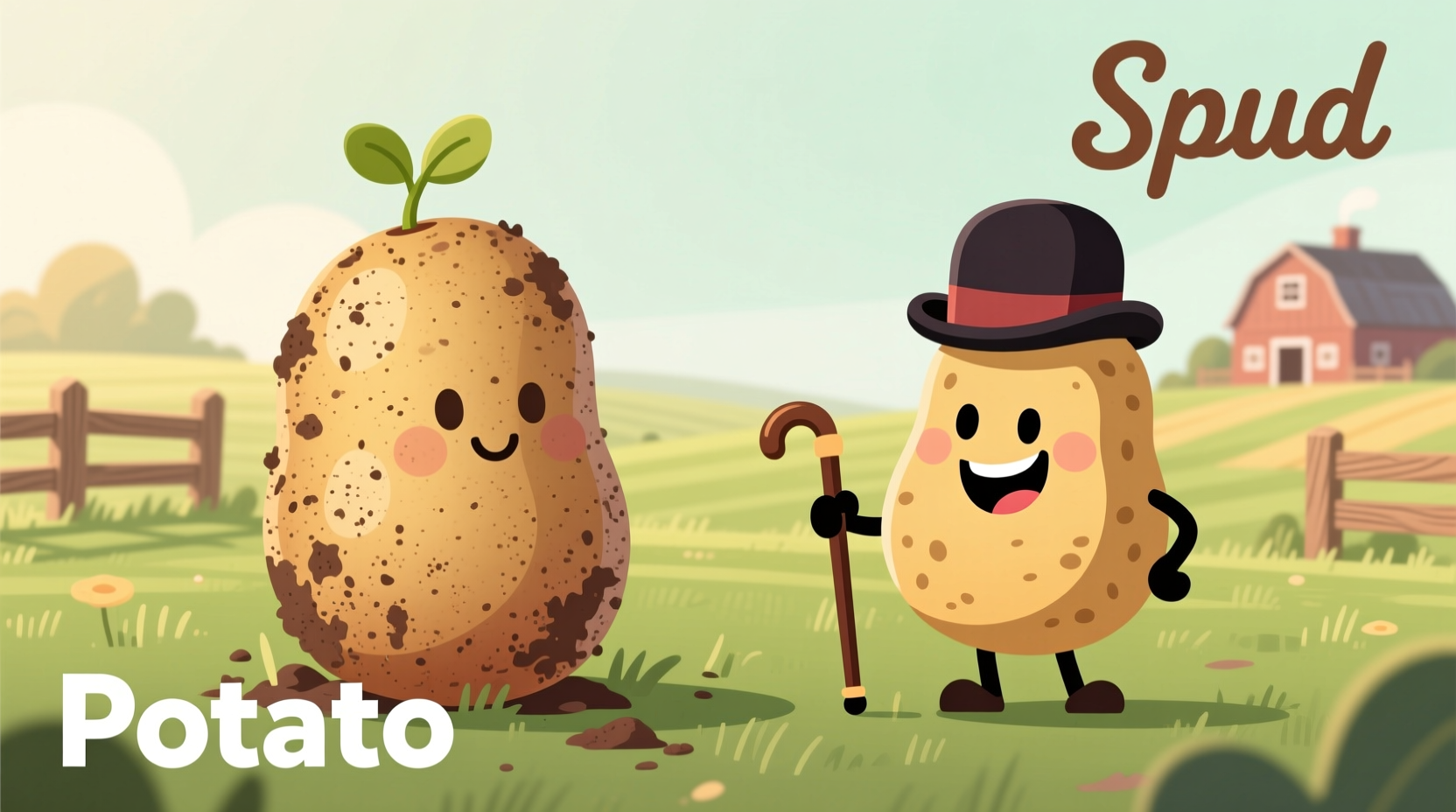
The Solanum tuberosum, commonly known as the **potato**, is a starchy, underground tuber native to the Andes Mountains of South America. Domesticated over 7,000 years ago by indigenous peoples, it was introduced to Europe in the mid-16th century following Spanish exploration. Today, it ranks among the world’s most vital staple crops, second only to maize and rice in global caloric intake.
A **spud**, meanwhile, is not a distinct plant species, variety, or cultivar. It is simply a colloquial term for a potato. While botanically identical, the word carries different connotations depending on region, context, and tone. In British English, “spud” is widely used in casual speech and media. In North America, it appears more selectively—often playfully or nostalgically. Despite its informal status, “spud” has earned legitimacy through decades of culinary use, appearing in product names (e.g., “spud flour”), idioms (“in the spud locker”), and even agricultural reporting.
The persistence of dual terminology reflects more than linguistic redundancy—it reveals how foods are humanized through slang, humor, and historical resistance.
Key Characteristics of the Potato (a.k.a. Spud)
Regardless of what you call it, the physical and culinary traits remain consistent. Below is a breakdown of essential characteristics shared by all forms of the common potato:
| Characteristic | Description |
|---|---|
| Scientific Name | Solanum tuberosum |
| Origin | Andean highlands (modern-day Peru and Bolivia) |
| Flavor Profile | Earthy, mildly sweet, nutty; varies slightly by variety |
| Texture | Creamy when cooked; firm when raw; ranges from waxy to fluffy |
| Color/Form | Skin: tan, red, purple, or yellow; Flesh: white, yellow, blue-purple |
| Culinary Function | Starch source, thickener, side dish, base ingredient |
| Shelf Life | 2–5 weeks at cool room temperature; up to 6 months refrigerated (with caveats) |
| Common Uses | Mashed, roasted, fried, boiled, baked, hashed, scalloped |
These attributes apply equally whether you label the tuber a “potato” or a “spud.” No variety grown commercially or cultivated in backyard gardens escapes this profile. The distinction lies solely in semantics.
The Etymology of “Spud”: How a Potato Got Its Nickname
The origin of the word “spud” predates its association with potatoes—a twist that adds irony to the conversation. In the early 15th century, “spud” referred to a short, narrow shovel used for digging in soil. The tool was especially useful for excavating roots and tubers, including the newly introduced potato. By the 18th century, British farmers and laborers began using “spud” as a verb: *“to spud a potato”* meant to dig one up.
Over time, metonymy took hold—the tool gave its name to the object it unearthed. Just as “crowbar” might jokingly become shorthand for something pried open, “spud” transitioned from verb and noun (the tool) to noun (the tuber). This shift solidified during the 19th century, particularly amid rising skepticism about the potato’s role in society.
Historical Insight: The term gained wider traction due to the “Spud Act” myth—an apocryphal 19th-century British law supposedly restricting potato cultivation. Though no such law existed, critics of the potato’s growing dominance coined “S.P.U.D.” as an acronym: Society for the Prevention of an Unwholesome Diet. While fictional, this anecdote illustrates cultural anxiety over reliance on a single crop, especially after the Irish Potato Famine (1845–1852).
Thus, “spud” emerged not just as slang, but as a linguistic artifact of agricultural history, class dynamics, and dietary debate.
Practical Usage: When to Use “Potato” vs. “Spud”
In modern cooking and communication, choosing between “potato” and “spud” depends less on accuracy and more on tone, audience, and intent. Here’s how to navigate their usage effectively:
Culinary Writing & Professional Kitchens
In formal recipes, restaurant menus, and technical documentation, **“potato”** is standard. It ensures clarity and avoids ambiguity, especially in multilingual or international contexts. For example:
- “Peel and dice two medium potatoes for the gratin.”
- “Roasted fingerling potatoes with rosemary and olive oil.”
Using “spud” here could undermine professionalism unless employed deliberately for branding or thematic effect (e.g., a diner named “The Happy Spud”).
Casual Cooking & Home Kitchens
In informal settings, **“spud”** adds warmth, whimsy, or familiarity. It often appears in phrases like:
- “Toss the spuds in oil before roasting.”
- “Need a few more spuds for the stew.”
Parents might say, “Eat your spud,” to children, softening the directive with affection. Similarly, gardening blogs may use “spud” when describing planting or harvesting: “Time to spud the rows,” meaning to mound soil around emerging stems to protect developing tubers.
Regional and Cultural Variations
Usage trends vary geographically:
- United Kingdom & Ireland: “Spud” is commonplace in daily speech and media. Supermarkets may label bins “Spuds” rather than “Potatoes.”
- Australia & New Zealand: Similar to the UK, “spud” is widely accepted and neutral in tone.
- United States & Canada: “Spud” feels folksier or nostalgic. Often used in brand names (e.g., “Spudnuts”) or humor (“I’m just a humble spud”).
Branding and Marketing
Food businesses leverage “spud” for its approachable, rustic appeal:
- Restaurants: “Loaded Spud Bar” signals indulgence and customization.
- Packaged Goods: “Spud Chips” instead of “Potato Crisps” evokes artisanal charm.
- Children’s Products: “Mr. Spud” toys or books personify the vegetable for educational purposes.
In sum, “potato” conveys precision; “spud” conveys personality.
Cooking Tip: When writing recipes for broad audiences, default to “potato.” Reserve “spud” for social media posts, blog titles, or family notes where informality enhances engagement.
Variants & Types: All Potatoes Are Spuds, But Not All Spuds Are Alike
While “potato” and “spud” refer to the same species, hundreds of cultivars exist, each suited to specific culinary applications. Understanding these types helps optimize texture, flavor, and performance—regardless of what you call them.
Main Categories by Starch Content
| Type | Starch Level | Best Uses | Examples |
|---|---|---|---|
| Russet | High | Baking, mashing, frying | Russet Burbank, Idaho |
| Yukon Gold | Medium | Roasting, boiling, general-purpose | Yukon Gold, Nicola |
| Fingerling | Low-Medium | Rosting, grilling, salads | French Fingerling, Russian Banana |
| Red | Low | Boiling, steaming, salads | Red Bliss, Norland |
| Sweet Potato | Medium (not a true potato) | Baking, mashing, casseroles | Garnet, Jewel, Beauregard |
Note: Sweet potatoes (Ipomoea batatas) are not true potatoes and belong to a different plant family. They should not be considered “spuds” in botanical terms, though colloquially some may refer to them as such.
Prepared Forms
Potatoes also come in processed forms, each altering shelf life and usability:
- Frozen: Pre-cut fries, hash browns, diced potatoes.
- Dehydrated: Instant mashed potatoes, potato flakes, granules.
- Canned: Less common, but available in some regions for soups.
- Flour/Starch: Potato flour (whole tuber ground) vs. potato starch (extracted carbohydrate), used in gluten-free baking.
All of these can be called “spuds” in casual reference, though precision matters in baking chemistry.
Comparison with Similar Ingredients
Despite being the same item, confusion sometimes arises due to overlapping terminology or misperceptions. Below are clarifications against commonly conflated concepts.
| Term | Relation to Potato/Spud | Key Difference |
|---|---|---|
| Tater | Colloquial synonym | Diminutive form (e.g., “tater tots”), primarily North American |
| Spud Gun | Unrelated device | Air-powered launcher that shoots potatoes; named for projectile, not food quality |
| Yam | Often mislabeled | True yams are tropical tubers (Dioscorea spp.), rarely sold in U.S. supermarkets; orange “yams” are actually sweet potatoes |
| Jerusalem Artichoke | Different species | A sunflower tuber (Helianthus tuberosus); no relation despite “artichoke” and “potato-like” appearance |
The key takeaway: “spud” is purely a nickname. It does not indicate a separate category of tuber, preparation method, or genetic strain.
Practical Tips & FAQs
Q1: Can I substitute “spud” for “potato” in any recipe?
A1: Yes, absolutely. The substitution is linguistic, not culinary. Any recipe calling for a potato can use the term “spud” in notes or narration without affecting outcome.
Q2: Are baby potatoes different from spuds?
A2: No. “Baby potato” refers to young, small-harvested tubers of full-sized varieties. They are still potatoes—and thus spuds—just picked earlier for tenderness and skin delicacy.
Q3: Why do some people dislike the word “spud”?
A3: In professional agronomy or scientific contexts, “spud” may seem imprecise or overly casual. Some chefs avoid it to maintain technical rigor, particularly when distinguishing between cultivars or discussing crop diseases.
Q4: How should I store my spuds/potatoes?
A4: Store in a cool, dark, well-ventilated place (ideally 45–50°F / 7–10°C). Avoid plastic bags; use burlap or paper. Do not refrigerate long-term—cold temperatures convert starch to sugar, causing undesirable sweetness and darkening when cooked. Never store near onions, which emit gases that accelerate sprouting.
Q5: Is “spud” used outside of English-speaking countries?
A5: Rarely. Most languages have direct equivalents for “potato” (e.g., *papa* in Spanish, *kartoffel* in German, *jagoda* in Polish). “Spud” remains largely confined to Anglophone cultures.
Q6: What dishes showcase the versatility of spuds?
A6: Consider these global preparations:
- Irish Colcannon: Mashed potatoes with cabbage or kale.
- French Pommes Anna: Layered baked potato discs with butter and cream.
- German Kartoffelpuffer: Grated potato pancakes.
- Peruvian Papa a la Huancaína: Boiled potatoes in spicy cheese sauce.
- Indian Aloo Gobi: Potato and cauliflower curry.
Each demonstrates how a simple tuber—whether called potato or spud—can anchor diverse cuisines.
“The potato is the most democratic of vegetables. It grows in poor soil, feeds millions, and answers to many names—but always delivers sustenance.” — Dr. Elena Torres, Agricultural Historian, University of Edinburgh
Summary & Key Takeaways
The difference between a potato and a spud is not found in the field, the market, or the kitchen. It exists in language, history, and cultural expression. To clarify:
- ✅ A **potato** and a **spud** are the same botanical entity: Solanum tuberosum.
- ✅ “Spud” originated as a digging tool, later becoming slang for the tuber it unearthed.
- ✅ The term gained popularity in part through satirical opposition to potato dependence in 19th-century Britain.
- ✅ Use “potato” in formal, technical, or international contexts; reserve “spud” for casual, regional, or branding purposes.
- ✅ Regional dialects influence preference—common in the UK and Australia, rarer in formal U.S. usage.
- ✅ All potato varieties—from russets to fingerlings—are “spuds” in colloquial terms, though sweet potatoes are not true potatoes.
Understanding this distinction enriches culinary vocabulary and highlights how food terminology evolves beyond science into story, identity, and tradition. Whether you’re peeling, roasting, or planting, remember: every spud is a potato, and every potato, in the right context, can be a spud.
Final Thought: Next time someone asks, “Is there a difference between a potato and a spud?” you can answer with confidence: none at all—except the one we’ve grown together through language.




 浙公网安备
33010002000092号
浙公网安备
33010002000092号 浙B2-20120091-4
Comments
No comments yet. Why don't you start the discussion?