
In the quiet depths of the ocean, far from human eyes, an extraordinary act of natural engineering unfolds. Small male pufferfish, no larger than a human hand, spend days crafting elaborate geometric patterns in the seafloor sand—circles up to two meters wide, adorned with radial grooves and delicate ridges. These are not random disturbances but meticulously constructed \"underwater crop circles,\" designed for one purpose: courtship. This behavior, first documented in 1995 but only widely recognized in the 2010s, reveals a stunning intersection of instinct, aesthetics, and evolutionary strategy.
What makes this phenomenon so compelling is not just its visual complexity, but the fact that it's created by a creature often overlooked for its more infamous traits—like toxicity and inflation. The pufferfish’s sand art represents one of the most sophisticated non-human construction behaviors in the animal kingdom, rivaling the nests of bowerbirds or the tunnel systems of ants. And unlike those examples, these masterpieces are entirely ephemeral, washed away by currents within days, seen by few, and yet perfected over generations through natural selection.
The Discovery of an Oceanic Mystery
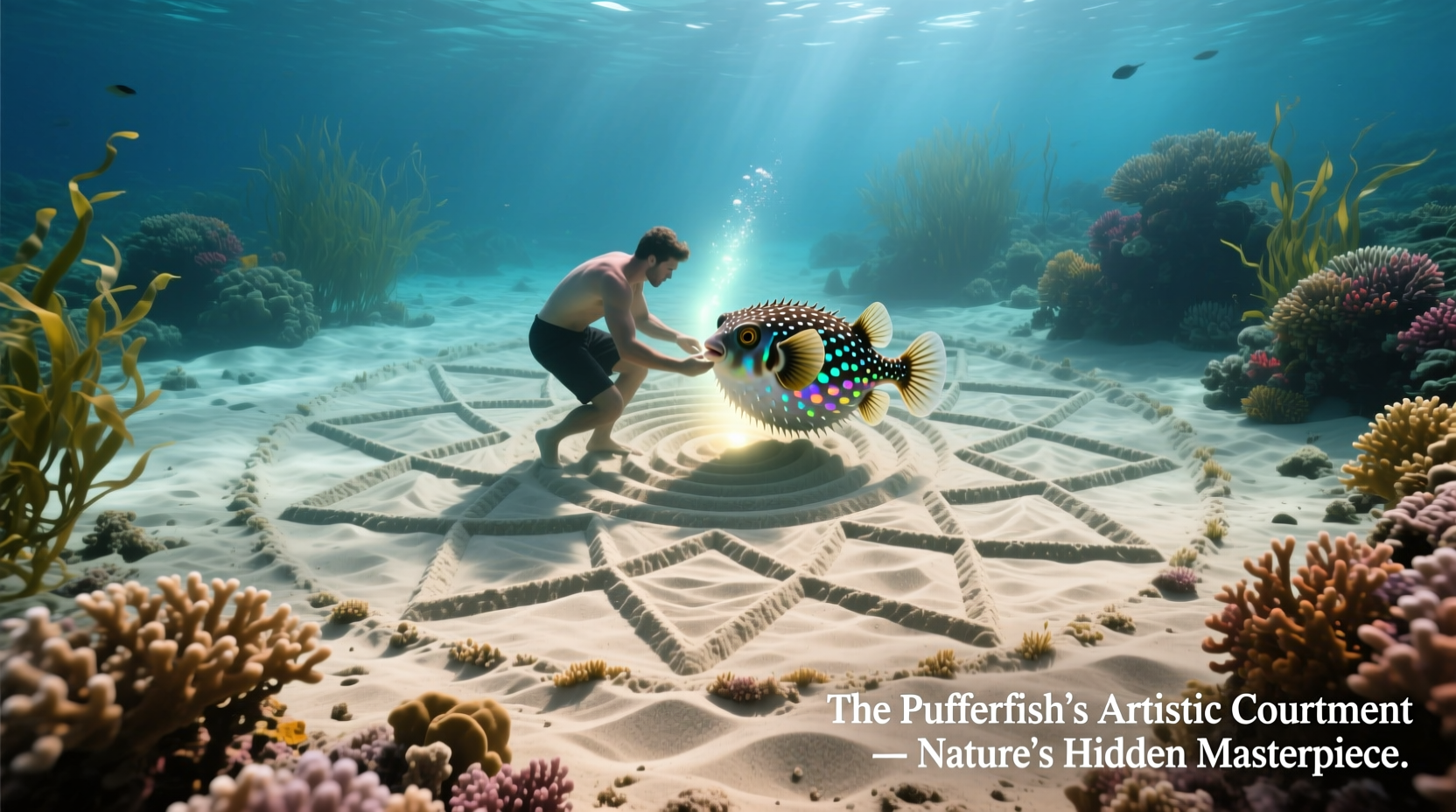
The story begins off the southern coast of Japan, near Amami Ōshima, where local divers first spotted mysterious circular patterns on the sandy seabed. For years, their origin remained unknown. Some speculated they were the work of extraterrestrial forces or undiscovered marine species. It wasn’t until 2011 that scientists from the Nature Aquarium and Japanese research teams captured footage revealing the architect: the white-spotted pufferfish (*Torquigener albomaculosus*).
Using time-lapse photography and underwater observation, researchers documented males spending up to ten days excavating the sand with their bodies and fins. They swim in precise spirals, flapping their pectoral fins to carve concentric ridges and valleys. The final design includes a central hub (where mating occurs), a series of outer peaks, and hundreds of tiny peaks arranged in radial symmetry. Even more astonishing, the fish decorates the structure with shell fragments and coral bits collected from nearby reefs—materials that enhance water flow and signal fitness to potential mates.
“Before this discovery, we had no idea fish could create such complex structures. It challenges our understanding of cognitive ability in small-brained species.” — Dr. Keiichi Kawase, Marine Biologist, Mie University
How the Crop Circle Is Built: A Step-by-Step Construction Process
The creation of these sand sculptures follows a precise sequence driven by instinct and environmental feedback. While each individual may vary slightly, the general timeline remains consistent:
- Site Selection: The male chooses a flat, open area of fine sand, typically at a depth of 10–30 meters, where currents are moderate.
- Foundation Grooving: Using rapid undulations of its body, the pufferfish carves deep outer rings, forming the boundary of the circle.
- Spiral Carving: Moving inward, it creates tightly spaced concentric grooves, resembling the grooves of a vinyl record.
- Ridge Formation: By pushing sand toward the center, it builds raised peaks between the grooves, increasing structural contrast.
- Decoration Phase: The fish collects crushed shells and fine debris, placing them strategically along the inner grooves. These particles vibrate subtly in the current, possibly producing visual or tactile cues.
- Maintenance: Even after completion, the male continuously repairs damage from tides and predators, often working several hours daily.
Why Build Such Complexity? The Evolutionary Purpose
At first glance, such effort seems excessive for a temporary mating ground. But every element serves a biological function:
- Female Attraction: The symmetry and precision of the circle act as indicators of genetic quality. Females inspect multiple sites before choosing a mate.
- Egg Protection: The outer ridges disrupt ocean currents, creating a calmer micro-environment in the center where eggs can settle safely.
- Signal Amplification: The crushed shells shimmer and shift in the light, potentially enhancing visibility or stimulating sensory responses in females.
- Male Competition: Larger, more symmetrical circles correlate with higher mating success, suggesting strong sexual selection pressure.
A study published in *Scientific Reports* (2013) found that females consistently preferred males whose circles exhibited greater radial symmetry and denser decoration. This preference implies that the artwork functions as an honest signal—only healthy, energetic males can sustain the physical demands of construction.
Comparative Table: Pufferfish Art vs. Other Animal Constructions
| Species | Structure Type | Purpose | Duration | Complexity Level |
|---|---|---|---|---|
| White-spotted pufferfish | Sand circle with radial symmetry | Mating display & egg protection | 7–14 days | ★★★★★ |
| Bowerbird (male) | Stick bower with decorative items | Mating display | Several weeks | ★★★★☆ |
| Beaver | Dam and lodge | Shelter & flood control | Years | ★★★★☆ |
| Honeybee | Wax comb | Nursery & food storage | Lifelong | ★★★☆☆ |
| Trapdoor spider | Burrow with camouflaged lid | Predation & shelter | Months to years | ★★☆☆☆ |
Real Example: A Diver’s Encounter with the Artist
In 2018, marine photographer Yoji Ookata spent six weeks diving near Okinawa in pursuit of the elusive pufferfish. After spotting a near-perfect circle nearly two meters across, he set up a remote camera. Over three nights, the footage revealed a single male tirelessly repairing wave damage each morning. On the fourth day, a female approached cautiously, circling the structure twice before descending into the center. Spawning occurred within minutes. Within 48 hours, both fish had vanished, and tidal forces erased the entire design, leaving no trace.
This fleeting interaction underscores the transient beauty of the ritual. Unlike birdsong or firefly flashes, which can be heard or seen repeatedly, the pufferfish’s masterpiece exists for less than a week—yet represents hundreds of hours of labor. Its impermanence does not diminish its significance; rather, it highlights nature’s emphasis on timing, precision, and reproductive urgency.
Common Misconceptions About the Crop Circles
Despite growing awareness, several myths persist:
- Myth: The circles are made by multiple fish working together.
Reality: Each structure is built entirely by a single male. - Myth: They serve as feeding grounds.
Reality: No evidence suggests the site is used for foraging. - Myth: The designs are random or accidental.
Reality: Controlled experiments show consistent geometry across individuals and locations.
Frequently Asked Questions
Do all pufferfish species create these circles?
No. Only certain species in the genus *Torquigener*, primarily *T. albomaculosus*, have been observed building these complex structures. Most pufferfish do not exhibit this behavior.
How do scientists study something so fragile and deep underwater?
Researchers use remote-operated cameras, scuba monitoring, and sonar imaging. Time-lapse technology has been crucial in capturing the full construction cycle without disturbing the environment.
Can humans replicate these structures?
While artists and engineers have attempted recreations, none match the hydrodynamic efficiency or symmetry achieved by the fish. The combination of body motion, sediment manipulation, and spatial awareness remains unmatched in biomimetic design.
Conservation and the Future of the Ritual
As coastal development increases and ocean temperatures rise, the habitats where these rituals occur face growing threats. Sandy seabeds are vulnerable to trawling, pollution, and sediment disruption. Because the pufferfish relies on specific substrate conditions, even minor changes can prevent successful construction.
There is currently no formal conservation status for *Torquigener albomaculosus*, but its reliance on pristine sandy flats makes it an indicator species for seafloor health. Protecting its habitat benefits countless other bottom-dwelling organisms.
Conclusion: Nature’s Hidden Masterpiece
The pufferfish’s underwater crop circle is more than a curiosity—it is a testament to the ingenuity embedded in evolution. In silence and obscurity, a small fish performs an act of creation that combines physics, aesthetics, and survival. It reminds us that intelligence and artistry are not exclusive to large brains or land animals. Beauty, in nature, often arises not for admiration, but as a silent language of fitness and continuity.




 浙公网安备
33010002000092号
浙公网安备
33010002000092号 浙B2-20120091-4
Comments
No comments yet. Why don't you start the discussion?