
The ability to ask the right questions is a cornerstone of effective communication, problem-solving, and decision-making. Among the most powerful tools for inquiry are the five Ws: who, what, when, where, and why—with how often included as an essential sixth element. While commonly taught in journalism and research, these foundational questions extend far beyond reporting. They serve as a framework for clarity, analysis, and deeper understanding across education, business, personal development, and everyday interactions.
Understanding and applying the five Ws allows individuals to dissect complex situations, extract relevant information, and respond with precision. Whether you're troubleshooting a project delay, conducting an interview, or trying to understand a child’s perspective, this structured approach brings order to ambiguity.
What Are the Five Ws (and One H)?
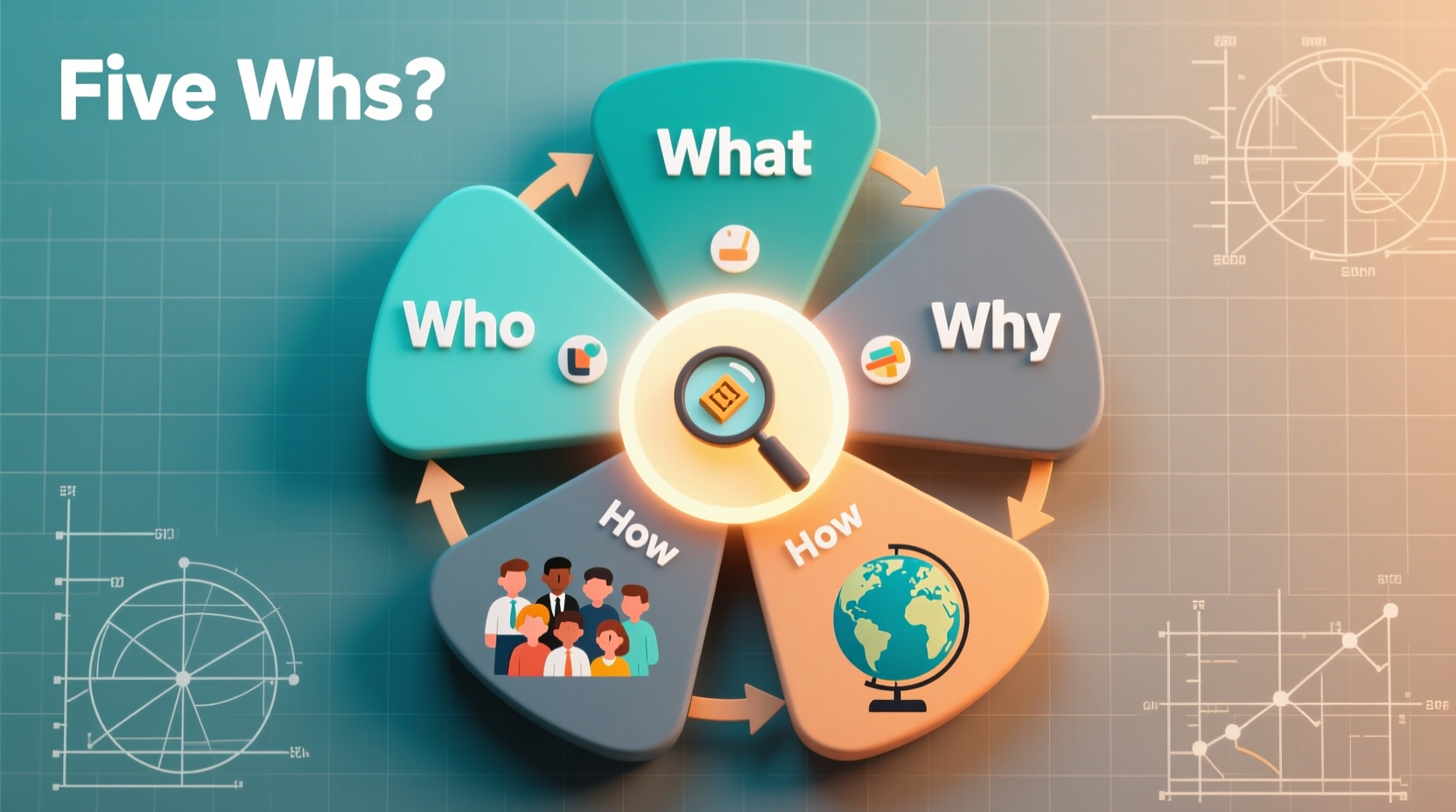
The five Ws—who, what, when, where, why—along with how, form a set of interrogative prompts used to gather comprehensive information about any subject or event. Each question targets a different dimension of understanding:
- Who? Identifies people involved—responsibility, agency, and stakeholders.
- What? Defines the action, object, or event in question.
- When? Establishes timing, sequence, and deadlines.
- Where? Locates the event or activity in physical or conceptual space.
- Why? Seeks purpose, motivation, or underlying causes.
- How? Explores method, process, or mechanism.
Together, they create a holistic picture. For instance, knowing what happened is useful, but without understanding why it occurred or how it was executed, your comprehension remains incomplete.
Practical Applications Across Fields
The five Ws are not confined to classrooms or newsrooms. Their utility spans numerous domains:
Journalism and Storytelling
Reporters use the five Ws in lead paragraphs to deliver essential facts quickly. A well-crafted news story answers all six questions within the first few sentences, ensuring readers grasp the core of the event immediately.
Project Management
Before launching a new initiative, teams apply the five Ws to define scope. Questions like “Who is responsible?” and “Why are we doing this?” align stakeholders and prevent mission drift.
Education
Teachers encourage students to use the five Ws during reading comprehension exercises. By identifying key elements in a narrative, learners build stronger analytical skills and retain information more effectively.
Customer Service
Support agents use the framework to diagnose issues. Asking “When did the error occur?” or “Where were you navigating?” helps isolate technical problems efficiently.
“Clarity begins with curiosity. The five Ws are the scaffolding of intelligent inquiry.” — Dr. Linda Chen, Cognitive Psychologist and Communication Researcher
A Step-by-Step Guide to Applying the Five Ws
To harness the full power of these questions, follow this structured process:
- Identify the Subject: Choose the event, problem, or idea you want to explore.
- Ask Each Question Systematically: Work through who, what, when, where, why, and how in order.
- Record Answers Clearly: Write concise responses for each. Avoid assumptions; verify facts when possible.
- Analyze Gaps: Note any unanswered questions. These highlight areas needing further investigation.
- Synthesize Insights: Combine the answers into a coherent summary or action plan.
This method proves especially valuable during incident reviews. For example, after a service outage, a post-mortem might reveal that while the team knew what failed and when, they initially overlooked why the backup system didn’t activate—leading to process improvements.
Common Pitfalls and How to Avoid Them
Despite their simplicity, the five Ws are often misapplied. Here are frequent errors and corrections:
| Pitfall | Consequence | Solution |
|---|---|---|
| Skipping \"why\" | Superficial understanding; recurring issues | Always probe motivations and root causes |
| Assuming \"who\" is obvious | Misplaced accountability | Explicitly name roles and responsibilities |
| Vagueness in \"how\" | Inconsistent execution | Document step-by-step procedures |
| Ignoring \"when\" | Poor time management | Set clear timelines and milestones |
Mini Case Study: Resolving a Team Conflict
A marketing team missed a campaign deadline. Initial frustration pointed fingers, but the manager applied the five Ws to uncover the real issue:
- Who? The content writer, designer, and approval lead.
- What? Final assets were not delivered on time.
- When? The deadline was Friday at 5 PM; submission occurred Monday morning.
- Where? Collaboration happened via email and cloud folders—no centralized platform.
- Why? The writer revised copy over the weekend after last-minute feedback from a stakeholder not previously involved.
- How? Feedback loops were unstructured, and no change control process existed.
The root cause wasn't laziness—it was unclear ownership and poor workflow design. As a result, the team adopted a shared project dashboard and defined revision protocols. Subsequent campaigns launched on schedule.
Checklist: Mastering the Five Ws in Daily Practice
Use this actionable checklist to integrate the five Ws into your routine:
- ✅ Begin emails or reports with a brief five-W summary for clarity.
- ✅ Apply the framework when delegating tasks to ensure full understanding.
- ✅ Use the questions during conversations to avoid misunderstandings.
- ✅ Review decisions by asking, “Did we consider the why?”
- ✅ Teach children or students the five Ws to strengthen critical thinking.
- ✅ Reflect weekly: What important question did I fail to ask?
Frequently Asked Questions
Is \"how\" really part of the five Ws?
Strictly speaking, no—there are only five Ws. However, \"how\" is so integral to understanding process and execution that it's routinely grouped with them. Many refer to the full set as the \"5W1H\" model (Five Ws and One How) in fields like journalism, education, and quality management.
Can the five Ws be used in personal life?
Absolutely. They help evaluate major decisions—like moving cities or changing careers. Ask: Who will be affected? What am I gaining or losing? When do I need to decide? Where will I live? Why is this important? How will I make it happen? This structure reduces emotional bias and promotes rational planning.
What if I can’t answer one of the Ws?
An unanswered question signals a gap in knowledge or planning. Treat it as a red flag. Instead of guessing, commit to finding the answer or acknowledge the uncertainty in your conclusions. In investigations, missing a \"where\" or \"who\" may require further data collection.
Conclusion: Turn Questions Into Clarity
The five Ws—where, what, how, and why questions—are more than a journalistic formula. They are instruments of insight, designed to cut through noise and expose truth. By consistently applying who, what, when, where, why, and how, you cultivate a mindset of precision and depth. Whether resolving conflicts, planning projects, or seeking self-understanding, these questions empower you to move from reaction to intention.




 浙公网安备
33010002000092号
浙公网安备
33010002000092号 浙B2-20120091-4
Comments
No comments yet. Why don't you start the discussion?