
Time doesn’t move faster or slower in reality—but our perception of it does. One weekend can feel endless, while an entire month at work might vanish in a blink. This discrepancy isn’t random; it’s rooted in cognitive science. How we experience time is shaped by attention, novelty, emotion, and routine. By understanding the psychology behind time perception, you can intentionally shape your days so they feel more dynamic, fulfilling, and—if you want—like they’re flying by.
The sensation of time \"flying\" often occurs during moments of deep engagement or high stimulation. Conversely, boredom and repetition stretch seconds into minutes. The key isn’t to escape time but to master its subjective flow. With deliberate practice, you can design experiences that accelerate your sense of time without sacrificing presence or meaning.
The Science Behind Time Perception
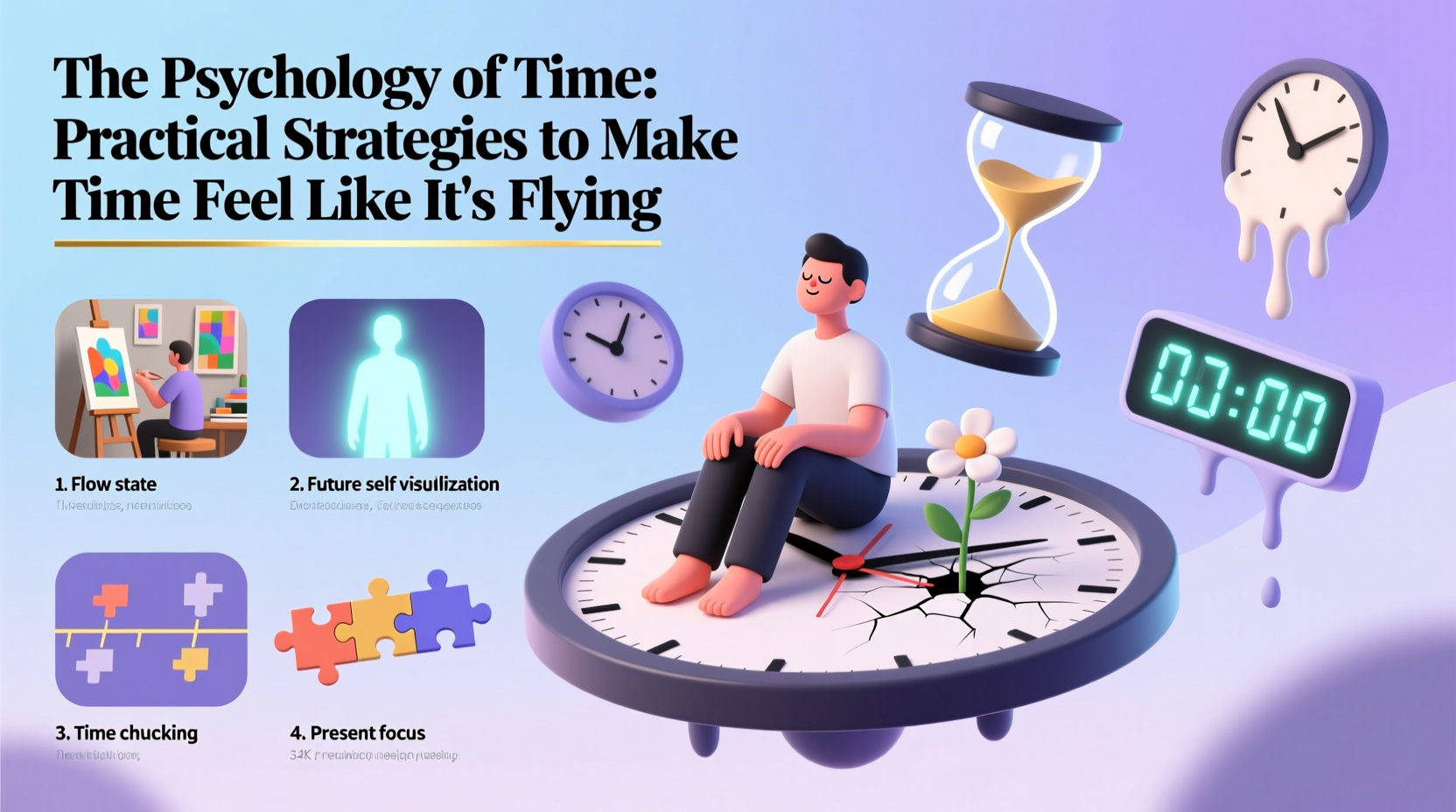
Our brains don’t have a single “time center.” Instead, multiple regions—including the prefrontal cortex, basal ganglia, and hippocampus—work together to estimate duration. These systems rely on memory density: the more new information your brain records, the longer a period feels in retrospect. This explains why childhood summers seemed endless—each day was packed with first-time experiences.
As we age, routines dominate. Commute, work, dinner, sleep. Fewer novel inputs mean fewer memory markers. When you look back, weeks blur because there’s little to distinguish one from another. That’s why time appears to accelerate with age—not because clocks tick faster, but because the mind stops registering milestones.
“Time perception is less about clock ticks and more about mental events per second. The richer the experience, the longer it feels in memory—but the faster it seems as it happens.” — Dr. David Eagleman, Neuroscientist and Author of *Brain Time*
In real-time, however, flow states—moments of intense focus where self-awareness fades—make hours feel like minutes. Paradoxically, the same event can feel fast as it unfolds yet long when remembered, depending on how deeply engaged you were.
Strategies to Make Time Feel Like It’s Flying
If your goal is to make time pass quickly—during a long flight, a tedious task, or even a busy season of life—focus on increasing engagement and reducing self-monitoring. Here are five evidence-backed techniques:
1. Enter Flow States Through Challenge-Skill Balance
Flow, a concept developed by psychologist Mihaly Csikszentmihalyi, occurs when a task is just difficult enough to require full attention but not so hard that it causes anxiety. In this zone, time distortion is common. You lose track of minutes, sometimes hours.
For example, instead of passively scrolling social media, try learning a song on guitar, coding a small app, or solving logic puzzles. The moment your skill meets challenge, time begins to slip.
2. Reduce Clock Checking
Monitoring time pulls you out of the present. Each glance at the clock reinforces temporal awareness, making minutes feel drawn out. A 2017 study published in Cognition found that participants who avoided checking the time perceived waiting periods as significantly shorter.
In environments where you can’t control pace—airports, meetings, queues—turn off device clocks or cover watch faces. Replace time monitoring with sensory immersion: listen to music, observe surroundings, or practice breath counting.
3. Increase Novelty in Routine Tasks
While novelty makes time feel longer in memory, it speeds up real-time perception by capturing attention. When your brain is processing new stimuli, it has less bandwidth to monitor time.
Try altering small elements of daily routines: take a different route to work, rearrange your desk, use your non-dominant hand for simple actions, or eat lunch in a new location. These micro-changes keep the mind engaged and reduce the feeling of sluggish time.
4. Engage in Social Synchrony
Laughter, conversation, and shared activities compress time. Group settings—especially those involving coordination like dancing, team sports, or collaborative projects—create rhythmic alignment between people. This synchrony distracts from internal timekeeping.
A simple way to apply this: schedule more interactive tasks during slow periods. Turn solo errands into social outings. Even brief, meaningful conversations can make an afternoon disappear.
5. Use Music and Rhythm to Alter Tempo
Fast-tempo music increases arousal and reduces time estimation accuracy. In one experiment, drivers exposed to upbeat music underestimated journey duration by nearly 15%. Rhythmic patterns also entrain brainwaves, creating a smoother, faster-moving experience.
Create playlists with 120–140 BPM (beats per minute) tracks for tasks you want to fly through—cleaning, driving, administrative work. Avoid lyrical music if concentration is needed; instrumental or ambient tracks maintain momentum without distraction.
Do’s and Don’ts of Time Perception Management
| Do | Don't |
|---|---|
| Engage in moderately challenging tasks to induce flow | Choose tasks far above or below your skill level |
| Introduce small changes to familiar routines | Stick rigidly to predictable patterns without variation |
| Spend time in social, interactive settings | Isolate yourself during monotonous periods |
| Use background music with steady rhythm | Constantly check the clock or countdown timers |
| Focus on process, not duration | Label activities as “boring” or “wasting time” |
Mini Case Study: Transforming a Long Workday
Mark, a software developer, used to find Friday afternoons painfully slow. Despite finishing core tasks, he struggled through the final hours, constantly checking the clock. After learning about time perception, he redesigned his routine.
Instead of defaulting to email triage, he began using Fridays for experimental coding—building side tools with no deadline pressure. He played ambient electronic music, worked in 90-minute blocks with short social breaks, and disabled all notifications. Within two weeks, he reported that afternoons now “fly by,” and he leaves work feeling energized rather than drained.
The change wasn’t in workload—it was in engagement. By replacing passive maintenance with active creation, Mark shifted his brain state from waiting to flowing.
Step-by-Step Guide to Accelerate Your Time Experience
- Identify slow-time situations – List moments when time drags (e.g., commutes, admin work).
- Select one activity to redesign – Start with a low-stakes, repetitive task.
- Add a challenge element – Set a personal goal (e.g., complete a report in 45 minutes).
- Remove time cues – Hide clocks and disable screen time displays.
- Introduce sensory engagement – Add music, change environment, or involve others.
- Reflect post-activity – Note whether time felt faster and what contributed most.
- Iterate and expand – Apply successful tactics to other areas.
Checklist: Quick Wins to Make Time Fly
- ☑ Turn off notifications during focused work
- ☑ Play rhythmic, upbeat music during routine tasks
- ☑ Schedule at least one flow-inducing activity per day
- ☑ Replace solo downtime with light social interaction
- ☑ Introduce one small novelty into your daily routine
- ☑ Avoid looking at clocks during waiting periods
- ☑ Reframe “boring” tasks as opportunities for mindfulness or skill-building
FAQ
Why does time feel slower when I’m bored?
Boredom increases self-referential thinking and attention to internal states, including time monitoring. With little external input, your brain defaults to tracking the passage of time, making it feel elongated.
Can meditation make time go faster?
Paradoxically, yes—when done correctly. Mindfulness reduces rumination and fixation on time. While meditative moments may feel expanded in memory, during practice, the absence of mental chatter can make sessions feel surprisingly short.
Is it healthy to want time to pass quickly?
In moderation, yes. Wanting time to fly during tedious or stressful periods is natural. However, consistently seeking to escape the present can lead to disengagement. Balance accelerated-time strategies with intentional presence during meaningful moments.
Conclusion
Time is not just measured in seconds, but in attention, novelty, and depth of experience. By leveraging the psychology of perception, you can shift how time feels—making dull stretches more bearable and productive hours more fluid. The goal isn’t to rush through life, but to align your mind with moments worth losing yourself in.




 浙公网安备
33010002000092号
浙公网安备
33010002000092号 浙B2-20120091-4
Comments
No comments yet. Why don't you start the discussion?