
For centuries, humans have been fascinated by the idea of defying gravity—levitating, floating, or even running on air. From ancient myths to modern superhero films, the image of someone bounding across the sky with no visible support captures the imagination. But is there any scientific basis for such feats? Can a person truly run on air, or is it purely fantasy? The answer lies at the intersection of physics, biomechanics, and emerging technologies. This article dissects the myths, explores real-world possibilities, and outlines what it would actually take to achieve something resembling \"running on air.\"
The Myth of Running on Air: Origins and Misconceptions
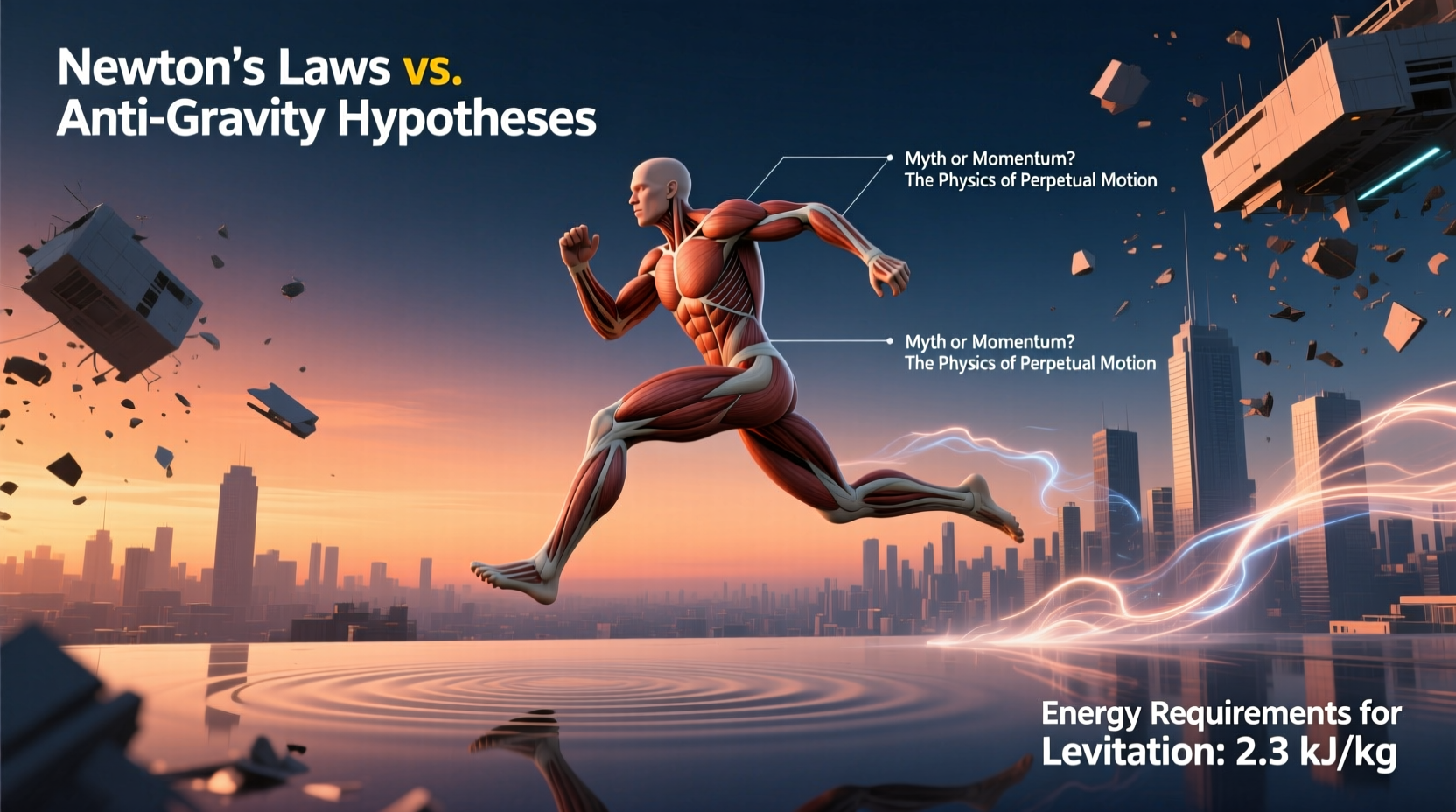
The notion of running on air often stems from exaggerated depictions in media—characters like The Flash or Goku sprinting across water or thin air as if solid ground were beneath them. These portrayals exploit visual spectacle rather than physical plausibility. In reality, running requires force application against a surface. Newton’s Third Law states that every action has an equal and opposite reaction; when a runner pushes down on the ground, the ground pushes back, propelling them forward.
Without a reactive surface, forward motion becomes impossible. Air, being a fluid with low density, cannot provide sufficient resistance for sustained propulsion under normal conditions. Attempts to \"run\" on air fail because limbs push through it without generating meaningful thrust. This fundamental principle debunks the literal interpretation of running on air—but not all interpretations are entirely fictional.
What Science Says About Defying Gravity
Gravity is one of the four fundamental forces of nature, and while we can temporarily overcome it—through jumping, flying, or orbital mechanics—we cannot eliminate its influence without extraordinary conditions. Human locomotion relies on overcoming gravitational pull through muscular effort and structural support. To \"defy\" gravity in a meaningful way means either reducing its effect (as in microgravity environments) or creating counteracting forces.
In controlled settings, such effects are simulated. NASA uses parabolic flights to create short bursts of weightlessness. Magnetic levitation trains float above tracks using powerful electromagnets. However, these rely on external systems—not human capability alone. For an individual to mimic such phenomena unaided, they would need to generate forces comparable to those produced by advanced machinery or exist in environments where gravity is negligible.
“Biologically, humans are bound by muscle strength, skeletal structure, and the laws of physics. True levitation remains outside our natural reach.” — Dr. Lena Patel, Biomechanics Researcher at MIT
Real-World Analogues: Technologies That Simulate Running on Air
While true air-running remains impossible, several technologies create the illusion—or functional equivalent—of defying gravity:
- Jet-powered exoskeletons: Devices like the Gravity Industries jet suit use miniature turbines to lift and propel a person through the air. Though not “running,” controlled flight allows movement over terrain without ground contact.
- Magnetic boots and low-gravity training: Used in space simulations, these allow astronauts to “walk” on walls or ceilings, mimicking anti-gravity movement in enclosed environments.
- High-speed water surface running: Certain animals, like the basilisk lizard, can run across water by slapping the surface rapidly enough to generate upward force. Humans have attempted similar stunts using specialized footwear, though success is limited and brief.
- Wind-assisted platforms: Vertical wind tunnels used in indoor skydiving suspend individuals mid-air via powerful airflow, enabling controlled body flight that resembles hovering.
| Technology | Mechanism | Limitations |
|---|---|---|
| Jet Suits | Thrust from gas turbines | High fuel consumption, short flight time (~10 mins) |
| Magnetic Levitation Shoes | Electromagnetic repulsion | Requires metal surfaces, heavy power source |
| Aquatic Surface Runners | Rapid impact force on water | Only feasible at high speed, short duration |
| Wind Tunnels | Vertical airflow suspension | Tethered environment, no forward propulsion |
What It Would Take to Actually Run on Air
To achieve genuine air-running, multiple scientific breakthroughs would be required:
- Enhanced Muscular Power Output: Human muscles would need to generate explosive force far beyond current limits—potentially 5–10 times greater—to create enough downward thrust against air molecules.
- Density Manipulation: Altering local air density or creating temporary solid-phase air pockets could provide a reactive medium. While theoretically possible via plasma fields or acoustic levitation, scaling this to human movement is currently impractical.
- Anti-Gravity Field Generation: If localized gravity shielding were achievable (a concept still speculative), it could reduce effective body weight, allowing light steps to produce large displacements.
- Advanced Propulsion Integration: Wearable propulsion systems—such as micro-thrusters embedded in shoes—could simulate step-and-push mechanics in mid-air, effectively turning flight into a form of aerial running.
Even with such advancements, energy efficiency remains a major hurdle. The metabolic cost of sustaining airborne motion would likely exceed human endurance without artificial augmentation.
Mini Case Study: The Jet Suit Sprint Test
In 2021, a team at Gravity Industries conducted an experiment to test whether their jet suit could simulate running-like motion over water. Pilot Richard Browning flew just above the surface, adjusting thrust to mimic strides. While he didn’t make contact, the motion pattern resembled running in slow motion. The test demonstrated that with precise control, propulsion-based systems can replicate the kinematics of running—without touching the ground. However, the maneuver consumed full battery power in under six minutes and required extensive training to stabilize.
This case illustrates that while biological running on air is impossible, engineered solutions can approximate the experience under constrained conditions.
Checklist: How Close Are We to Running on Air?
Use this checklist to evaluate current capabilities versus future potential:
- ✅ Ability to hover briefly using jet propulsion – Yes
- ✅ Simulate running motion in mid-air – Limited success with drones and suits
- ❌ Generate enough thrust from leg muscles alone – No biological possibility
- ❌ Create stable air-solid interfaces for foot contact – Not yet feasible
- ✅ Reduce perceived gravity via technology – Partial success in VR and simulation labs
- ❌ Achieve sustained, energy-efficient air-running – Still science fiction
Frequently Asked Questions
Can humans ever run on water or air naturally?
No. Due to our size, weight, and limited limb speed, humans cannot generate enough force to run on water or air without mechanical assistance. Even elite athletes lack the power-to-weight ratio required for such feats.
Are there animals that can run on air or water?
Not exactly on air, but the basilisk lizard can run across water for short distances by slapping the surface to create air pockets that delay sinking. This is sometimes called the \"Jesus Christ lizard\" phenomenon. No animal runs on air, but some birds and insects use rapid wing movements to hover, which is a related concept.
Will future tech let us run on air?
Possibly in a functional sense. With wearable thrusters, magnetic fields, or environmental modifications, we may develop systems that allow people to move through the air with running-like motions. However, this would be technological augmentation—not innate ability.
Conclusion: Embracing the Possible While Questioning the Impossible
The dream of running on air reflects humanity’s enduring desire to transcend physical limits. While literal air-running violates known laws of physics, the pursuit of that vision drives innovation in propulsion, materials science, and biomechanics. Rather than dismissing the idea as pure myth, we should view it as inspiration—a challenge to engineer new ways of moving through our world.




 浙公网安备
33010002000092号
浙公网安备
33010002000092号 浙B2-20120091-4
Comments
No comments yet. Why don't you start the discussion?