
The sudden explosion of “Why?” questions from a once-content toddler can catch even the most prepared parent off guard. One day, your child is absorbing the world in quiet curiosity; the next, they’re peppering you with relentless inquiries about everything from gravity to garbage trucks. This stage—commonly known as the “why phase”—is not only normal but a critical milestone in cognitive and linguistic development. It typically begins around age 2 and peaks between 3 and 4, driven by an expanding vocabulary and a growing desire to understand cause and effect. While intellectually enriching, this phase can test parental patience and creativity. The key to navigating it lies not in avoiding questions but in embracing them as opportunities for connection, learning, and emotional growth.
What Triggers the Toddler Why Phase?
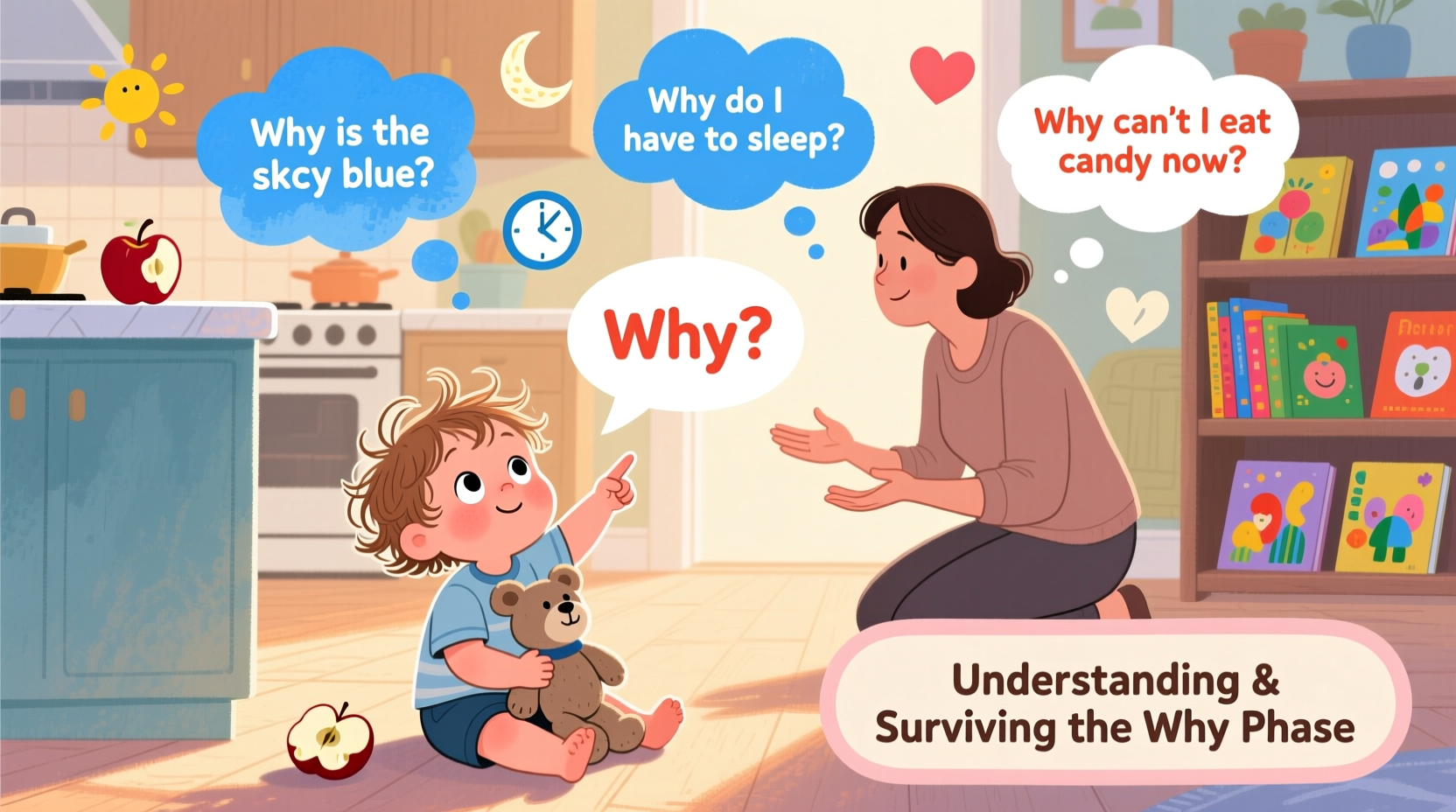
Between the ages of 2 and 4, children undergo rapid brain development. Their language skills evolve from simple words to full sentences, allowing them to express curiosity more precisely. At the same time, their theory of mind—the ability to understand that others have thoughts and beliefs—begins to form. This cognitive leap makes them aware that knowledge exists beyond their immediate experience, prompting them to seek explanations.
Neurologically, the prefrontal cortex, responsible for reasoning and problem-solving, becomes increasingly active during this period. Combined with improved memory and attention span, toddlers start recognizing patterns and inconsistencies in their environment. When something doesn’t align with their expectations—like why water disappears when boiled—they ask “why” to close the gap in understanding.
Psychologist Dr. Alison Gopnik, a leading researcher in child development, explains:
“The ‘why’ phase is one of the clearest signs that children are natural scientists. They form hypotheses, run experiments through play, and revise their models of the world based on evidence—including your answers.” — Dr. Alison Gopnik, author of *The Philosophical Baby*
How to Respond Effectively (Without Losing Your Mind)
Answering every “why” in full scientific detail isn't practical or necessary. The goal isn’t to provide textbook accuracy but to validate curiosity while offering age-appropriate clarity. Here are several response strategies tailored to different situations:
- Simplify complex concepts: Use metaphors and analogies. For example, “The sun goes down like a ball rolling behind a hill.”
- Ask back: “What do you think happens when the light turns off?” This encourages independent thinking and reveals what they already understand.
- Limit information: Give one clear reason at a time. Too many details overwhelm young minds.
- Use storytelling: Turn explanations into short narratives. “The tree drops leaves in fall so it can rest before spring comes.”
- Admit uncertainty: Saying “I don’t know—let’s look it up!” models intellectual honesty and teaches research skills.
Avoid overloading responses with jargon or abstract ideas. A 3-year-old won’t grasp thermodynamics, but they can understand that ice melts when it gets warm because “heat gives energy to the tiny pieces of ice so they wiggle apart.”
Practical Checklist: Managing the Why Phase Daily
To maintain balance between nurturing curiosity and preserving your sanity, follow this actionable checklist:
- Set boundaries: Designate “question times” after meals or during walks to contain constant interruptions.
- Carry a curiosity notebook: Jot down tough questions to explore later together.
- Use books and videos: Keep age-appropriate science and nature books on hand to answer common queries.
- Practice patience rituals: Take a breath before responding if frustration builds.
- Rotate explanation styles: Alternate between direct answers, guided guesses, and joint investigations.
- Praise inquiry: Reinforce the behavior you want: “I love how you’re trying to figure things out!”
- Know when to disengage: If a child asks “why” repeatedly for attention, calmly redirect: “We talked about that. Now let’s draw a picture of clouds.”
Do’s and Don’ts During the Why Phase
| Do | Don’t |
|---|---|
| Encourage exploration through hands-on activities (e.g., mixing colors, planting seeds). | Shut down questions with “Not now!” unless safety or focus demands it. |
| Repeat and rephrase questions to confirm understanding. | Provide overly technical answers beyond the child’s comprehension level. |
| Use real-life moments (rain, cooking, bedtime) as teaching opportunities. | Label questions as “annoying” or “too much,” even jokingly. |
| Celebrate incorrect guesses as part of learning: “Good idea! But here’s what actually happens…” | Interrupt play just to deliver long-winded explanations. |
A Real-Life Example: The Case of the Vanishing Soap
Sophie, a 3-year-old from Portland, began asking, “Why does soap get small?” every time she washed her hands. Her parents initially gave quick replies: “Because we use it.” But Sophie persisted. Instead of repeating the same answer, her mother decided to turn it into a mini-experiment.
She placed two identical bars of soap—one used daily, one untouched—into clear containers. Each night, Sophie observed the differences. After a week, her mom asked, “What do you notice?” Sophie pointed excitedly: “This one has holes and is tiny! The other is big and smooth.” Her mother explained: “When we scrub, tiny bits break off and wash away. That’s how soap cleans our hands.”
This approach transformed a repetitive question into a lesson in observation, comparison, and physical change. More importantly, Sophie felt heard and empowered. Over time, her “why” frequency decreased—not because curiosity faded, but because she gained tools to explore independently.
Step-by-Step Guide: Turning Questions Into Learning Moments
Follow this five-step process to make the most of the why phase:
- Pause and listen: Make eye contact and show genuine interest in the question.
- Clarify: Repeat the question in your own words: “You’re asking why birds don’t fall when they sleep?”
- Assess understanding: Ask, “What do you think?” to gauge their current knowledge.
- Respond simply: Offer a concise, concrete explanation using familiar concepts.
- Extend gently: Add one related fact or suggest a follow-up activity: “Want to watch a video of sleeping birds tonight?”
This method fosters dialogue rather than monologue and keeps interactions engaging without becoming overwhelming.
Frequently Asked Questions
Is it normal for my toddler to ask “why” over 100 times a day?
Yes. Research suggests toddlers may ask up to 75–150 questions per day during peak curiosity phases. This intensity usually lasts a few months and gradually declines as they internalize explanatory patterns and gain confidence in reasoning.
What if I don’t know the answer?
It’s perfectly okay—and beneficial—to admit you don’t know. Respond with, “I’m not sure, but I’d love to find out with you.” Then search online, consult a book, or visit a museum. Modeling curiosity and lifelong learning is more valuable than having all the answers.
Could constant questioning indicate anxiety or behavioral issues?
Rarely. In most cases, persistent questioning reflects healthy cognitive development. However, if questions are accompanied by clinginess, sleep disturbances, or meltdowns when answers aren’t provided, consider consulting a pediatrician or child psychologist to rule out underlying anxiety.
Conclusion: Embrace the Whys, Not Endure Them
The toddler why phase isn’t a hurdle to survive—it’s a window into a blossoming mind. Each “why” is an invitation to connect, teach, and witness the wonder of discovery through fresh eyes. Rather than viewing these questions as interruptions, reframe them as milestones of intelligence and emotional engagement. With patience, structure, and a touch of creativity, parents can transform this intense period into one of the most rewarding stages of early childhood. The habits of inquiry you nurture now may shape how your child approaches challenges for years to come.




 浙公网安备
33010002000092号
浙公网安备
33010002000092号 浙B2-20120091-4
Comments
No comments yet. Why don't you start the discussion?