
Folding a piece of paper into a functional aircraft may seem simple, but achieving stable, long-distance flight requires more than luck. Behind every soaring dart or graceful glider lies careful design, precise folds, and an understanding of aerodynamics. Whether you're introducing a child to basic physics or competing in a distance challenge, mastering the craft of paper airplanes blends creativity with science. This guide walks you through the principles, construction methods, and performance tuning that transform ordinary printer paper into extraordinary flyers.
The Science Behind Flight
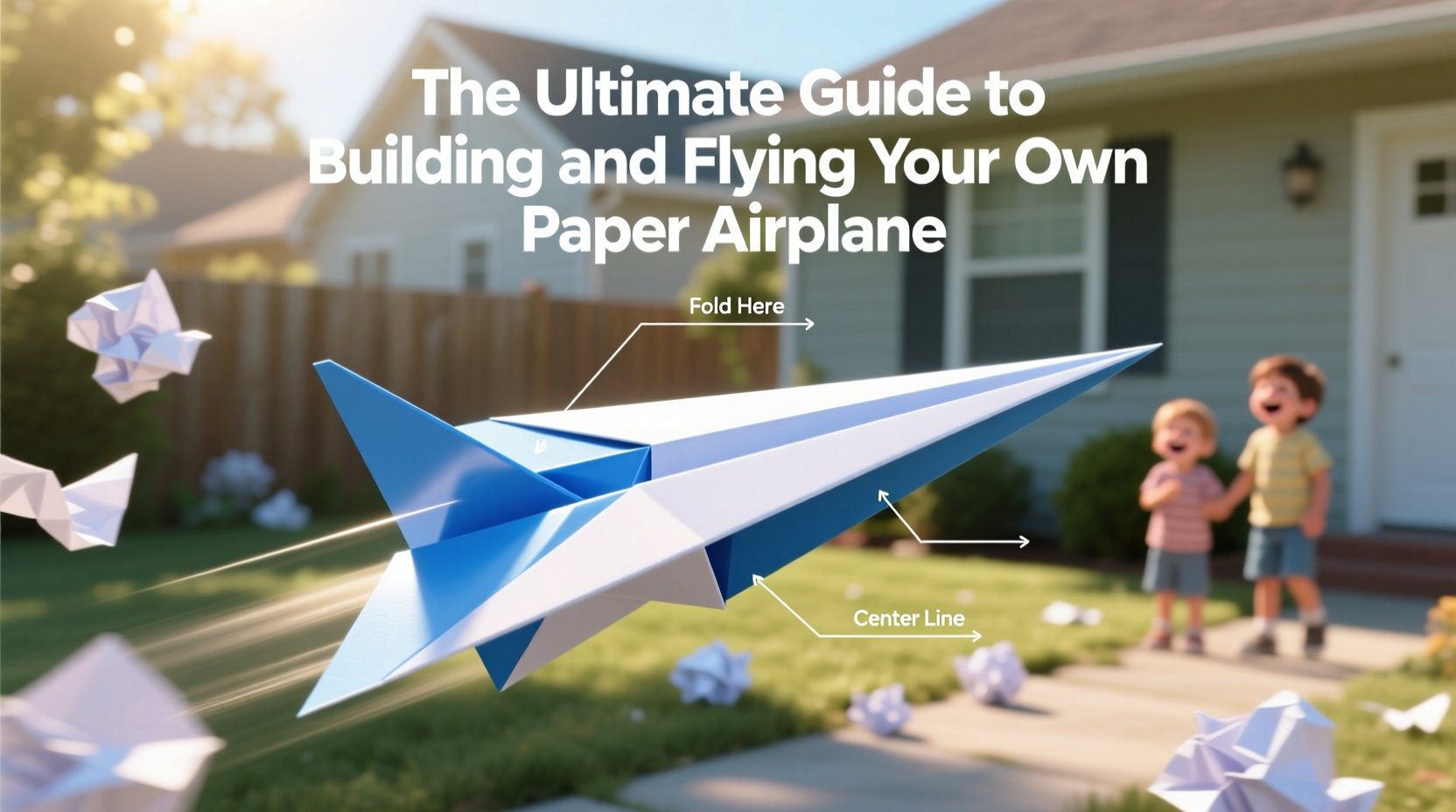
Paper airplanes follow the same fundamental forces as full-sized aircraft: lift, drag, thrust, and weight. When you throw a paper airplane, you provide thrust. As it moves forward, air flows over and under its wings, creating lift. Drag resists motion, while gravity pulls the plane downward. The balance between these forces determines how far and how smoothly it flies.
Lift is generated by wing shape and angle. Even flat wings on paper planes create slight pressure differences when angled upward (known as angle of attack). Too steep an angle increases drag and causes stalling. Too shallow, and there’s not enough lift. Stability depends on center of gravity—slightly forward of the midpoint—to keep the nose from rising uncontrollably.
Choosing the Right Paper and Tools
Not all paper performs equally. Standard 8.5” x 11” printer paper (about 80 gsm) offers the best compromise between stiffness and weight. Heavier cardstock is too dense and stalls quickly; tissue paper lacks rigidity and collapses mid-flight.
| Paper Type | Flight Performance | Best Use Case |
|---|---|---|
| Standard Copy Paper | Excellent balance of weight and stiffness | All-purpose designs |
| Construction Paper | Too heavy, poor glide | Decorative models only |
| Newspaper | Light but floppy | Large gliders with broad wings |
| Origami Paper | Too small and often slippery | Indoor micro-gliders |
Use a flat, hard surface for folding. A ruler can help crease sharp, symmetrical folds—critical for balanced flight. Avoid crumpling or touching wing surfaces excessively, as oils from fingers can weaken fibers and warp shape over time.
Step-by-Step: Building the Arrow Dart (Beginner)
The Arrow Dart is a classic design known for speed and straight-line performance. It's ideal for learning symmetry and clean folding.
- Start with a standard sheet of letter-size paper, placed vertically.
- Fold the paper in half lengthwise, then unfold. This creates a center guideline.
- Fold the top two corners toward the center crease, forming a pointed nose.
- Fold the new top edges down to the center again, maintaining a sharp tip.
- Fold the plane in half along the original center crease, so folded sides are on the outside.
- Fold the wings down so their tips align with the bottom edge of the body.
- Create small winglets by folding up the outer 1/2 inch of each wing tip for added stability.
Ensure both wings are even. Hold near the nose—about one-third from the front—and throw with moderate force at a slight upward angle (10–15 degrees).
Advanced Design: The Sky King Glider
For longer flights and gentle descents, try the Sky King—a high-lift glider optimized for indoor use. Its wide wings generate more lift at low speeds.
- Begin with paper laid horizontally.
- Fold in half top to bottom to mark centerline, then unfold.
- Fold top corners to center, leaving a small triangle at the bottom.
- Fold the top edges to center again, forming a narrow diamond.
- Fold 1 inch of the top down to reinforce the nose and shift center of gravity forward.
- Fold in half backward along the center crease.
- Fold large wings down, extending from near the nose to the tail, keeping them level with the bottom edge.
- Add 45-degree upward wingtips to prevent rolling.
This model excels in still air. Launch gently from shoulder height, aiming slightly upward. It should climb briefly, then transition into a slow, smooth descent.
“Even minor asymmetry in wing folds can cause dramatic veering. Precision matters more than complexity.” — Dr. Ken Blackburn, former Guinness World Record holder for longest paper airplane flight duration
Tuning and Trimming Your Plane
No paper airplane flies perfectly on the first try. Adjustments, known as trimming, correct flight flaws. These modifications mimic control surfaces on real aircraft.
- Nose dives: Bend wing trailing edges slightly upward.
- Stalls or loops: Add small downward bends to wing backs or reduce nose weight.
- Turns left or right: Slightly twist one wingtip up or adjust rudder-like folds on the tail.
- Rolls sideways: Ensure both wings are level; add dihedral by angling wingtips higher than roots.
Make one adjustment at a time and test after each change. Small tweaks have big effects. Tape is acceptable for securing weak joints but avoid overuse—it adds weight.
Mini Case Study: The Classroom Distance Challenge
In a fourth-grade STEM class in Portland, students were tasked with designing paper airplanes for maximum distance in a gymnasium setting. Initial attempts with random folds averaged less than 15 feet. After instruction on symmetry, center of gravity, and launch angles, they adopted the Arrow Dart template. Students used rulers for crisp folds and tested adjustments systematically.
One student, Maya, noticed her plane yawed right consistently. Instead of refolding, she subtly bent the left wingtip up by 2 millimeters. Her next launch traveled 32 feet—nearly double the class average. The project demonstrated how small corrections based on observation lead to significant improvements, reinforcing scientific method through play.
Checklist: Pre-Flight Tuning Routine
Before launching any paper airplane, run through this checklist:
- ✅ Verify symmetry in wings and folds
- ✅ Check center of gravity (should be slightly forward)
- ✅ Inspect for warped or bent surfaces
- ✅ Confirm sharp, well-creased folds
- ✅ Test balance by resting fingertips under wings—nose should dip slightly
- ✅ Adjust elevators or rudders as needed based on previous flights
Frequently Asked Questions
Can I make a paper airplane fly farther outdoors?
Outdoor flight is challenging due to wind and turbulence. Use slightly heavier paper and designs with narrower wings to cut through air. Avoid gusty days. Long, wide-winged gliders perform poorly outdoors—opt for darts instead.
What’s the world record for longest paper airplane flight?
According to the Guinness World Records, the longest duration flight was 29.2 seconds, achieved by John Collins’ “Suzanne” design in 2012. The farthest flight reached over 226 feet, set by Joe Ayoob in 2012 using a specialized dart.
Do paper airplanes teach real aerodynamics?
Absolutely. They demonstrate lift, drag, pitch stability, and center of mass. Educators use them to introduce airflow concepts, making abstract physics tangible. Even aerospace engineers use paper models for quick prototyping ideas.
Mastery Through Experimentation
The true joy of paper airplanes lies not in perfection, but in iteration. Each fold teaches something—about balance, airflow, or craftsmanship. Some of the best designs emerged from failed prototypes. Try modifying wing width, adding flaps, or experimenting with swept-back shapes inspired by jets. Document what works. Keep a flight log noting design changes and results.
Organize competitions with friends or students. Measure distance, time aloft, or accuracy landing in a target zone. These challenges build problem-solving skills and deepen appreciation for flight mechanics.
“The simplest designs often outperform complex ones. Elegance in engineering means doing more with less.” — Dr. Robert J. Salto, Aerospace Educator
Conclusion
Building and flying a paper airplane is more than childhood nostalgia—it’s accessible science, creative expression, and quiet meditation in motion. With the right techniques, attention to detail, and willingness to learn from each flight, anyone can create a plane that soars with purpose. Start with the basics, refine through testing, and let curiosity guide your designs.




 浙公网安备
33010002000092号
浙公网安备
33010002000092号 浙B2-20120091-4
Comments
No comments yet. Why don't you start the discussion?