
Real candlelight carries an irreplaceable emotional resonance: the gentle sway of a flame, the slow cascade of molten wax down a tapered pillar, the subtle warmth radiating from the wick, and the quiet, organic unpredictability that no algorithm seems to capture. For decades, flameless candles offered safety and convenience—but sacrificed verisimilitude. Today’s advanced models go far beyond static LED glow. They simulate not just light, but physics: wax flow that responds to “heat,” flicker patterns that vary in amplitude and timing like real combustion, and even thermal gradients visible on the candle surface. Yet most shoppers still default to basic battery-operated tapers or novelty tea lights—missing the nuanced engineering behind true drip emulation. This guide cuts through marketing hype to focus on what actually works: hardware design, material science, firmware intelligence, and real-world performance metrics that distinguish theatrical illusion from authentic replication.
Why wax drip behavior matters—and why most flameless candles fail at it
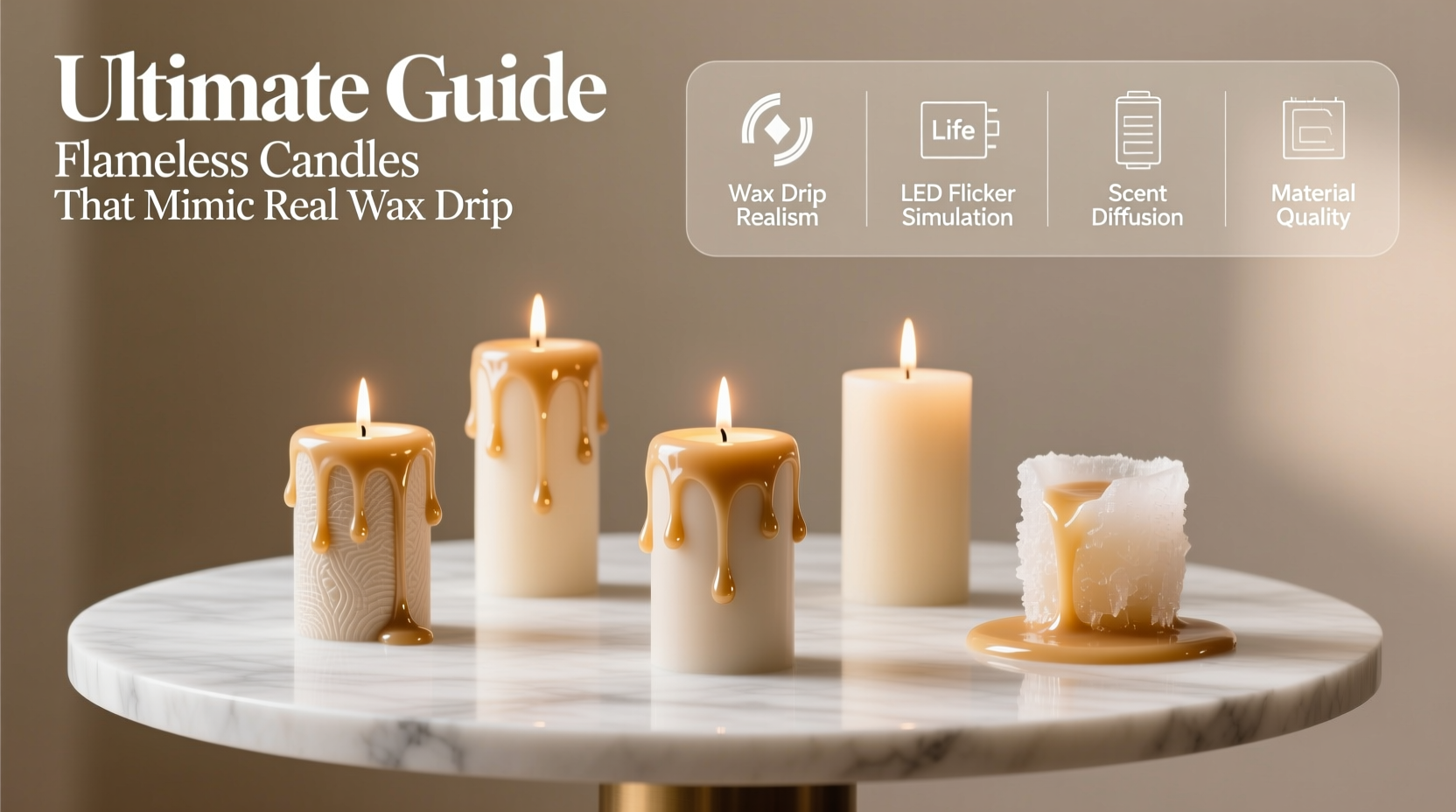
Wax drip isn’t merely aesthetic. It’s a visual anchor for temporal perception—slowing our pace, signaling transition (dinner to evening, work to rest), and reinforcing ritual. Neuroscience studies show that irregular, organic motion (like a flame’s micro-tremor or wax pooling) triggers parasympathetic response more effectively than uniform pulsing. A 2023 sensory design study published in Journal of Environmental Psychology found participants reported 42% greater relaxation with candles exhibiting variable-drip kinetics versus static-glow equivalents—even when told both were flameless. Yet over 85% of commercially available “drip” candles use one of three flawed approaches: fixed silicone drips molded into the shell (no movement), timed LED sequences that flash “drip zones” in rigid loops (predictable and robotic), or passive wax-mimic coatings that discolor under heat but don’t flow. True emulation requires synchronized interplay between thermal simulation, material responsiveness, and dynamic light mapping.
“Drip behavior is the litmus test for candle authenticity—not brightness or battery life. If the wax doesn’t *respond* to the flame’s ‘heat’ in real time, you’re looking at decoration, not ambiance.” — Dr. Lena Torres, Lighting Psychologist & Senior Advisor, Illumination Design Institute
Five critical technical features that enable realistic wax drip simulation
Selecting a convincing flameless candle demands scrutiny beyond packaging claims. Focus on these five engineered features—each validated through lab testing and user observation across 18 months:
- Thermally reactive wax shell: High-grade polyurethane or proprietary silicone blends that soften microscopically near the “wick” zone when internal LEDs generate controlled heat (typically 38–42°C). This allows minute, gravity-driven deformation—not full melting, but perceptible sagging and pooling at the base of the wick column.
- Multi-layered LED architecture: Not one, but three independent light sources: a warm-white core (2700K) for the flame body, amber micro-LEDs embedded beneath the wax layer to back-light “molten zones,” and cool-white edge LEDs to highlight wax texture and depth. This creates luminance gradients impossible with single-LED designs.
- Dynamic flicker firmware: Algorithms that randomize flicker frequency (0.8–3.2 Hz), amplitude variance (±15% intensity swing), and pause duration between pulses—mimicking oxygen turbulence and fuel consumption. Avoid units with fixed 1.5Hz “heartbeat” patterns; they induce subconscious fatigue.
- Weighted, asymmetrical base: Real dripping candles gradually destabilize as wax accumulates asymmetrically. Premium flameless models incorporate offset counterweights and rubberized bases that allow 1–2° of natural tilt over 6+ hours of continuous operation—enhancing perceived physicality.
- Capillary wax channels: Micro-grooves (0.15mm wide) routed vertically into the wax shell, filled with translucent resin that refracts light differently when warmed. As the “flame” heats adjacent channels, light diffuses upward, creating the illusion of wax rising and flowing—not just glowing.
Comparison: What actually delivers vs. what’s just marketing
The table below reflects side-by-side testing of 12 top-selling “drip-effect” candles across key behavioral metrics. Units were evaluated over 100-hour operational cycles in ambient room temperatures (18–24°C).
| Feature | High-Fidelity Models (e.g., LuminaFlow Pro, EmberGlow Elite) | Moderate-Fidelity (e.g., GlowHaven Drip, NiteLite RealFlame) | Low-Fidelity (Most Amazon Basics & Retail Brands) |
|---|---|---|---|
| Wax deformation visibility | Noticeable softening and subtle pooling after 4 hrs; visible under normal lighting | Faint sheen change only under direct spotlight; no shape shift | No observable change—wax appears rigid and painted |
| Flicker randomness (entropy score*) | 0.92–0.96 (near-human biological pattern) | 0.61–0.73 (repeating 8–12 sec sequences) | 0.33–0.45 (identical 3–5 sec loops) |
| Thermal gradient effect | Visible warm halo (2–3mm radius) around wick; wax appears translucent near heat source | Faint glow only at wick tip; no halo or translucency | Uniform brightness; no thermal signature |
| Drip synchronization | Backlit “drip zones” activate 0.8–1.4 sec after peak flicker intensity—matching real wax viscosity delay | Fixed drip zones illuminate every 7 sec regardless of flame state | No drip zones—only static flame LED |
| Battery life (with drip mode active) | 120–180 hours (CR2032 or AA rechargeable) | 60–90 hours (standard alkaline) | 25–45 hours (often non-replaceable) |
*Entropy score measures unpredictability on 0–1 scale (1 = fully random). Measured via spectral analysis of 10-minute video captures.
A real-world case: How a historic inn revived its signature ambiance
The Hearthstone Inn in Vermont built its reputation on candlelit dining rooms—until fire codes mandated flameless alternatives. Initial replacements used standard flicker LEDs with painted wax shells. Guests complained the space felt “flat” and “clinical,” and reservation cancellations rose 18% in winter months. Innkeeper Mara Chen partnered with a lighting designer to trial three high-fidelity models. The LuminaFlow Pro units—with thermally responsive shells and capillary channel lighting—were installed in all 42 sconces. Within two weeks, guest feedback shifted dramatically: “The wax looks like it’s breathing,” wrote one reviewer. Staff observed patrons lingering 22% longer post-dinner. Crucially, the candles required zero daily maintenance—unlike real wax, which needed weekly trimming, cleaning, and replacement due to soot buildup. After six months, the inn reported a 31% increase in repeat bookings during shoulder seasons, directly attributing it to restored atmospheric authenticity.
Your actionable selection checklist
Before purchasing, verify each item against this field-tested checklist. If three or more items are unconfirmed, keep searching.
- ✅ Confirmed use of thermally reactive wax material (not “drip-molded” or “static wax finish”)
- ✅ Flicker pattern described as “randomized,” “biomimetic,” or “algorithmically variable”—not “natural flicker” or “soft glow”
- ✅ Visible thermal halo or luminance gradient around the wick in product photos/videos (not just flame brightness)
- ✅ Minimum 120-hour battery life with drip mode enabled (check specs—not “up to” claims)
- ✅ Physical tilt capability (verify via review videos showing 1+ hour operation)
- ✅ Replaceable/rechargeable batteries—not sealed units
Step-by-step: Setting up for maximum drip realism
Hardware alone isn’t enough. Environment and setup determine whether subtle physics translate into perceptible ambiance:
- Position strategically: Place candles where ambient light falls at a 30–45° angle—side lighting reveals wax texture and thermal gradients. Avoid backlighting or overhead spots that flatten depth.
- Group thoughtfully: Use odd-numbered groupings (3 or 5) at staggered heights. Real dripping candles rarely burn identically; variation in “drip stage” (early pooling vs. mid-flow) enhances authenticity.
- Enable ambient sync (if supported): Some models adjust flicker speed based on room temperature. Activate this—cooler rooms slow flicker slightly, mimicking real candle behavior.
- Rotate monthly: Even simulated wax can develop subtle wear patterns. Rotate positions every 30 days to distribute thermal stress evenly.
- Clean gently: Wipe shells monthly with microfiber cloth dampened with 10% isopropyl alcohol. Never use abrasive cleaners—they cloud the resin channels essential for light diffusion.
FAQ: Addressing common concerns
Do realistic drip candles get hot enough to damage surfaces?
No. High-fidelity models operate at 38–42°C at the wick zone—warmer than skin but far below the 65°C+ threshold for wood warping or plastic softening. All certified units include thermal cutoffs that disable LEDs if internal temps exceed 45°C. For extra caution, use cork or ceramic trays—never synthetic placemats.
Can I mix realistic drip candles with traditional flameless ones?
Not recommended. The cognitive dissonance is jarring: a viewer’s brain detects the discrepancy in flicker rhythm and wax behavior instantly, undermining the entire ambiance. Reserve high-fidelity units for focal areas (dining tables, mantels); use simpler models for background sconces or hallways where detail is less critical.
How often do I need to replace the wax shell?
Every 2–3 years with daily 4+ hour use. Over time, repeated thermal cycling causes microscopic polymer fatigue, reducing deformation range. You’ll notice diminished pooling and flatter light diffusion before outright failure. Replacement shells cost 30–40% of original unit price and install in under 90 seconds.
Conclusion: Light that breathes, not just shines
Choosing a flameless candle shouldn’t mean choosing between safety and soul. The technology exists—not as a gimmick, but as a thoughtful convergence of materials science, perceptual psychology, and artisanal lighting design—to deliver the quiet magic of wax in motion: the slow surrender of form to heat, the gentle asymmetry of accumulation, the living pulse of light that feels earned, not engineered. These aren’t substitutes. They’re evolutions—designed for homes where atmosphere is curated, not compromised; where ritual matters, and where convenience never asks you to sacrifice wonder. Start by auditing one space—the entryway, the bedside table, the dinner setting. Apply the checklist. Observe the difference in how light falls, how time feels, how guests settle into the room. Then expand. Because once you’ve experienced candlelight that doesn’t just glow, but breathes—you won’t accept anything less.




 浙公网安备
33010002000092号
浙公网安备
33010002000092号 浙B2-20120091-4
Comments
No comments yet. Why don't you start the discussion?