
Music follows you throughout the day—from morning workouts to late-night drives, from home speakers to office headphones. Spotify has become the soundtrack of modern life, but only when it works smoothly across every device you own. Too often, users face frustrating gaps: a playlist missing on mobile, offline songs failing to download, or playback that refuses to transition between devices. These issues aren’t inevitable. With the right setup and understanding, you can achieve flawless synchronization across smartphones, tablets, laptops, smart speakers, wearables, and car systems—all under one account, in perfect harmony.
Understanding Spotify’s Sync Ecosystem
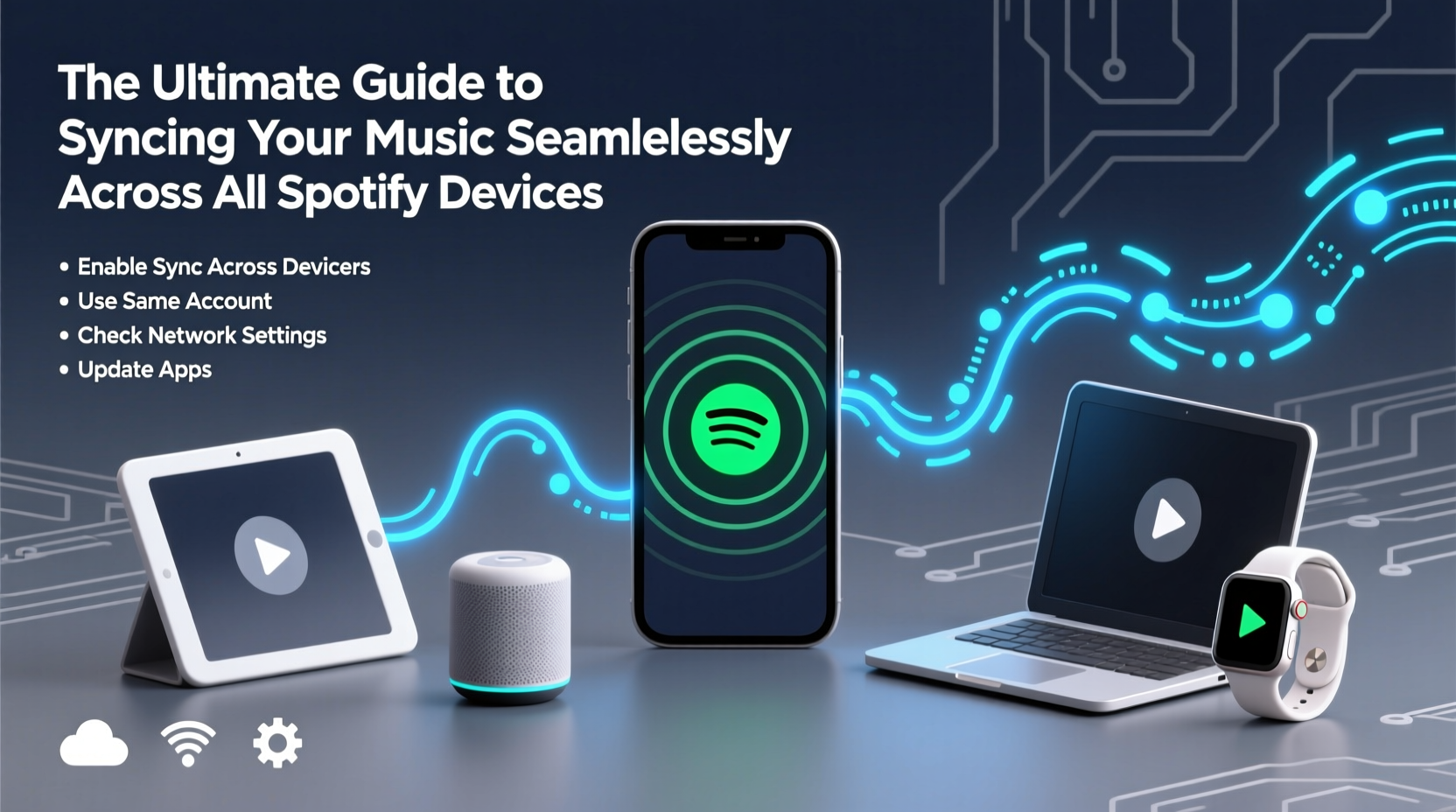
Spotify doesn’t “sync” files like traditional cloud storage. Instead, it synchronizes access to its vast library through your account, metadata (playlists, history, preferences), and cached content for offline use. This means your music isn’t stored locally as MP3s, but rather streamed—or temporarily downloaded—with your personal settings mirrored wherever you log in.
The foundation of seamless syncing lies in three components:
- Account Consistency: Use the same login across all devices.
- Internet Connectivity: Devices must periodically connect to update library data.
- App Updates: Outdated apps may lack sync features or bug fixes.
When these elements align, Spotify’s ecosystem operates like a well-conducted orchestra—each device playing its part at the right time.
Step-by-Step Guide to Perfect Device Synchronization
Achieving true cross-device harmony requires deliberate configuration. Follow this timeline to ensure every device behaves as an extension of your musical identity.
- Verify Account Access
Log into Spotify on each device using the same credentials. Enable two-factor authentication for security without sacrificing accessibility. - Update All Apps
Check your app store or system updates. Older versions may not support Connect, Crossfade, or Offline Mode properly. - Enable Sync Settings
Navigate to Settings > Playback and confirm:- \"Sync Library\" is turned on (for saved tracks and playlists).
- \"Available Offline\" is enabled for critical playlists.
- \"Automatically Download Podcasts\" is toggled per preference.
- Use Spotify Connect
Ensure all compatible devices (smart TVs, Sonos, Google Home) are connected to the same Wi-Fi network. Open Spotify, tap the speaker icon, and select your desired output device. - Test Transition Scenarios
Play a song on your phone, then switch to tablet or desktop. Use \"Transfer Playback\" in the Now Playing screen to shift audio instantly. - Monitor Offline Caching
For travel or low-signal areas, download playlists directly to mobile or tablet. A green arrow indicates successful caching.
Real Example: Commuter’s Seamless Flow
Sophia starts her day by playing a focus playlist on her laptop at home. As she leaves, she taps “Continue on Phone” via Spotify Connect. The music pauses on the laptop and resumes mid-song on her earbuds. During her train ride, offline mode kicks in automatically—no signal required. At work, she transfers playback again to her office smart speaker using voice command: “Hey Google, play my Focus Mix on Spotify.” Not once does she lose her place or manually search for the track. This fluid experience isn’t magic—it’s meticulous sync setup in action.
Do’s and Don’ts of Multi-Device Management
| Do | Don't |
|---|---|
| Use the same Spotify account everywhere | Switch between multiple accounts frequently |
| Download playlists for offline use before flights | Assume downloaded content stays forever (expires after 30 days without online check-in) |
| Keep devices on the same Wi-Fi during setup | Ignore app update notifications |
| Label devices in Settings for easy identification | Leave unused devices logged in publicly |
Expert Insight: What Engineers Know About Syncing
“Spotify’s backend prioritizes metadata consistency over file replication. That means your likes, saves, and queue states are synced in near real-time—often within seconds—while actual audio is streamed or cached locally only when needed.” — Lena Torres, Former Backend Developer at Spotify
This explains why your recently played list appears identical across devices even if they’ve never held the same audio file. It also underscores the importance of regular internet access: without periodic syncing, your local cache becomes outdated, leading to confusion about what’s available.
Troubleshooting Common Sync Failures
Even with best practices, hiccups occur. Here’s how to resolve frequent issues:
- Offline songs won’t play: Re-download the playlist. Sometimes updates invalidate old caches.
- Playback won’t transfer: Restart the Spotify app or reboot the target device. Ensure both devices are updated.
- Missing liked songs: Check if “Sync Library” is disabled. Go to Settings > Music & Podcasts > Sync Library and toggle it on.
- Out-of-date playlists: Manually refresh by pulling down on the playlist screen. If changes still don’t appear, log out and back in.
Frequently Asked Questions
Can I sync Spotify across different operating systems?
Absolutely. Spotify supports iOS, Android, Windows, macOS, Linux, web browsers, smart TVs, and IoT devices. As long as you’re logged into the same account and have a stable connection, your library remains consistent regardless of platform.
Why do my downloaded songs disappear?
Spotify requires you to go online at least once every 30 days to verify your Premium subscription. If you remain offline longer, downloaded content is removed until re-authentication. To avoid surprises, connect to Wi-Fi weekly if you rely heavily on offline listening.
How many devices can I use with one account?
You can install Spotify on countless devices, but only one can play music at a time (except in group session mode). There’s no hard limit on installations, though excessive inactive devices may trigger security reviews.
Maximizing Sync Potential with Advanced Features
Beyond basic functionality, Spotify offers tools designed specifically for multi-device users:
- Group Session: Share playback control with friends nearby via QR code. One person manages the queue while others add tracks—ideal for parties or road trips.
- Crossfade & Gapless Playback: Adjust transition settings so songs blend smoothly when switching sources or devices.
- Auto-Download for Podcasts: Set preferred shows to download automatically on mobile when connected to Wi-Fi.
- Car Thing Integration (if available): Use voice commands or physical knobs to control Spotify in your vehicle, fully synced with your main account.
These features turn passive listening into an interactive, adaptive experience—one where context matters as much as content.
Conclusion: Your Music, Everywhere You Are
Seamless syncing isn’t just about convenience; it’s about continuity. When your music moves with you effortlessly, it enhances productivity, elevates moods, and deepens emotional connections to sound. By aligning your devices, maintaining consistent settings, and leveraging Spotify’s full suite of tools, you transform disjointed listening into a unified rhythm.




 浙公网安备
33010002000092号
浙公网安备
33010002000092号 浙B2-20120091-4
Comments
No comments yet. Why don't you start the discussion?