
In Minecraft, reaching the pinnacle of defensive gear is a milestone that marks progression from survival novice to seasoned adventurer. While diamond armor has long been the gold standard, the introduction of netherite in version 1.16 shifted the benchmark. Netherite armor offers superior toughness, knockback resistance, and durability—making it essential for exploring dangerous biomes, battling the Wither, or surviving deep-level mining expeditions. Upgrading your diamond armor to netherite isn’t just an improvement—it’s a transformation. This guide walks you through every critical step, resource requirement, and strategic consideration to ensure your upgrade is seamless and efficient.
Gathering the Essential Materials
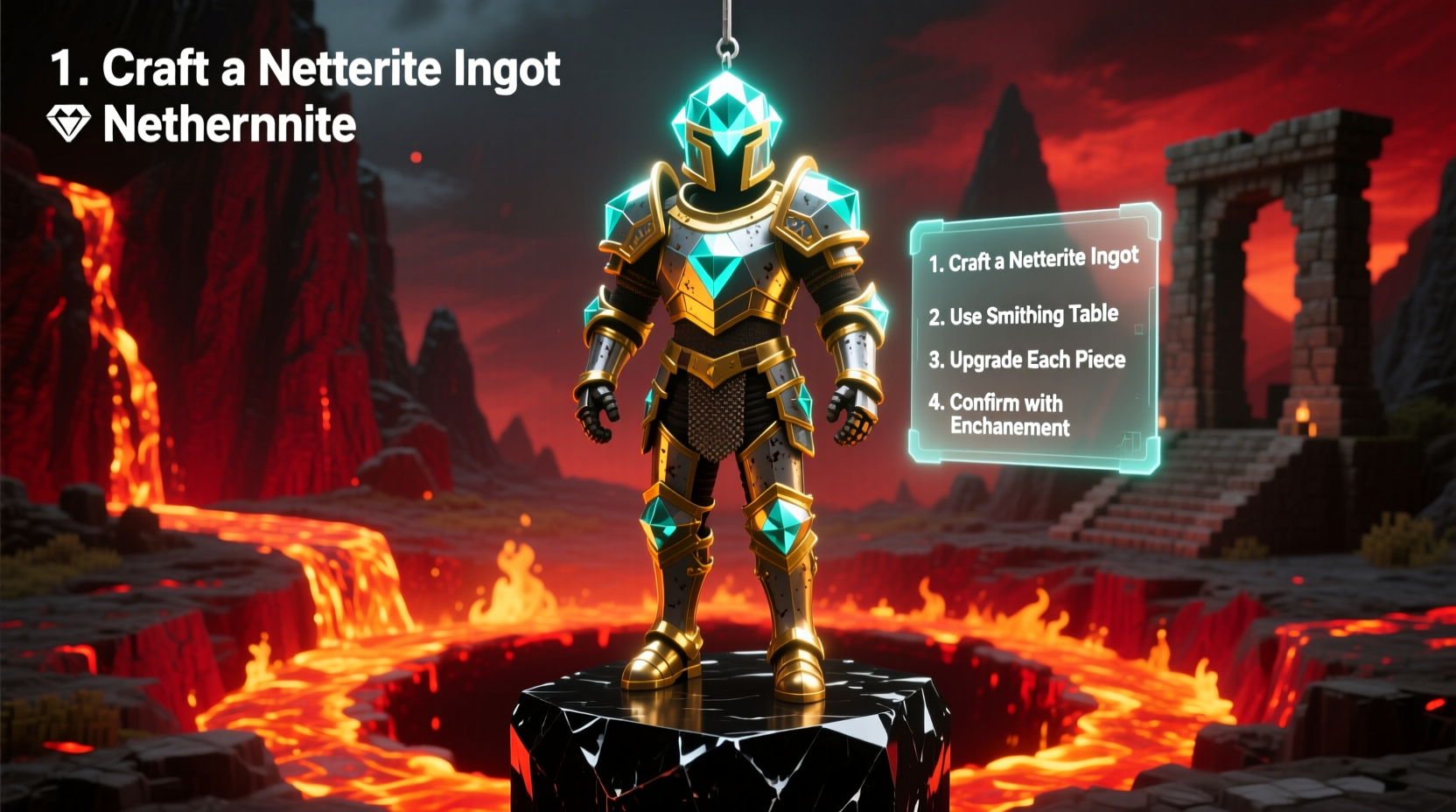
Before any upgrade can occur, you must collect all necessary components. The process hinges on two primary materials: ancient debris and diamonds. Unlike diamonds, which are found in the Overworld between layers 1 and 16, ancient debris spawns exclusively in the Nether, typically between Y-levels 8 and 22. It is blast-resistant, requiring at least a diamond pickaxe to mine, and drops netherite scraps when smelted.
To craft one piece of netherite armor, you’ll need:
- 4 netherite ingots (each made from 4 netherite scraps + 4 gold ingots)
- The corresponding piece of diamond armor
This means upgrading a full set of diamond armor requires 16 netherite ingots—or 64 netherite scraps and 64 gold ingots. Given that ancient debris typically spawns in veins of 1–3 blocks, obtaining enough material demands patience and proper preparation.
Step-by-Step Upgrade Process
Once you have both your diamond armor and netherite ingots, the actual upgrade occurs at a smithing table. Introduced alongside netherite, this block allows players to combine diamond gear with netherite ingots to create their upgraded counterparts.
- Locate or craft a smithing table. You’ll need 2 iron ingots and 4 wood planks (any type). Craft them in a 3x3 grid: place iron ingots in the top center and middle center, and wood planks in the remaining bottom three and middle left/right slots.
- Place the smithing table in your base or near your crafting station for easy access.
- Open the smithing table interface. Drag your diamond chestplate (or helmet, leggings, boots) into the first slot.
- Add one netherite ingot to the second slot. The result will appear automatically in the output box.
- Drag the netherite armor into your inventory. The original diamond piece is consumed.
- Repeat for each remaining piece of armor.
It’s important to note that enchantments on your diamond armor carry over to the netherite version. This makes preserving high-level enchantments like Protection IV, Feather Falling IV, or Mending absolutely worthwhile.
Resource Efficiency and Strategic Mining
Mining ancient debris efficiently requires planning. Due to its low spawn rate (average of 1.67 blocks per chunk), brute-forcing through netherrack is time-consuming and risky. Instead, adopt a systematic approach.
Strip mining at Y=15 or Y=12 maximizes exposure to ancient debris while minimizing lava lake encounters. Build a secure tunnel system two blocks high and one block wide, spacing branches every three blocks. Use buckets of water to neutralize lava pockets—a crucial safety measure in the Nether.
Smelting netherite scraps requires fuel. A single furnace can handle the load, but using a blast furnace cuts smelting time in half. For 64 scraps, expect to use approximately 32 coal or 64 wooden logs.
| Material | Quantity Needed (Full Set) | Source |
|---|---|---|
| Netherite Scraps | 64 | Smelted from ancient debris in the Nether |
| Gold Ingots | 64 | Smelted from gold ore or obtained via trading |
| Diamond Armor (Full Set) | 24 Diamonds | Mined in the Overworld |
| Iron Ingots | 2 | For crafting the smithing table |
“Efficiency in the Nether isn’t just about speed—it’s about minimizing risk while maximizing yield. Always bring fire resistance potions and a reliable escape route.” — Alex Turner, Minecraft Survival Guide Author
Avoiding Common Pitfalls
Many players rush into netherite upgrades without considering the risks or logistics. Here are frequent mistakes and how to avoid them:
- Underestimating lava exposure: Ancient debris often generates near or beneath lava seas. Always carry a water bucket and wear fire-resistant gear.
- Using inefficient tools: A silk touch pickaxe does not work on ancient debris. Only diamond or netherite picks are effective.
- Ignoring enchantment preservation: If your diamond armor has Mending or Unbreaking, do not disenchant it. The upgrade preserves these traits—don’t waste them.
- Skipping base preparation: Establish a Nether portal near your mining zone with a secure platform. Falling into lava during a retreat can cost hours of progress.
Real-World Example: From Diamond to Netherite in One Session
Jamie, an intermediate player, had spent weeks gathering diamond gear and enchanting it with Protection IV and Mending. Ready to tackle the End, she decided to upgrade her armor. She prepped by building a Nether portal adjacent to her base, stocked up on golden carrots, potions of fire resistance, and several stacks of cobblestone for bridge-building.
She descended to Y=12 in the Nether and began strip mining in a straight line. After clearing three tunnels, she located a cluster of four ancient debris blocks. Over the next 45 minutes, she mined 22 debris blocks, yielding 22 scraps. With a blast furnace running continuously, she smelted the scraps and crafted six netherite ingots by session’s end—enough to upgrade her helmet, chestplate, and leggings. The boots were completed two days later after a second expedition.
The key to her success? Preparation, persistence, and smart inventory management. She never entered the Nether unprepared and always prioritized safety over speed.
Frequently Asked Questions
Can I upgrade enchanted diamond armor?
Yes. All enchantments transfer seamlessly from diamond to netherite armor during the smithing process. This includes high-value enchantments like Mending, Unbreaking, and Protection.
Do I need a netherite pickaxe to mine ancient debris?
No. A diamond pickaxe is sufficient. Netherite tools offer no advantage in mining ancient debris, though they last longer and mine faster overall.
Can I repair netherite armor with diamonds?
No. Once upgraded, netherite armor can only be repaired using additional netherite ingots in an anvil. Diamonds will not work.
Final Checklist Before You Begin
Before heading into the Nether to begin your upgrade journey, ensure you have the following:
- ✔ Full set of diamond armor (preferably enchanted)
- ✔ Diamond pickaxe (minimum)
- ✔ At least 10 gold ingots (more for full set)
- ✔ Water bucket (for lava safety)
- ✔ Fire resistance potions (minimum 3 minutes duration)
- ✔ Blast furnace and fuel supply (coal, charcoal, or wood)
- ✔ Smithing table crafted and placed
- ✔ Secure Nether base or fast escape route
Conclusion
Upgrading diamond armor to netherite is more than a gear milestone—it’s a testament to your mastery of Minecraft’s progression systems. By methodically gathering resources, respecting the dangers of the Nether, and preserving valuable enchantments, you transform survivability into dominance. Whether you're preparing for the End, delving into deep caves, or facing hordes of mobs, netherite armor gives you the edge. Now that you know the full process, gather your tools, fortify your resolve, and forge your legacy in the strongest material Minecraft has to offer.




 浙公网安备
33010002000092号
浙公网安备
33010002000092号 浙B2-20120091-4
Comments
No comments yet. Why don't you start the discussion?