
A well-fitted jacket transforms not only how you look but also how you feel. Off-the-rack options often fall short in capturing the tailored elegance that a custom garment delivers. However, the key to unlocking that flawless silhouette lies in one critical step: accurate measurement. Whether you're ordering online or working with a tailor, incorrect measurements lead to poor drape, restricted movement, and wasted investment. This guide walks you through each stage of measuring for a custom fitted jacket with precision, clarity, and professional insight.
Why Accurate Measurements Matter
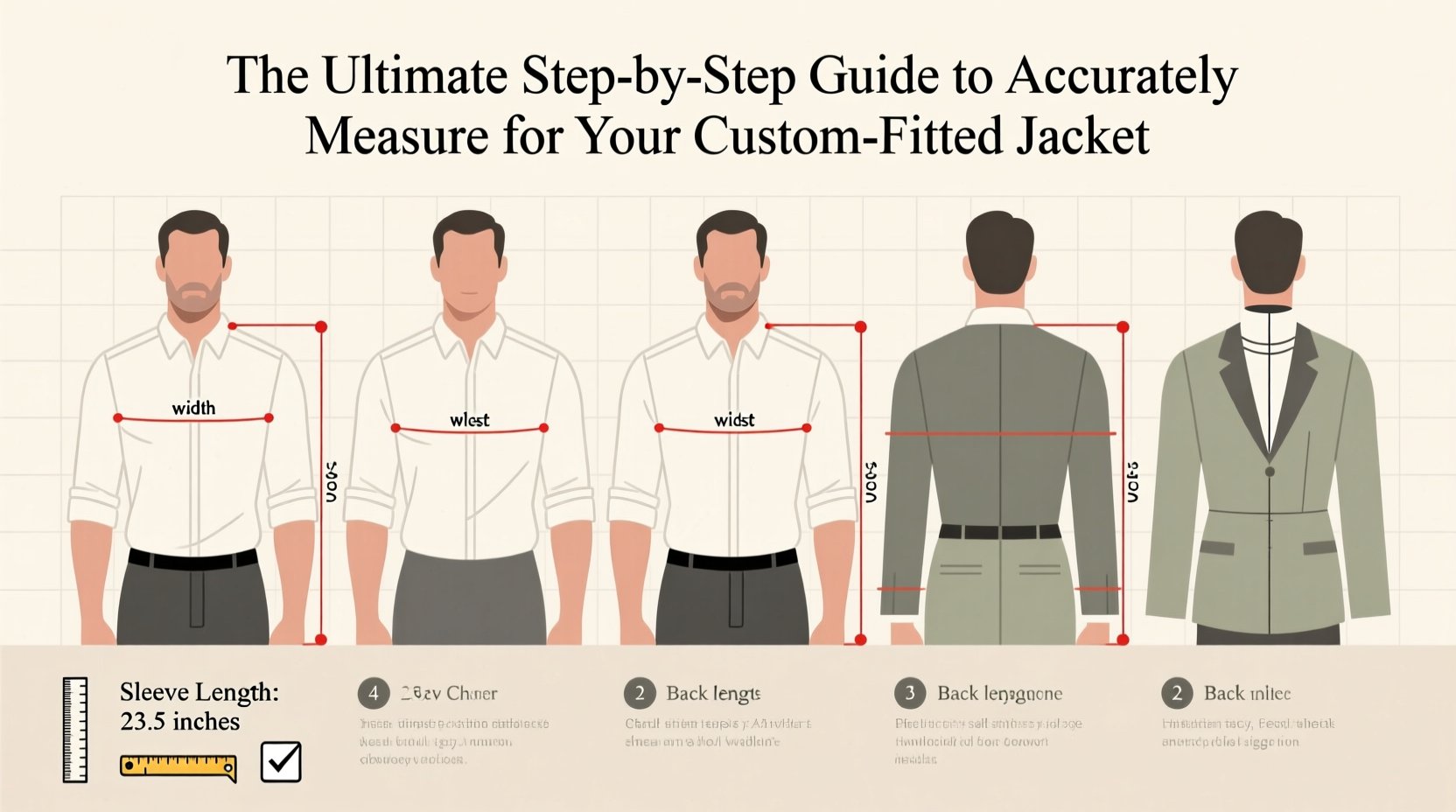
Custom tailoring is only as good as the data it’s built on. A jacket that fits impeccably enhances posture, elongates the torso, and flatters your natural shape. On the other hand, even minor discrepancies—a half-inch too tight in the chest or sleeves an inch too long—can undermine the entire purpose of going custom.
Most people assume their suit size (e.g., 40R) is sufficient. But ready-to-wear sizing varies widely between brands and doesn’t account for individual proportions. True customization requires exact body dimensions taken under controlled conditions.
“Measurement isn’t just about numbers—it’s about understanding proportion. A skilled tailor can adjust for posture, shoulder slope, and stance, but only if they have accurate baseline data.” — Daniel Reyes, Master Tailor & Bespoke Consultant, Savile Row Atelier
The Essential Tools You’ll Need
Before beginning, gather the right tools. Using improper equipment leads to inconsistent results.
- Tailor’s measuring tape – Flexible, non-stretch fabric or fiberglass tape. Avoid rigid metal rulers or retractable tape measures.
- Mirror – To ensure proper posture and alignment during measurement.
- Fitting clothes – Wear slim-fitting garments similar to what you’d wear under a jacket (e.g., dress shirt).
- Pencil and paper – Record measurements immediately to avoid memory errors.
- Assistant (recommended) – Some measurements are nearly impossible to take alone with accuracy.
Step-by-Step Measurement Process
Follow this sequence carefully. Each measurement builds on the last, ensuring consistency and reducing error.
- Chest: Wrap the tape around the fullest part of your chest, typically just under the armpits and across the shoulder blades. Keep arms relaxed at your sides. Exhale naturally before recording the number. This is your most critical dimension.
- Waist: Measure at your natural waistline—the narrowest part of your torso, usually an inch or two above the navel. Stand naturally; don’t suck in your stomach.
- Hips: Around the fullest part of your hips and seat. Important for jacket length and rear vent function.
- Shoulders: Have an assistant measure from the outer edge of one shoulder bone, across the back base of the neck, to the other shoulder. Do not include any slope down the arm.
- Sleeve Length: Start at the top of the shoulder (where the arm meets the torso), go over the elbow, and extend to the wrist bone. The arm should be slightly bent. For jackets, add ½ inch to allow for shirt cuff exposure.
- Center Back Length: From the base of the collar (C7 vertebra, where your neck meets your spine) straight down to your desired jacket hem. Standard lengths range from 29” to 32” depending on height.
- Bicep: With arm slightly bent, measure around the thickest part of the bicep. Crucial for athletic builds or broad-shouldered individuals.
- Neck: Measure around the base of the neck where a collar would sit. Useful for determining lapel width and button stance.
Common Measurement Mistakes to Avoid
Even experienced buyers make preventable errors. Awareness is the first step toward precision.
| Mistake | Why It’s Wrong | How to Fix It |
|---|---|---|
| Measuring over bulky clothing | Adds false volume, leading to oversized cuts | Wear thin, form-fitting layers like a dress shirt |
| Standing slouched or unnaturally straight | Distorts posture-based proportions | Stand naturally, feet shoulder-width apart, eyes forward |
| Pulling tape too tight | Underestimates true size, causes discomfort | Allow slight slack—tape should glide smoothly |
| Guessing sleeve length solo | Nearly impossible to align shoulder point correctly | Always get help for sleeve and shoulder measurements |
Real-World Example: John’s Custom Jacket Journey
John, a 34-year-old financial analyst, ordered his first custom jacket online. Confident in his ability to self-measure, he used a metal tape measure over a thick sweater and estimated his chest at 42 inches. When the jacket arrived, the shoulders gaped, and the sleeves restricted movement.
He returned it and visited a local tailor, who re-measured him properly. The correct chest was 40.5 inches, but more importantly, his shoulder width was narrower than assumed, and his sleeve needed a 33-inch length due to longer arms. The second jacket fit flawlessly—sharp at the shoulder, clean through the chest, and perfectly balanced in length.
John learned that precision beats estimation, and context matters as much as the number itself.
Checklist: Pre-Measurement Preparation
Use this checklist before you begin measuring to ensure optimal conditions:
- ☑ Wear appropriate clothing (dress shirt, no jacket)
- ☑ Use a flexible, non-stretch measuring tape
- ☑ Stand on a hard, level surface
- ☑ Position yourself in front of a full-length mirror
- ☑ Have a helper available for shoulder, sleeve, and back measurements
- ☑ Breathe normally—don’t hold your breath or flex muscles
- ☑ Record each measurement immediately after taking it
When to See a Professional Tailor
While DIY measurement works for many, certain situations demand expert hands:
- First-time custom order – Learning the process with guidance reduces costly mistakes.
- Unusual body proportions – Such as broad shoulders, long torso, or significant weight distribution differences.
- Formal or high-investment garments – Tuxedos, wedding suits, or premium wool jackets warrant precision fitting.
- Posture variations – Slight stooping, rounded shoulders, or scoliosis require compensatory adjustments.
A professional doesn’t just measure—they assess drape, balance, and movement. Many offer initial fittings at little or no cost, especially if you’re purchasing through them.
FAQ: Common Questions About Measuring for a Custom Jacket
Can I measure myself accurately alone?
Some measurements (like chest and waist) can be done solo with care, but shoulders, sleeves, and back length are extremely difficult to capture correctly without assistance. For best results, enlist a friend or visit a tailor.
How much ease should be added to my measurements?
Never add ease yourself. Reputable tailors and manufacturers build in 2–4 inches of chest ease depending on the cut (slim, regular, or comfort fit). Providing raw body measurements ensures they apply the correct allowance.
What if my measurements fall between sizes?
Custom means no compromises. Provide exact figures—down to the quarter inch. A good maker will blend patterns or draft from scratch to match your unique proportions.
Final Thoughts: Precision Is Personal
A custom fitted jacket is more than clothing—it’s a statement of attention to detail, confidence, and personal standards. But its success hinges on the quiet, meticulous work done before the fabric is ever cut. Taking accurate measurements may seem tedious, but it’s the foundation of lasting style.
Whether you're investing in your first bespoke piece or refining a growing wardrobe, treat measurement as a ritual of respect—for the craft, the material, and yourself. Do it once, do it right, and enjoy a jacket that doesn’t just fit your body, but fits your life.




 浙公网安备
33010002000092号
浙公网安备
33010002000092号 浙B2-20120091-4
Comments
No comments yet. Why don't you start the discussion?