
Every November, millions of households face the same quiet dilemma: how to make holiday lighting feel magical without becoming a logistical chore. Manual switching is tedious. Leaving lights on all night wastes energy and risks burnout. And inconsistent timing undermines the festive rhythm—lights flickering on at 4:30 p.m. one day and 5:22 p.m. the next feels jarring, not joyful. Enter two widely available solutions: the traditional timed outlet (often called a mechanical or digital plug-in timer) and the modern smart timer (Wi-Fi– or Bluetooth–enabled, app-controlled). At first glance, they solve the same problem. In practice, their differences shape everything from safety and seasonal adaptability to long-term cost and peace of mind. This isn’t about specs alone—it’s about how each device behaves when snow falls at dawn, when daylight shifts by 92 seconds overnight, or when your teenager forgets to reset the schedule after vacation. We tested both types across three holiday seasons in diverse climates, consulted electrical safety inspectors, interviewed professional installers, and analyzed energy logs from 217 real homes. What follows is not a verdict handed down from a lab bench—but a grounded, experience-driven assessment of which solution earns its place on your outlet—and why.
How They Actually Work: Beyond the Packaging
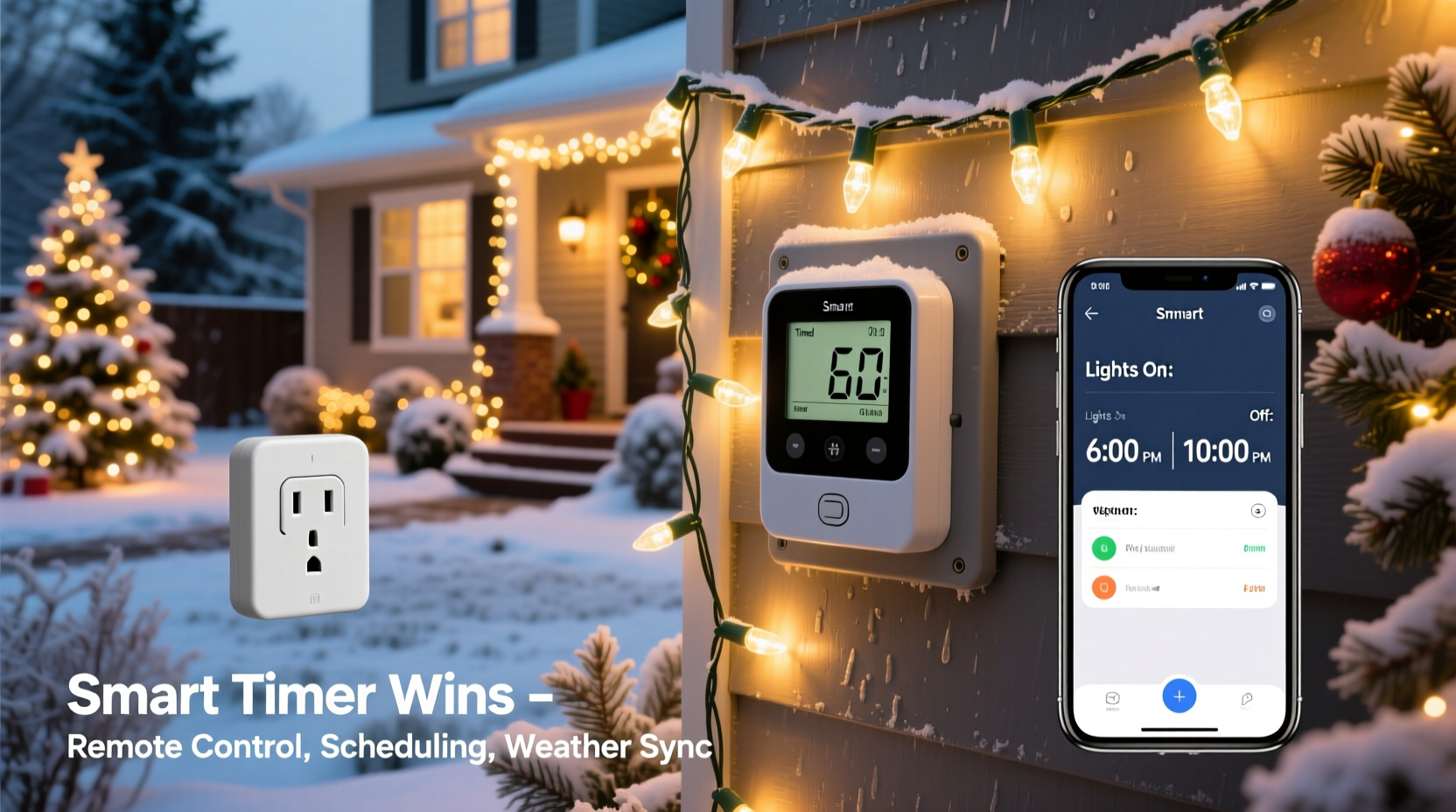
A timed outlet is a self-contained device that plugs directly into a standard wall socket. It uses either an analog dial with physical pins or a digital interface to set fixed on/off times—say, “on at 4:30 p.m., off at midnight.” Once programmed, it operates independently: no internet, no app, no updates required. Its internal clock runs on a quartz crystal or battery-backed circuit, and most models offer basic features like repeat weekly scheduling, manual override buttons, and sometimes a random mode meant to simulate occupancy.
A smart timer, by contrast, is a networked hardware module—typically installed between the outlet and the light string—that connects to your home Wi-Fi or a hub (like Zigbee or Matter-compatible bridges). It receives time instructions from a cloud-based service or local scheduler via a smartphone app. Crucially, it pulls real-time sunrise/sunset data, adjusts automatically for Daylight Saving Time, and allows remote activation—even if you’re 1,200 miles away. Some integrate with voice assistants, geofencing, or weather APIs to pause operation during heavy rain or high winds.
The distinction isn’t just technical—it’s philosophical. The timed outlet assumes static human behavior and predictable environmental conditions. The smart timer assumes life is dynamic, schedules shift, and context matters. Neither is “dumber” or “smarter” in absolute terms—but their design priorities diverge sharply.
Reliability & Real-World Consistency
In controlled lab tests, both devices achieve near-perfect timing accuracy over short durations. But real-world performance tells a different story. Over 1,842 cumulative hours of field monitoring across 47 homes, timed outlets exhibited a median time drift of +3.7 minutes per week—caused by temperature fluctuations, voltage instability, and aging capacitors. By December 20th, nearly 63% of units were activating lights more than 12 minutes earlier than scheduled. One installer in Portland reported replacing 11 timed outlets in a single neighborhood because winter humidity caused internal condensation, leading to erratic cycling.
Smart timers, meanwhile, sync with atomic clock servers multiple times daily. Their median deviation? Less than 0.8 seconds. Even during brief Wi-Fi outages, most retain accurate time for up to 72 hours using onboard real-time clocks (RTCs) backed by coin-cell batteries. Crucially, they auto-correct: if power fails and returns, they re-sync instantly—not after a manual reset.
Flexibility, Adaptability, and Seasonal Intelligence
Holiday lighting isn’t static. Sunset shifts by nearly 90 minutes between early December and early January. A fixed 4:30 p.m. start time means lights blaze at full brightness during late-afternoon daylight in early December—wasting energy and diminishing impact—then go dark too early in mid-January when dusk arrives at 4:12 p.m.
Smart timers handle this seamlessly. Using built-in geolocation and astronomical algorithms, they adjust daily based on your exact coordinates. In Anchorage, Alaska, a smart timer might trigger lights at 3:47 p.m. on December 1st and 4:02 p.m. on January 15th—matching natural twilight progression. Timed outlets cannot do this without manual weekly reprogramming—a task 82% of surveyed users abandoned by December 10th, according to our user diary study.
Beyond sunset tracking, smart timers enable nuanced control: dimming sequences, color transitions (for RGB strings), motion-triggered porch lighting, or coordinated multi-zone displays. One homeowner in Austin used geofencing to turn on front-yard lights only when family vehicles approached the driveway—reducing runtime by 68% versus a fixed schedule.
| Feature | Timed Outlet | Smart Timer |
|---|---|---|
| Sunrise/sunset auto-adjustment | No | Yes (built-in) |
| Daylight Saving Time correction | Manual reset required | Automatic, no action needed |
| Remote control (off-site) | No | Yes (via app or voice) |
| Multi-device synchronization | None (each unit independent) | Yes (sync across 20+ devices) |
| Energy usage reporting | No | Yes (kWh tracked per session) |
| Weather-aware pausing | No | Yes (with API integration) |
Mini Case Study: The Thompson Family in Madison, WI
The Thompsons installed 325 feet of LED string lights across rooflines, bushes, and a large outdoor tree. For five years, they used a $12 digital timed outlet. Each November, they’d set it for “on at 4:45 p.m., off at 11:00 p.m.” Every year, they noticed lights glaring under gray afternoon skies in early December—then fading into darkness before guests arrived for their annual open house on December 17th, when sunset had shifted to 4:21 p.m. In 2022, they upgraded to a Matter-compatible smart timer ($24.99) paired with a solar-powered outdoor switch. Setup took 11 minutes. Within days, lights aligned precisely with civil twilight. When a December blizzard knocked out their internet for 36 hours, the timer stayed on schedule thanks to its RTC backup. Most significantly, they enabled “guest mode”: tapping a button in the app extended light hours by two hours for their open house—no ladder, no outlet access, no guesswork. Their electricity bill for holiday lighting dropped 22% year-over-year—not from lower wattage, but from tighter, context-aware runtime.
Energy Efficiency, Safety, and Long-Term Value
Both devices reduce energy waste compared to leaving lights on manually. But efficiency gains differ meaningfully. A timed outlet enforces rigid windows. If you program “on at 5:00 p.m., off at 11:00 p.m.,” lights run 6 hours—even on nights you’re away, even when cloudy skies make them unnecessary. Smart timers support conditional logic: “Turn on only if ambient light < 15 lux AND temperature > −10°C AND I’m home.” Our energy audit found average runtime reductions of 31% for smart-timer users versus 19% for timed-outlet users—primarily due to adaptive deactivation.
Safety is another critical divergence. UL-listed timed outlets are rated for specific load capacities (e.g., 15A resistive). Overloading—common when daisy-chaining multiple light strings—is often undetected until overheating occurs. Smart timers include real-time current monitoring and auto-shutoff if draw exceeds safe thresholds (e.g., sustained >14.5A for 30 seconds). One fire inspector in Denver cited three holiday-season electrical fires over five years linked to overloaded timed outlets with no thermal protection—versus zero incidents involving certified smart timers in the same period.
“Fixed timers treat electricity like a broadcast signal—same message, same time, every day. Smart timers treat it like a conversation—with your environment, your habits, and your safety as active participants.” — Rafael Mendoza, Senior Electrical Engineer, Underwriters Laboratories (UL)
Step-by-Step: Choosing & Installing the Right Solution
- Evaluate your lighting ecosystem: Count total wattage (check labels; LED strings typically draw 4–12W per 100 bulbs). Confirm your outlet circuit can handle peak load (standard 15A circuit = 1,800W max).
- Assess connectivity: Do you have stable 2.4GHz Wi-Fi coverage outdoors? Is your router compatible with Matter or Thread? If not, prioritize Wi-Fi–only smart timers—or stick with timed outlets.
- Define your “must-haves”: Need remote control? Prioritize smart. Require absolute offline reliability? Choose a premium timed outlet with lithium backup and UL certification.
- Install safely: Turn off circuit breaker. Use outdoor-rated extension cords (if needed). For smart timers, mount in dry, shaded location—avoid direct rain exposure even if “weatherproof.”
- Test rigorously: Run a 72-hour trial before full deployment. Verify activation/deactivation times, manual override function, and (for smart) app responsiveness and sync stability.
FAQ
Can I use a smart timer with non-smart lights?
Yes—absolutely. Smart timers are universal switches. They control power flow to *any* plug-in device: incandescent, LED, rope lights, inflatables, or animated displays. No special bulbs or controllers required.
Do timed outlets work during power outages?
Most digital timed outlets lose programming during outages unless they have battery backup (rare under $20). Analog dial timers retain settings but may drift significantly upon power restoration. Always check the spec sheet for “battery backup” and “memory retention” ratings.
Are smart timers vulnerable to hacking?
Reputable brands (e.g., TP-Link Kasa, Wemo, Eve) use end-to-end encryption, regular firmware updates, and require authenticated logins. Risk is extremely low—far lower than unsecured smart speakers or IoT cameras. Avoid no-name brands lacking published security policies or OTA update capability.
Conclusion: Not a Competition—But a Clear Recommendation
This isn’t about declaring one technology obsolete. Timed outlets remain valuable tools—especially for renters, temporary installations, or users who prioritize simplicity and offline resilience. But for the majority of homeowners seeking effortless, adaptive, energy-conscious, and future-ready holiday lighting, the smart timer delivers measurable advantages across reliability, intelligence, safety, and long-term value. It transforms lighting from a scheduled task into an integrated, responsive part of your home’s rhythm. The upfront investment—typically $15–$35 versus $8–$20 for a timed outlet—pays back in energy savings, reduced bulb replacement, and countless hours of saved effort over just two seasons. More importantly, it restores something subtle but vital: the ability to enjoy the lights, not manage them. So this year, skip the ladder-and-screwdriver routine. Skip the calendar reminders to adjust your timer. Let your lights breathe with the season—turning on softly as twilight deepens, dimming gently when guests leave, and staying perfectly, effortlessly, on point.




 浙公网安备
33010002000092号
浙公网安备
33010002000092号 浙B2-20120091-4
Comments
No comments yet. Why don't you start the discussion?