
Cloudy days can be deceptive. While the sun may seem hidden behind a thick layer of gray, harmful UV rays still penetrate the atmosphere and reach your eyes. Many people assume that sunglasses are only necessary under bright sunlight, but consistent eye protection is crucial regardless of cloud cover. When choosing between tinted and polarized sunglasses for overcast conditions, understanding their functional differences is key to making the right decision for long-term ocular health.
Tinted lenses reduce overall brightness by darkening light across the spectrum, while polarized lenses specifically target reflected glare—especially from horizontal surfaces like wet roads, puddles, or car hoods. On cloudy days, where scattered light and reflective glare are common, one type may offer superior visual comfort and protection. This article breaks down how each lens technology works, evaluates their performance in low-sunlight environments, and provides actionable guidance for selecting optimal eyewear.
How Light Behaves on Cloudy Days
On overcast days, sunlight is diffused by water droplets and ice crystals in clouds. Rather than direct exposure, light scatters in multiple directions—a phenomenon known as diffuse sky radiation. While this reduces visible brightness, up to 80% of ultraviolet (UV) radiation can still pass through cloud cover. The World Health Organization confirms that UV levels on cloudy days often remain high enough to cause corneal damage, cataracts, and photokeratitis (sunburn of the eye) with prolonged exposure.
In addition to invisible UV risks, cloudy conditions create unique visual challenges. Surfaces such as asphalt, concrete, and standing water reflect scattered light unevenly, producing veiling glare that impairs depth perception and contrast sensitivity. This makes driving, cycling, or even walking near reflective urban infrastructure more visually demanding. Because of these factors, simply wearing any pair of darkened glasses isn’t sufficient—optical quality and lens technology matter significantly.
Tinted Sunglasses: Function and Limitations
Tinted sunglasses use colored lens materials—commonly gray, brown, green, or amber—to absorb a portion of incoming visible light. The darkness level, measured by Visible Light Transmission (VLT), determines how much illumination reaches the eye. For example, Category 2 lenses (30–50% VLT) are suitable for variable light, including cloudy days, while Category 3 (8–30% VLT) suits brighter conditions.
The primary benefit of tinted lenses is improved visual comfort by reducing luminance. However, they do not selectively filter glare. A dark gray lens may make the environment feel dimmer but won't eliminate blinding reflections off wet pavement or metallic surfaces. In fact, because tinted lenses constrict the pupil, they can sometimes worsen glare-related issues—if reflected light enters the now-dilated eye unfiltered, it increases retinal exposure intensity.
Moreover, not all tinted lenses provide full UV protection. Some inexpensive fashion sunglasses darken the view without blocking UVA or UVB rays, creating a dangerous false sense of security. Always verify that your tinted sunglasses are labeled “UV400” or “100% UV protection.” Without this feature, the lenses may do more harm than good by allowing more focused UV energy into the eye.
Polarized Lenses: Targeting Glare at the Source
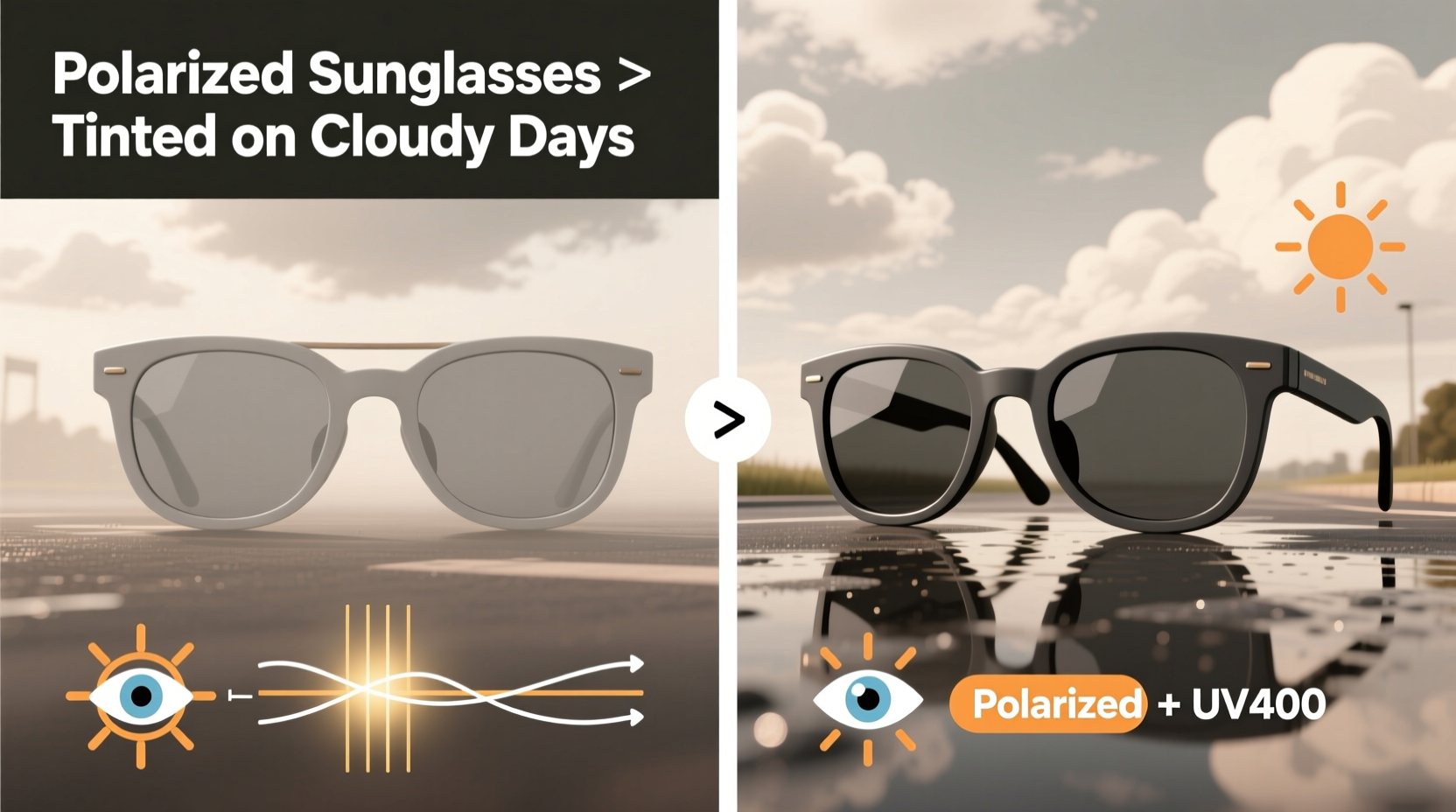
Polarized sunglasses incorporate a special chemical filter applied within the lens material that blocks horizontally oriented light waves—the primary component of surface glare. When sunlight bounces off flat, non-metallic surfaces like roads, water, snow, or glass, it becomes horizontally polarized. Polarizing filters act like microscopic vertical blinds, permitting vertically aligned light to pass while absorbing the disruptive horizontal component.
This selective filtering dramatically improves visual clarity, especially in dynamic weather. On cloudy days, when ambient light is already scattered and contrast is reduced, eliminating glare enhances object definition and depth perception. Drivers report fewer instances of temporary blindness after rain, cyclists notice clearer road textures, and pedestrians find it easier to navigate shiny sidewalks.
Crucially, polarization does not replace UV protection—it complements it. High-quality polarized lenses include UV400 shielding as standard. The combination delivers dual-layer defense: blocking invisible radiation and minimizing visible optical stress caused by glare. According to Dr. Laura Foster, an optometrist specializing in environmental vision, “Polarization is particularly effective in low-contrast situations. It restores natural visual hierarchy, helping the brain process spatial information faster.”
“Even on overcast days, polarized lenses reduce eye strain and improve reaction time by cutting out disorienting reflections.” — Dr. Laura Foster, O.D., Environmental Vision Specialist
Performance Comparison: Tinted vs Polarized on Overcast Days
To evaluate which option offers better eye protection and visual performance in cloudy conditions, consider the following criteria:
| Feature | Tinted Sunglasses | Polarized Sunglasses |
|---|---|---|
| UV Protection | Only if explicitly labeled UV400 | Standard on quality models |
| Glare Reduction | Limited; may worsen glare due to pupil dilation | Highly effective against horizontal reflections |
| Visual Clarity | Moderate; dims entire scene uniformly | Superior; enhances contrast and detail |
| Color Distortion | Varies by tint (e.g., brown warms, gray neutral) | Minimal with premium coatings |
| Driving Safety (wet/cloudy) | Fair; limited improvement in visibility | Excellent; reduces halos and reflection blind spots |
| Eye Strain Reduction | Mild; reduces brightness but not glare | Significant; lowers visual fatigue over time |
The data shows that while basic tinted lenses offer some relief from brightness, polarized lenses deliver comprehensive benefits tailored to the specific challenges of cloudy-day lighting. Their ability to preserve contrast while eliminating blinding reflections gives them a clear edge in both safety and ocular protection.
Real-World Scenario: Commuting in Overcast Rain
Consider Mark, a daily commuter who cycles 12 miles to work through city streets. During a week of persistent drizzle and overcast skies, he alternated between his old tinted sunglasses and a new pair of polarized ones. On Tuesday, wearing tinted lenses, he struggled to see potholes on wet asphalt due to intense glare from streetlights reflecting off puddles. He nearly collided with a curb after misjudging its distance.
On Thursday, using polarized lenses, the same route felt markedly different. Reflections from cars and wet pavement were suppressed, allowing him to clearly distinguish textures and elevation changes. Traffic signals appeared sharper, and his overall eye fatigue decreased despite longer exposure to mixed artificial and natural light. By Friday, he had switched permanently to polarized eyewear—even on fully overcast mornings with no direct sun.
This case illustrates a broader truth: protection isn’t just about blocking UV rays. It’s also about maintaining visual performance under challenging conditions. Polarized lenses support both objectives simultaneously.
Choosing the Right Lens for Cloudy Conditions
Selecting effective sunglasses for overcast days requires attention to technical specifications rather than aesthetics alone. Follow this step-by-step guide to ensure optimal eye protection:
- Verify UV400 protection: Check product labels or manufacturer details to confirm 100% UVA/UVB blockage.
- Opt for medium-tint polarization: Choose lenses with 30–50% VLT (Category 2) and polarization for balanced light control.
- Avoid overly dark lenses: On cloudy days, Category 3 or 4 tints may reduce visibility too much, increasing fall or collision risk.
- Prefer neutral or amber tints: Gray maintains color accuracy; amber boosts contrast in low-light fog or haze.
- Test for polarization: Hold the glasses in front of an LCD screen (phone, laptop). Rotate them 60°. If the screen darkens significantly, polarization is active.
- Inspect lens quality: Look for scratch-resistant, anti-reflective coatings to prevent internal glare.
Common Misconceptions About Sunglass Use
- Myth: “I don’t need sunglasses if it’s not sunny.”
Reality: Up to 80% of UV radiation penetrates clouds. Daily wear prevents cumulative damage. - Myth: “Darker lenses mean better protection.”
Reality: Darkness only affects visible light. UV protection depends on chemical coatings, not tint depth. - Myth: “Polarized lenses are only for beaches or snow.”
Reality: They’re most beneficial in urban and suburban settings where artificial surfaces generate glare.
FAQ: Tinted vs Polarized on Cloudy Days
Do I need polarized sunglasses on a cloudy day?
Yes, especially if you're driving, cycling, or near reflective surfaces. Polarization reduces glare caused by scattered light bouncing off wet roads, vehicles, or buildings, improving safety and visual comfort even without direct sunlight.
Can tinted sunglasses protect my eyes without polarization?
Only if they have UV400 protection. Basic tinting without UV filtering is potentially harmful because it dilates your pupils, letting in more unfiltered UV light. Always prioritize UV protection over aesthetic darkness.
Are there downsides to polarized lenses on cloudy days?
Minor limitations exist: polarization can make it harder to read LCD screens (like gas pumps or ATMs) at certain angles. However, this trade-off is negligible compared to the gains in visual clarity and eye safety during extended outdoor exposure.
Final Recommendation: Prioritize Polarized UV400 Lenses
When comparing tinted versus polarized sunglasses for eye protection on cloudy days, the evidence strongly favors polarized lenses—provided they include UV400 shielding. They address both major threats: invisible UV radiation and visible glare-induced visual fatigue. Tinted lenses, unless specifically engineered with polarization and proper UV blockers, offer incomplete protection and may compromise safety under diffuse lighting.
For anyone spending time outdoors—whether commuting, hiking, running errands, or enjoying leisure activities—investing in quality polarized sunglasses is a proactive step toward preserving long-term eye health. Don’t let overcast skies fool you into skipping protection. Your eyes face real risks every day, and the right eyewear makes all the difference.




 浙公网安备
33010002000092号
浙公网安备
33010002000092号 浙B2-20120091-4
Comments
No comments yet. Why don't you start the discussion?