
As sun protection becomes a non-negotiable part of daily skincare, consumers are faced with more choices than ever. One growing trend is tinted sunscreen—formulas that combine UV defense with a hint of color to even out skin tone. But does the addition of pigment impact its ability to shield against harmful rays? More importantly, can a tinted version truly replace your traditional sunscreen without compromising protection?
The short answer: not inherently. A well-formulated tinted sunscreen can offer the same or even superior protection compared to regular (untinted) versions—if it meets specific criteria. However, the presence of color introduces variables that affect both function and user experience. Understanding these nuances is key to making an informed decision.
How Sunscreen Protection Works: SPF and Broad-Spectrum Basics
Sun Protection Factor (SPF) measures how effectively a product protects against UVB radiation—the primary cause of sunburn and a major contributor to skin cancer. An SPF 30 blocks about 97% of UVB rays; SPF 50 blocks around 98%. However, SPF alone doesn’t tell the full story. Equally important is broad-spectrum coverage, which means protection against UVA rays. These penetrate deeper into the skin, contributing to premature aging, pigmentation, and long-term DNA damage.
Whether a sunscreen is tinted or clear, its protective power depends on:
- The concentration and type of active ingredients (chemical, mineral, or hybrid)
- Application thickness and frequency
- Stability under sunlight (photostability)
- Water resistance
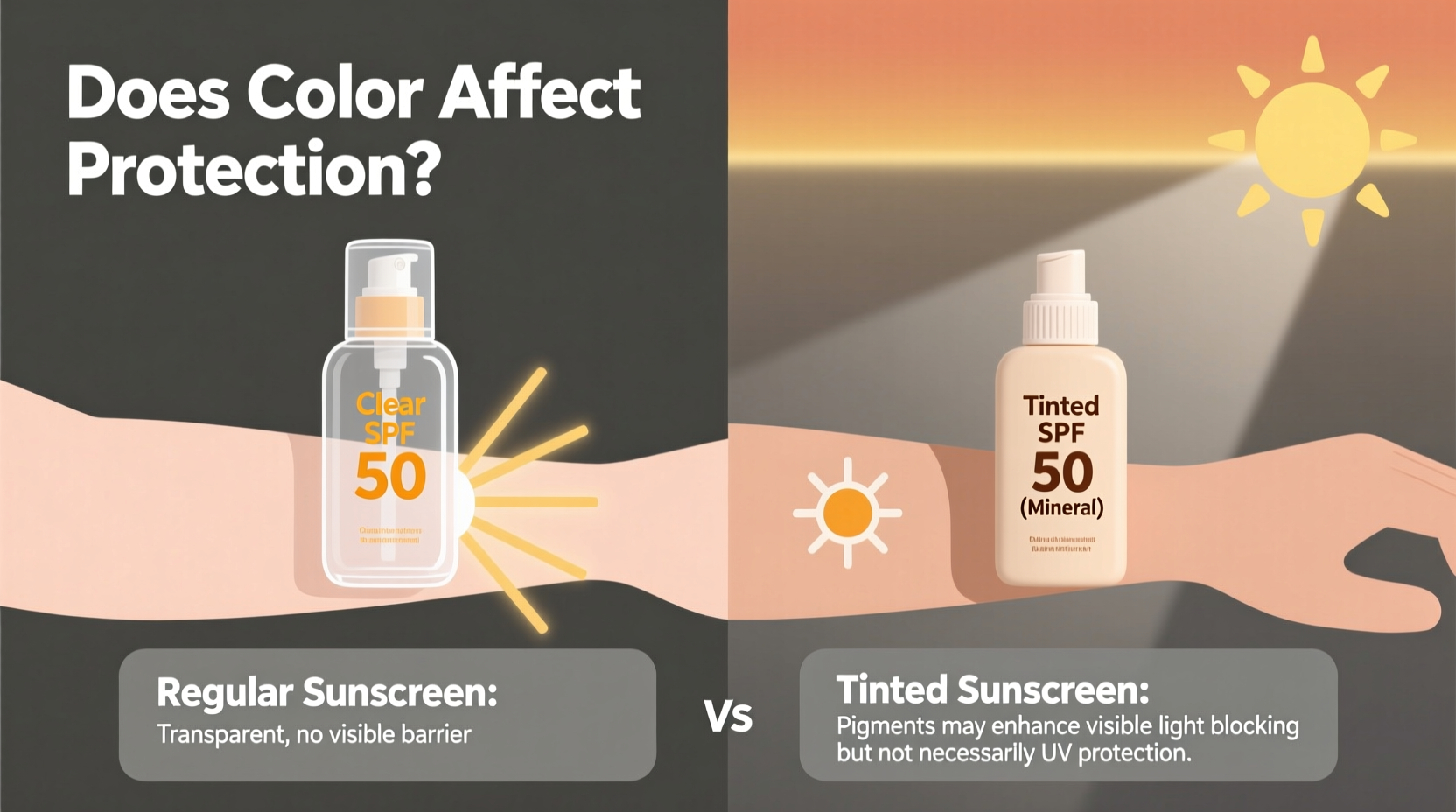
Color additives—typically iron oxides used in tinted sunscreens—do not interfere with UV filters when properly formulated. In fact, they may enhance overall protection, especially against visible light.
Tinted vs. Regular Sunscreen: Key Differences
The fundamental difference between tinted and regular sunscreen lies not in UV protection but in formulation purpose and aesthetic outcome.
| Feature | Tinted Sunscreen | Regular Sunscreen |
|---|---|---|
| Color Additives | Contains iron oxides and pigments to match skin tones | No added color; may leave white cast (especially mineral types) |
| UV Protection | Broad-spectrum, often enhanced by iron oxides blocking visible light | Broad-spectrum if labeled; no inherent visible light protection |
| Finish | Sheer coverage, evens skin tone, reduces redness or discoloration | Clear, gel, or white cast depending on base (mineral vs. chemical) |
| Best For | Daily wear, makeup replacement, melasma-prone or hyperpigmented skin | Layering under makeup, sensitive skin (fragrance-free options), outdoor activities |
| Application Consistency | Easier to see where applied; less likely to miss spots | Can be harder to apply evenly, especially white-cast formulas |
The inclusion of iron oxides in tinted sunscreens adds a layer of defense against high-energy visible (HEV) light—also known as blue light—from the sun and digital screens. This spectrum has been linked to oxidative stress and hyperpigmentation, particularly in individuals with darker skin tones. Regular sunscreens, unless specifically formulated with iron oxides, do not offer this benefit.
Does Color Reduce SPF Effectiveness?
A common misconception is that adding colorants weakens a sunscreen’s efficacy. There is no scientific evidence supporting this claim—provided the product is well-engineered. Reputable brands rigorously test tinted formulations to ensure they deliver the labeled SPF and maintain photostability.
However, issues arise when:
- Pigments are added in excessive amounts, potentially disrupting the uniform dispersion of UV filters
- The formula lacks proper emulsification, leading to uneven protection
- Consumers apply too thinly to avoid a heavy appearance, reducing actual SPF delivery
Dr. Leslie Baumann, a board-certified dermatologist and skincare researcher, emphasizes:
“Tinted sunscreens can be just as effective as untinted ones—if they’re applied correctly. The real issue isn’t the color; it’s whether people use enough product and reapply as needed.” — Dr. Leslie Baumann, Dermatologist & Author, *The Skin Type Solution*
In clinical settings, many dermatologists recommend tinted sunscreens precisely because the visible tint encourages more even and sufficient application. Unlike white cast or invisible lotions, users can see gaps and correct them immediately.
Real-World Example: Managing Melasma with Tinted Protection
Consider Maria, a 38-year-old woman with Fitzpatrick skin type IV who developed melasma during her second pregnancy. Despite using SPF 50 daily, her brown patches worsened over time. Her dermatologist reviewed her routine and discovered she was using a fragrance-free, untinted mineral sunscreen—but skipping it on days she wore makeup, assuming her foundation offered protection.
She was advised to switch to a tinted SPF 50 sunscreen containing zinc oxide and iron oxides. Within three months of consistent morning application—even under makeup—her melasma stabilized. The iron oxides in the tint blocked visible light exposure, while the tint ensured she never skipped application. “I actually enjoy wearing it now,” she reported. “It evens my tone, so I don’t feel like I need heavy concealer.”
This case illustrates that the value of tinted sunscreen extends beyond aesthetics—it can be a functional tool in managing pigmentary disorders exacerbated by light exposure beyond UV.
Choosing the Right Sunscreen: A Practical Checklist
When deciding between tinted and regular sunscreen, consider your skin type, lifestyle, and concerns. Use this checklist to guide your selection:
- Check for broad-spectrum protection – Ensure the label says “broad-spectrum” with SPF 30 or higher.
- Look for iron oxides if you have hyperpigmentation – Especially beneficial for melasma, PIH, or darker skin tones prone to discoloration.
- Match the tint to your skin tone – Swatch on your jawline in natural light. It should blend seamlessly, not appear ashy or orange.
- Assess texture and finish – Tinted sunscreens vary from matte to dewy; choose based on your skin’s oiliness and desired look.
- Reapplication strategy – Tinted formulas can be tricky to reapply over makeup. Consider tinted powders or setting sprays with SPF for touch-ups.
- Mineral vs. chemical filters – Mineral (zinc/titanium) is often preferred in tinted versions for stability and gentleness, but modern chemical filters are also effective and lightweight.
- Avoid fragrance and irritants if sensitive – Some tinted sunscreens include fragrance or essential oils to mask mineral odor—check ingredient lists carefully.
Common Myths About Tinted Sunscreens Debunked
Despite growing popularity, several myths persist:
- Myth: Tinted sunscreens aren’t strong enough for outdoor use.
Reality: Many tinted sunscreens meet water-resistance standards and offer SPF 50+. They’re suitable for daily commutes and moderate sun exposure. - Myth: The tint makes it harder to reapply.
Reality: While challenging over makeup, solutions exist—tinted SPF powders, blot-on sticks, or sheer mists allow midday top-ups without ruining your look. - Myth: All tinted sunscreens leave a gray or orange cast.
Reality: Modern formulations come in multiple shades. Brands like Supergoop!, Colorescience, and Black Girl Sunscreen offer inclusive ranges tailored to diverse complexions.
Step-by-Step Guide: How to Incorporate Tinted Sunscreen Into Your Routine
Maximize protection and cosmetic appeal with this simple integration plan:
- Cleanse and moisturize – Start with a clean face and apply your usual serum or moisturizer. Allow absorption for 1–2 minutes.
- Shake or stir the sunscreen – Pigments can settle; gently mix before use.
- Dispense a nickel-sized amount – Enough to cover face and neck. Don’t skimp.
- Apply evenly – Use fingers or a sponge, starting from the center of the face outward. Blend into hairline and jawline to avoid lines of demarcation.
- Wait 5 minutes before makeup – Ensures proper film formation for optimal UV protection.
- Reapply every two hours if exposed – Use a translucent SPF powder or spray for convenience during the day.
Frequently Asked Questions
Can I use tinted sunscreen under makeup?
Absolutely. Many people use tinted sunscreen as a base layer instead of primer or BB cream. Choose a matte version if you have oily skin to prevent slipping. Let it set for 5 minutes before applying foundation or powder.
Do tinted sunscreens work for dark skin tones?
Yes, but shade availability varies by brand. Look for inclusive lines such as Black Girl Sunscreen, Bolden, or Epara, which formulate tints specifically for deeper complexions without ashiness or orange casts.
Is tinted sunscreen better than regular?
Not universally. It’s better for those seeking light coverage, managing pigmentation, or wanting protection against visible light. Regular sunscreen may be preferable for sports, high sweat environments, or if you prefer layering under heavy makeup.
Final Thoughts: Protection First, Color Second
The choice between tinted and regular sunscreen shouldn’t come down to aesthetics alone. Both can deliver excellent UV protection when used correctly. What sets tinted versions apart is their added defense against visible light and their ability to improve user compliance through cosmetic elegance.
Ultimately, the best sunscreen is the one you’ll use consistently and generously. For many, the subtle color correction and confidence boost of a tinted formula make daily sun protection feel less like a chore and more like a seamless part of self-care.




 浙公网安备
33010002000092号
浙公网安备
33010002000092号 浙B2-20120091-4
Comments
No comments yet. Why don't you start the discussion?