
Building blocks have long been a staple of childhood development and creative expression. From simple wooden cubes to interlocking plastic bricks, the world of construction toys is vast and varied. Recently, a niche but growing category has emerged: \"Titanic in a bottle\" building blocks—kits designed to assemble intricate models inside sealed glass containers. These kits promise a unique challenge, but many parents, educators, and adult hobbyists wonder: are they actually fun to play with compared to traditional building blocks?
The answer isn’t straightforward. While both types engage spatial reasoning and fine motor skills, their purpose, experience, and long-term enjoyment differ significantly. Understanding these differences helps determine which type suits your goals—whether it’s open-ended creativity, educational value, or the satisfaction of completing a precise model.
What Are \"Titanic in a Bottle\" Building Blocks?
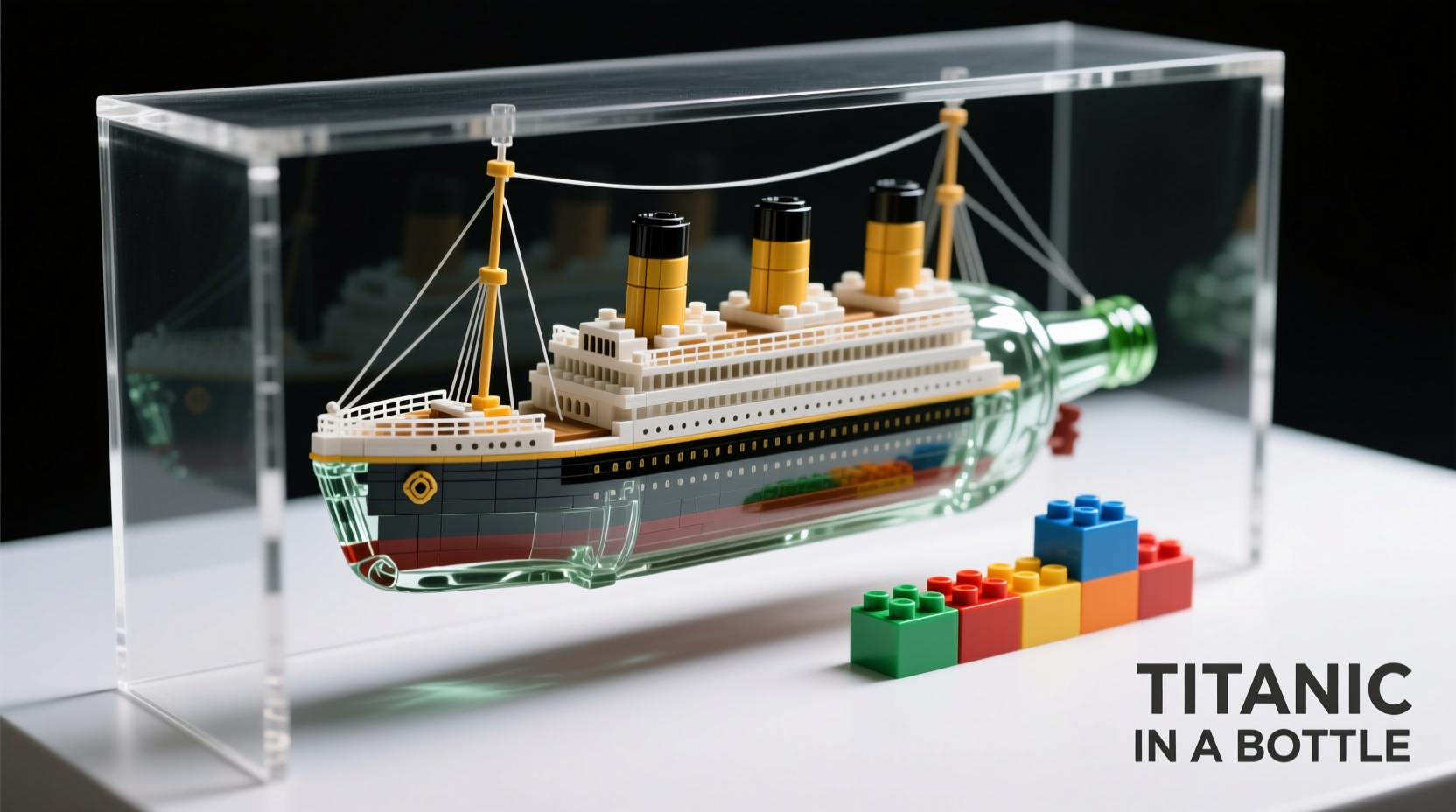
\"Titanic in a bottle\" refers to a style of model-building kit where users construct a detailed miniature structure—often a ship, house, or landmark—inside a transparent glass or acrylic container. The name draws from the classic art of ship-in-a-bottle craftsmanship, where model ships are assembled mast-first through a narrow neck using specialized tools.
Modern versions use pre-cut wooden or plastic pieces, glue, and micro-tools to build inside the enclosed space. Unlike traditional LEGO or magnetic tiles, these kits are not meant to be disassembled or repurposed. They are display-oriented, often marketed as decorative items or gifts for puzzle enthusiasts.
Popular brands like Wood Trick, Wrebbit 3D, and Great American Puzzle offer such kits, some requiring over 100 steps and several hours to complete. The appeal lies in precision, patience, and the visual payoff of a finished piece displayed under glass.
Regular Building Blocks: Open-Ended Creativity
Traditional building blocks—such as LEGO, Mega Bloks, Tegu, or unit blocks—emphasize open-ended play. Children (and adults) can build, dismantle, and rebuild endlessly. This flexibility fosters creativity, problem-solving, and storytelling. A single set can become a castle, spaceship, or robot depending on the day’s imagination.
These toys are developmentally rich. According to Dr. Doris Bergen, a developmental psychologist specializing in play, “Construction play supports cognitive growth, language development, and social cooperation.” The ability to experiment without fear of failure encourages risk-taking and iterative learning.
Moreover, regular blocks promote collaborative play. Siblings or classmates can work together on large builds, negotiate design choices, and troubleshoot structural issues—skills that translate well beyond the playroom.
“Open-ended materials like blocks allow children to express ideas, test theories, and develop executive function through self-directed play.” — Dr. Laura Jana, Pediatrician and Early Learning Advocate
Comparing Fun: Challenge vs. Freedom
Fun is subjective, especially in play. For some, fun comes from mastery and completion; for others, it stems from freedom and improvisation. Here's how the two block types compare across key dimensions:
| Feature | Titanic in a Bottle | Regular Building Blocks |
|---|---|---|
| Creativity | Limited to instructions | Unlimited, open-ended |
| Challenge Level | High (precision, fine motor) | Adjustable (by complexity) |
| Replayability | Low (single-use build) | High (rebuilds infinite) |
| Display Value | High (decorative finish) | Low (usually temporary) |
| Skill Development | Fine motor, focus, patience | Spatial reasoning, collaboration, innovation |
| Audience | Teens & adults | Children to adults |
The table reveals a clear trade-off: Titanic-style kits offer a rewarding challenge and a permanent artifact, while regular blocks prioritize process over product. One is a puzzle; the other is a playground.
Real Example: Emma’s Weekend Build
Emma, a 34-year-old architect and mother of two, purchased a Titanic-in-a-bottle model as a weekend project. She spent six hours over two days assembling a detailed lighthouse inside a glass cylinder. “It was meditative,” she said. “I had to slow down, read every step, and use tools I’d never touched before. I loved seeing it on my shelf afterward.”
But when her 7-year-old son asked to play with it, she hesitated. “It’s fragile. He’d want to take it apart, add dinosaurs, maybe knock it over. That’s not what this is for.” Instead, they built a roller coaster from his LEGO set later that evening—messy, loud, and full of laughter.
Both experiences were fulfilling but in different ways. Her build satisfied a need for focused accomplishment; theirs fulfilled a need for shared imagination.
Step-by-Step: Choosing the Right Type for You
Not sure which type of building block suits your needs? Follow this decision guide:
- Define your goal: Are you seeking relaxation, decoration, education, or entertainment?
- Consider the user: Is this for a child, teen, adult, or group?
- Evaluate space: Do you have room for ongoing builds, or do you prefer compact displays?
- Assess skill level: Does the user enjoy detailed instructions or prefer freeform creation?
- Budget for longevity: Will the toy be used repeatedly, or is it a one-time project?
If the goal is display, focus, or a gift for a detail-oriented person, go for a Titanic-style kit. If the goal is play, learning, or family bonding, choose regular building blocks.
Checklist: Before Buying Any Building Kit
- ✅ Read age and skill recommendations
- ✅ Check reviews for clarity of instructions
- ✅ Ensure all pieces are included (especially tiny ones)
- ✅ Verify tool requirements (tweezers, glue, etc.)
- ✅ Consider storage and display options post-build
- ✅ For kids: assess choking hazards and supervision needs
- ✅ Ask: Can this be rebuilt or repurposed?
Are They Even Fun? A Balanced Verdict
Yes—but differently. Titanic in a bottle building blocks are fun for those who enjoy puzzles, craftsmanship, and tangible results. The fun lies in the journey of meticulous assembly and the pride of a polished display. However, they lack the dynamic, evolving engagement of regular blocks.
Regular building blocks remain unmatched in fostering creativity, adaptability, and social interaction. Their enduring popularity across generations speaks to their universal appeal. They’re not just toys—they’re tools for thinking.
Ultimately, neither is superior. They serve different purposes. Think of Titanic kits as the equivalent of a crossword or jigsaw puzzle: satisfying to complete, best done solo or quietly. Regular blocks are more like a blank canvas or musical instrument—always ready for new expressions.
FAQ
Can kids use Titanic in a bottle building kits?
Some kits are labeled for ages 14+, due to small parts and complex steps. Younger children may struggle without constant supervision. Simpler versions exist, but they still require patience and fine motor control.
Are Titanic-style models worth the price?
If you value display artistry and the process of detailed building, yes. Most range from $30–$80. They’re comparable in cost to high-end puzzles and often last indefinitely as decor.
Can you combine Titanic builds with regular blocks?
Not directly—the sealed bottle prevents integration. However, some creators photograph their completed models alongside LEGO scenes for imaginative storytelling.
Conclusion
Whether Titanic in a bottle building blocks are fun depends entirely on what you seek from play. For quiet focus and artistic satisfaction, they deliver. For endless invention and shared joy, traditional building blocks reign supreme. The smart choice? Own both. Let precision meet possibility. Let display meet destruction. After all, true creativity thrives not in choosing one path, but in embracing many.




 浙公网安备
33010002000092号
浙公网安备
33010002000092号 浙B2-20120091-4
Comments
No comments yet. Why don't you start the discussion?