
When time is limited, every minute of exercise counts. For those aiming to maximize calorie burn in a short window—whether it’s 15, 20, or 30 minutes—the choice between a treadmill and an elliptical can significantly impact results. Both machines are staples in gyms and home setups, offering cardiovascular benefits, but they differ in intensity, biomechanics, and energy expenditure. Understanding these differences helps you make smarter decisions based on your fitness goals, physical condition, and available time.
This article breaks down the science behind calorie burn on treadmills and ellipticals during brief sessions. It includes data-driven comparisons, real-world examples, and practical strategies to help you get the most out of your workout—no matter which machine you choose.
How Calorie Burn Is Measured
Calories burned during exercise depend on several variables: body weight, workout intensity, duration, age, gender, and fitness level. The primary metric used to estimate energy expenditure is MET (Metabolic Equivalent of Task), which compares the energy cost of physical activity to rest. One MET equals the energy used while sitting quietly.
For example:
- Walking at 3 mph = ~3.5 METs
- Running at 6 mph = ~9.8 METs
- Elliptical training at moderate effort = ~5–7 METs
The formula for estimating calories burned per minute is:
( MET × 3.5 × body weight in kg ) / 200
A 155-pound (70 kg) person running at 6 mph (9.8 METs) would burn approximately 12 calories per minute. The same person using an elliptical at moderate resistance (6 METs) would burn about 7.3 calories per minute. That difference adds up quickly over a 20-minute session—nearly 100 extra calories with running.
Direct Comparison: Treadmill vs Elliptical in Short Workouts
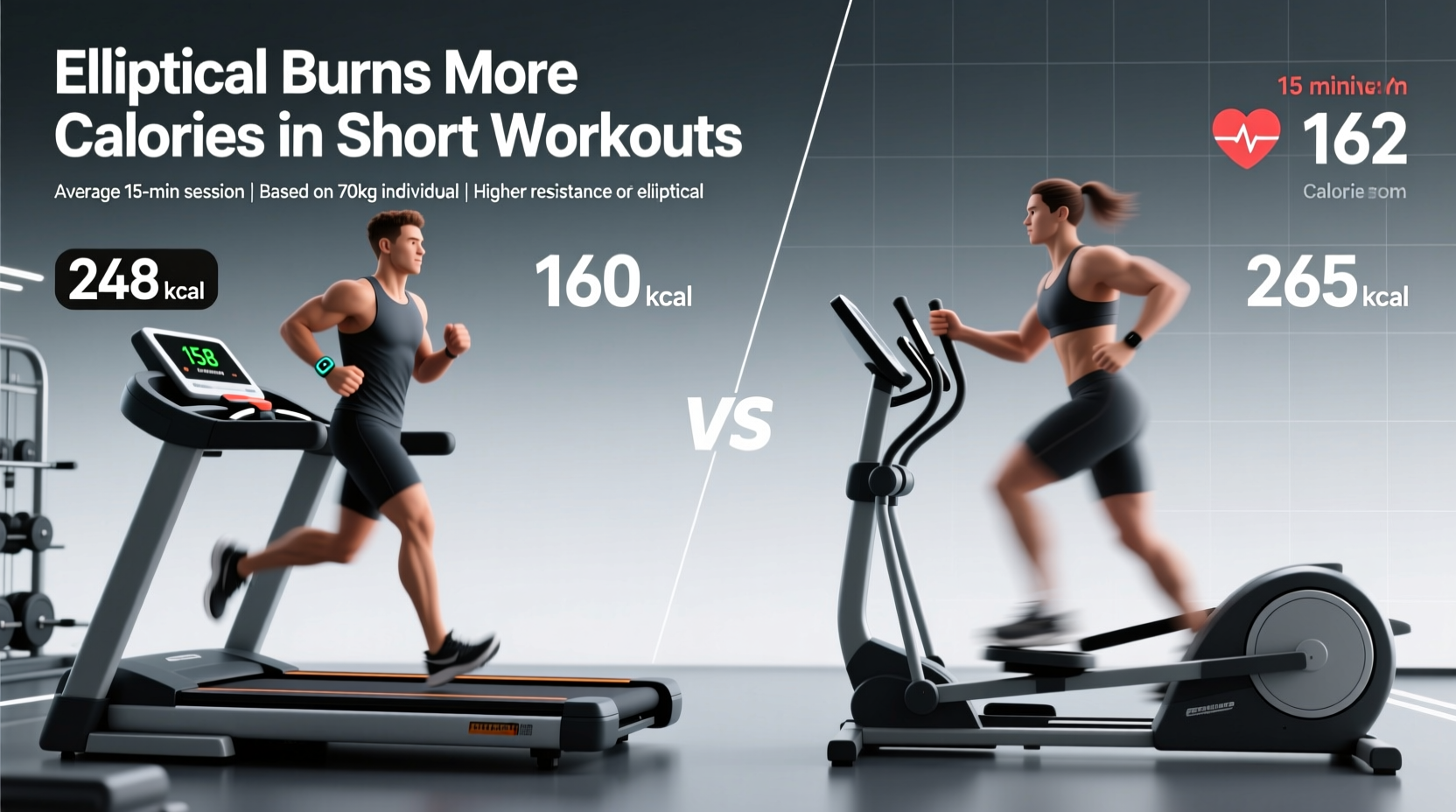
In general, treadmills tend to burn more calories than ellipticals during equivalent time periods, especially when higher intensities like running or incline walking are involved. This is due to greater muscle recruitment, impact forces, and overall metabolic demand.
To illustrate, here's a side-by-side comparison for a 20-minute workout:
| MACHINE | ACTIVITY | INTENSITY | CALORIES (155 lb / 70 kg) | CALORIES (185 lb / 84 kg) |
|---|---|---|---|---|
| Treadmill | Running 6 mph | High | 240 | 288 |
| Treadmill | Walking 3.5 mph + 6% incline | Moderate-High | 180 | 216 |
| Elliptical | General use, moderate resistance | Moderate | 146 | 175 |
| Elliptical | Interval training with arms & legs | High | 180–200 | 216–240 |
Data sourced from the American Council on Exercise (ACE) and Harvard Medical School studies on energy expenditure.
As shown, even high-effort elliptical training rarely surpasses steady-state running on a treadmill in total calorie output. However, the gap narrows when users push intensity on the elliptical through intervals, increased resistance, and full-body engagement.
Maximizing Results in Under 30 Minutes
Short workouts require strategic planning to achieve meaningful calorie expenditure. The key isn’t just choosing the right machine—it’s how you use it.
Here’s a proven approach to optimize either machine for rapid fat burning:
- Warm Up Efficiently (3–5 min): Light jogging or fast stepping prepares your heart and muscles without wasting time.
- Use High-Intensity Intervals (HIIT): Alternate 30–60 seconds of max effort with equal or slightly longer recovery periods.
- Engage Full Body: On treadmills, pump arms; on ellipticals, actively push and pull handles.
- Incorporate Incline or Resistance: Even small increases force more work from large muscle groups.
- Cool Down Briefly (2–3 min): Prevent dizziness and support recovery without cutting into productivity.
Example HIIT protocol (20 minutes):
- Min 0–3: Warm-up jog at 4 mph
- Min 3–18: 10 rounds of 1-min sprint (6.5–8 mph) / 1-min walk (3.5 mph)
- Min 18–20: Cool down at 3 mph
This type of routine can elevate post-exercise oxygen consumption (EPOC), meaning you continue burning calories after the workout ends—a phenomenon often called the “afterburn effect.”
Real Example: Sarah’s Morning Routine
Sarah, a 32-year-old office worker, has only 25 minutes each morning before her kids wake up. She alternates between treadmill sprints and elliptical intervals throughout the week. On treadmill days, she follows a 20-minute HIIT plan similar to the one above and consistently logs around 230 calories burned. On elliptical days, even with aggressive resistance and arm movement, her tracker shows 170–185 calories.
Over six weeks, she noticed faster improvements in stamina and waistline reduction on treadmill days. However, she preferred the elliptical on mornings when her knees felt stiff—appreciating its low-impact nature despite lower calorie totals.
Her takeaway? The treadmill delivered better fat-burning results in minimal time, but the elliptical served as a sustainable alternative when joint comfort was a priority.
Expert Insight: What Fitness Professionals Say
Dr. Lena Torres, exercise physiologist and certified strength coach, explains:
“Treadmills typically generate higher caloric expenditure because running involves ballistic movements—lifting your body off the ground repeatedly. That requires more energy than the smooth, gliding motion of an elliptical. But if someone can't tolerate impact due to injury or mobility issues, a properly programmed elliptical workout with upper-body involvement can still deliver excellent cardiovascular and metabolic benefits.” — Dr. Lena Torres, PhD, Exercise Physiology
She emphasizes that perceived exertion matters. Some people feel they’re working harder on the elliptical due to continuous motion and resistance, even if objective calorie counts are lower. Matching effort to measurable outcomes is crucial for progress tracking.
Choosing Based on Individual Needs
While treadmills generally win in raw calorie-burning potential, the best machine depends on personal circumstances:
- Choose the treadmill if: You're healthy, want maximum calorie burn, enjoy running or brisk walking, and have no joint concerns.
- Choose the elliptical if: You need low-impact options, have knee or hip sensitivities, want balanced upper-lower body engagement, or prefer consistent rhythm over explosive effort.
Additionally, adherence plays a role. If you dread the treadmill and skip workouts, a machine that keeps you consistent—even if slightly less efficient—is ultimately more effective long-term.
Checklist: How to Pick the Right Machine for Short Workouts
- ☐ Assess any joint pain or mobility restrictions
- ☐ Determine your preferred exercise style (rhythmic vs. dynamic)
- ☐ Test both machines at high intensity for 10 minutes
- ☐ Compare heart rate response and RPE (Rate of Perceived Exertion)
- ☐ Use a fitness tracker to log actual calories burned
- ☐ Prioritize consistency—choose the machine you’ll actually use
Frequently Asked Questions
Can I burn the same calories on an elliptical as on a treadmill?
Possibly, but only under specific conditions: very high resistance, full-body motion, and near-maximal effort. Most users don’t reach this level consistently. For average exercisers, treadmills burn 20–30% more calories in the same timeframe.
Is the elliptical useless for weight loss?
No. While less intense than running, the elliptical supports steady fat loss when used regularly and combined with proper nutrition. It’s particularly valuable for beginners, injured individuals, or those building endurance gradually.
Does incline walking beat elliptical training?
Yes, in most cases. Walking at 3.5–4 mph with a 6–10% incline activates glutes, hamstrings, and calves intensely, increasing energy demand beyond typical elliptical use. It also mimics hill climbing, a natural calorie-burning activity.
Final Verdict: Which Should You Choose?
If your sole goal is maximizing calorie burn in under 30 minutes, the treadmill holds a clear advantage—especially when used for running or steep incline walking. Its ability to generate high MET values quickly makes it ideal for time-crunched individuals seeking rapid metabolic returns.
However, the elliptical shouldn’t be dismissed. With smart programming—intervals, resistance changes, and upper-body drive—it becomes a potent tool for cardiovascular conditioning and moderate fat burning, all while protecting joints. For many, this trade-off is worth it.
The truth is, the “best” machine isn’t determined by averages or charts alone. It’s the one you can use safely, intensely, and consistently. Combine that with structured interval training, and you’ll turn even the shortest sessions into powerful fat-burning opportunities.




 浙公网安备
33010002000092号
浙公网安备
33010002000092号 浙B2-20120091-4
Comments
No comments yet. Why don't you start the discussion?