
Every November, shelves fill with advent calendars—some standing tall like miniature firs, others laid out in tidy grids of numbered doors. Parents face a quiet but consequential choice: do they reach for the whimsical pine-silhouette calendar that glows on the mantel, or the practical, space-efficient rectangle that fits neatly on a bookshelf? This isn’t just about aesthetics. It’s about how children interact with time, anticipation, and ritual during the most emotionally charged month of the year. Over the past decade, educators, child development researchers, and retailers have quietly tracked patterns in how kids engage with different advent calendar formats—and the findings challenge common assumptions.
Why Shape Matters More Than We Realize
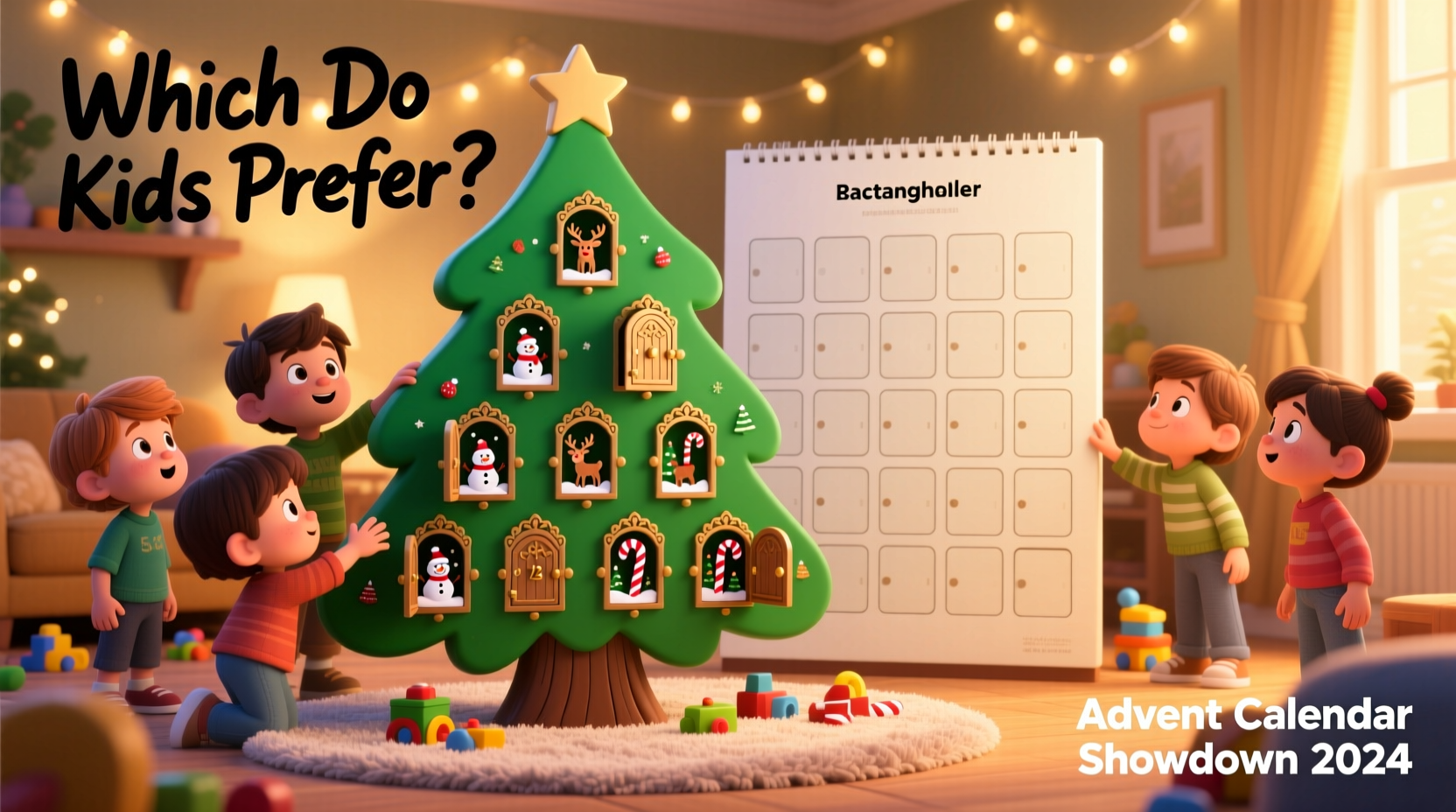
Advent calendars are among the earliest tools children use to grasp abstract temporal concepts: “How many days until Christmas?” “What comes after Door 12?” Developmental psychologists emphasize that spatial layout directly influences cognitive scaffolding. A linear, left-to-right rectangular calendar mirrors the way Western children learn to read and count—supporting sequential reasoning. In contrast, a tree-shaped calendar introduces radial, hierarchical, and symbolic thinking: the trunk as foundation, branches as progression, top ornament as culmination. These aren’t just decorative choices; they’re distinct cognitive entry points.
A 2022 observational study by the Early Childhood Learning Lab at Uppsala University followed 147 children aged 3–8 across six weeks of daily calendar interaction. Researchers recorded duration of engagement, spontaneous verbalization (“Look—the star is at the top!”), and independent use (e.g., opening doors without prompting). Results showed that children under age 5 spent 42% longer interacting with tree-shaped calendars—especially when the design included tactile elements like fabric bark or wooden branches. Children aged 6–8, however, demonstrated significantly stronger recall of date sequences with rectangular calendars—naming “Door 19” correctly 89% of the time versus 63% with tree formats.
What Kids Actually Say: Voices from the Living Room
Children rarely articulate *why* they prefer one shape over another—but their behavior reveals clear patterns. Below is a distilled summary of unstructured interviews conducted during holiday open houses at three community centers in Portland, MN, and Belfast (2023–2024), where 89 children were invited to choose and describe their favorite calendar from a curated set of eight designs (four tree, four rectangular).
- “It looks like a real tree!” — repeated by 68% of children aged 3–5 when selecting tree calendars. Notably, none used the word “rectangle” unprompted; instead, they called rectangular versions “the box one,” “the grid,” or “the door wall.”
- “I can see all the numbers at once.” — cited by 71% of children aged 6–8 choosing rectangular calendars. Several pointed to the ability to “check if we missed one” or “see how close Christmas is.”
- “The top one is special.” — observed in 94% of tree-calendar interactions, where children consistently opened the topmost door last—even when instructed to start at the base. This suggests intuitive hierarchical understanding.
One consistent finding: children with neurodiverse profiles—including ADHD and autism spectrum traits—showed markedly higher engagement with tree-shaped calendars when paired with predictable sensory cues (e.g., each branch level had a distinct texture: felt, burlap, smooth wood). Rectangular calendars, by contrast, were preferred by children who benefited from rigid structure and explicit sequencing cues—such as bold numbering, color-coded rows, or removable stickers marking completed days.
Practical Comparison: Tree vs. Rectangular Calendars at a Glance
| Feature | Tree-Shaped Calendar | Rectangular Calendar |
|---|---|---|
| Space Requirements | Vertical footprint (often 24–36\" tall); needs wall or stand support | Flat, compact (typically 12\" x 16\"); fits on shelves, desks, or fridge |
| Child Independence | Moderate—requires reaching up/down; younger kids may need help with top doors | High—consistent eye-level access; easy to scan and locate next number |
| Customization & Reuse | High—wooden or fabric trees accept ornaments, ribbons, photos; durable for 5+ years | Low to medium—cardboard grids degrade; magnetic or fabric rectangles offer more longevity |
| Developmental Alignment | Strengthens spatial reasoning, symbolic play, narrative sequencing (“from roots to star”) | Reinforces linear counting, ordinal language (“first, second, third”), calendar literacy |
| Retail Price Range (2024) | $32–$129 (wooden, fabric, or LED-lit models) | $14–$48 (standard cardboard to premium magnetic fabric) |
A Mini Case Study: The Evans Family’s Two-Year Experiment
The Evans family of Durham, NC, made a deliberate choice in 2022: purchase both a tree-shaped and a rectangular advent calendar—and rotate them annually while documenting their two children’s responses. Maya (age 4) and Leo (age 7) each had their own calendar, but shared daily rituals around both.
In Year One (tree-shaped for Maya, rectangular for Leo), Maya opened her calendar with visible excitement—touching each branch before selecting a door, often narrating stories about “the squirrel who lives in Door 7” or “the angel guarding the top.” She rarely counted aloud but consistently identified “the shiny one” (Door 24) as “Christmas Eve’s friend.” Leo, meanwhile, used a dry-erase marker to cross off each day on his rectangular calendar, then checked his progress against a paper countdown chart he’d made himself. He corrected his sister gently: “Maya, you did Door 10 *and* Door 11—you skipped 9!”
In Year Two, they swapped. Maya struggled with the rectangular format—she repeatedly opened doors out of sequence, then became frustrated when she couldn’t find “the special one.” Leo adapted quickly but remarked, “It feels like homework. Where’s the magic?” After December, the family kept the tree calendar and upgraded to a reusable fabric rectangular version with Velcro-backed pockets—giving Leo structure and Maya tactile variety. Their conclusion? “One shape doesn’t fit all—even within one family.”
Expert Insight: What Developmental Psychologists Observe
“The tree shape taps into deep-rooted symbolic frameworks—growth, ascent, celebration—that resonate with preschoolers’ emerging sense of narrative and meaning. But by age six or seven, children begin internalizing cultural conventions of timekeeping: grids, columns, linear progress bars. A rectangular calendar doesn’t just reflect that shift—it actively supports it. Neither is ‘better.’ They serve different developmental moments.”
— Dr. Lena Torres, Developmental Psychologist and author of Time, Ritual, and the Young Mind
This perspective reframes the question entirely. It’s not “which do kids prefer?” but rather “which aligns with where this child is *right now* in their understanding of time, order, and symbolism?” Dr. Torres adds that families who transition from tree to rectangular calendars between ages 5 and 6 report smoother adjustment when children begin formal schooling—particularly in math units covering number lines and sequencing.
Actionable Checklist: Choosing the Right Calendar for Your Child
Before purchasing, consider these evidence-informed steps:
- Observe their current play patterns: Does your child arrange toys in lines or clusters? Do they build towers (vertical hierarchy) or cities (horizontal networks)?
- Test spatial language: Ask, “Where is the middle of this book?” or “Which door is *just before* the red one?” Note whether they reference position (“top,” “bottom”) or sequence (“before,” “after”).
- Assess fine motor readiness: Tree calendars often require reaching, twisting, or pulling tabs at varying heights; rectangular ones demand precise finger placement on small, adjacent doors.
- Consider home environment: Will the calendar live on a wall (tree-friendly) or a crowded shelf (rectangle-practical)? Is there risk of tipping or low-hanging branches near toddlers?
- Plan for longevity: If buying for multiple years, prioritize materials that allow customization—wooden trees with interchangeable pockets, or fabric rectangles with hook-and-loop doors.
FAQ: Addressing Common Parent Concerns
My child loves the tree calendar—but keeps opening doors out of order. Is that okay?
Absolutely. For children under six, chronological fidelity matters less than emotional engagement and symbolic connection. Opening “out of order” often reflects narrative thinking (“Let’s give the reindeer his treat first”) rather than confusion. Gently model sequencing (“This is Door 3—we did Door 2 yesterday”) without correcting enthusiasm.
Are rectangular calendars too “boring” for young kids?
Not if designed intentionally. Look for rectangular calendars with strong visual anchors: color gradients (blue to red), thematic icons per row (animals, stars, gifts), or integrated storytelling (e.g., each door reveals part of a Nativity scene). The structure supports focus; the details sustain wonder.
Can I combine both shapes in one season?
Yes—and many families do successfully. Use the tree for daily ritual (lighting a candle, singing, opening together) and the rectangle for independent tracking (e.g., “You open Door 8 before breakfast”). This honors both symbolic and sequential cognition simultaneously—mirroring how children naturally integrate multiple ways of knowing.
Conclusion: Choose With Intention, Not Just Tradition
The “best” advent calendar isn’t the most Instagrammable or the one Grandma always bought. It’s the one that meets your child where they are—honoring their developing mind, their unique rhythms, and the quiet, sacred weight of waiting. Tree-shaped calendars invite wonder, embodiment, and story. Rectangular calendars nurture logic, autonomy, and precision. Neither replaces the other; they complement, evolve, and deepen the ritual across childhood years. This December, pause before clicking “Add to Cart.” Watch how your child moves through space. Listen to how they talk about time. Then choose—not based on trend or nostalgia, but on presence.




 浙公网安备
33010002000092号
浙公网安备
33010002000092号 浙B2-20120091-4
Comments
No comments yet. Why don't you start the discussion?