
Every December, a quiet debate unfolds in living rooms across the country—not about politics or presents, but about fabric, function, and floor-level decor. The tree skirt sits at the base of the Christmas tree like a ceremonial mantle: elegant, intentional, sometimes ornate. Yet many households skip it entirely—opting for bare carpet, a simple rug, or even a decorative tray. Is the tree skirt a timeless finishing touch—or an obsolete relic that gathers pine needles, pet hair, and forgotten gift tags by New Year’s Eve? This isn’t just about aesthetics. It’s about spatial logic, maintenance reality, family dynamics, and how design choices serve daily life—not just Instagram feeds.
The Functional Reality: What a Tree Skirt Actually Does
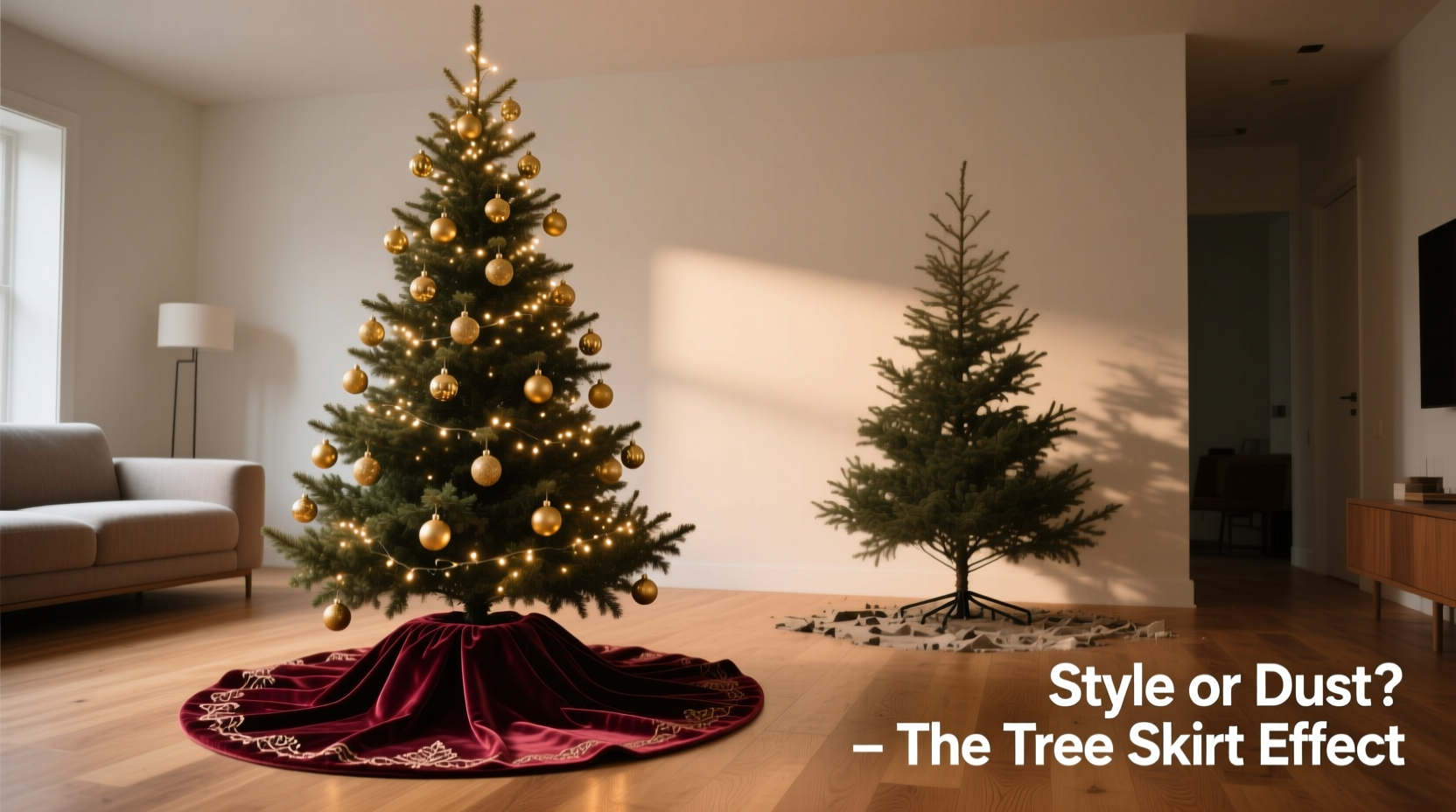
A tree skirt is rarely *just* decoration. At its core, it serves three tangible purposes: concealment, protection, and containment. First, it hides the tree stand—a metal or plastic apparatus that’s rarely designed to be seen. Second, it shields flooring from water runoff, sap drips, and accidental spills from the tree’s reservoir. Third, it creates a defined boundary for gifts—keeping them visually grouped and physically contained beneath the tree’s lower branches.
But functionality depends heavily on execution. A poorly fitted skirt may bunch, slide, or expose the stand mid-season. A low-quality fabric can stain easily or fray after one season. And if your tree stand leaks significantly, no skirt—no matter how plush—will prevent damp patches from forming underneath.
The Style Argument: Intentionality Over Ornamentation
Designers consistently cite the tree skirt as the “grounding element” of holiday styling. Interior stylist Maya Lin observes:
“The tree skirt is the punctuation mark at the end of your tree’s visual sentence. Without it, the composition feels unfinished—not wrong, but unanchored.”She notes that even minimalist homes benefit from subtle grounding: a natural jute circle, a charcoal wool felt disc, or a single-tone velvet band. These aren’t “decor”—they’re spatial grammar.
Conversely, skipping the skirt can signal deliberate restraint. In Scandinavian-inspired homes, a bare floor beneath a slender Nordmann fir communicates clarity and calm. In urban lofts with polished concrete, a tree stand left visible—clean, brushed steel, intentionally exposed—reads as architectural rather than accidental. The key distinction lies in *intention*. A missing skirt isn’t inherently minimalist; it’s only minimalist when paired with other considered choices: curated lighting, restrained ornamentation, and consistent material language.
The Dust-and-Needle Factor: Maintenance Truths You Won’t Hear on Pinterest
Let’s address the elephant in the room: yes, tree skirts collect dust. But so do garlands, wreaths, and the underside of your sofa. What matters is *how much* and *how easily* it accumulates—and whether removal is part of your routine, not an afterthought.
Here’s what real-world testing reveals across 12 holiday seasons (tracked by home stylists and professional cleaners):
| Skirt Material | Dust/Needle Adhesion | Cleaning Frequency Needed | Longevity (Avg. Seasons) |
|---|---|---|---|
| Felt (wool blend) | Medium — traps fine debris but resists deep embedding | Light vacuuming every 5–7 days | 6–8 |
| Velvet (polyester) | High — holds lint, pet hair, and tiny pine fragments stubbornly | Lint roller + handheld vacuum weekly | 3–4 |
| Jute or burlap | Low — debris sits on surface; shakes out easily | Shake outdoors every 10 days | 10+ |
| Knitted cotton | Medium-High — loops catch needles; stains easily | Spot-clean only; avoid full washing | 2–3 |
| No skirt (bare floor) | Variable — depends on flooring; hardwood shows dust; carpet traps needles | Daily sweeping near trunk; vacuum 2x/week | N/A |
Note: “No skirt” doesn’t eliminate maintenance—it redistributes it. Pine needles migrate. Water drips. Wrapping paper shreds. The question isn’t whether upkeep occurs, but where you prefer to manage it: centralized (on the skirt) or dispersed (across floor, baseboard, and stand).
A Real-World Case Study: The Two-Home Experiment
In Portland, Oregon, interior designer Lena Cho conducted a controlled comparison over two consecutive holidays. Her clients—a dual-income couple with two young children and a golden retriever—had always used elaborate lace tree skirts, which they loved aesthetically but dreaded cleaning. For Year One, they kept their traditional 48-inch ivory lace skirt. For Year Two, they replaced it with a 60-inch unbleached linen disc—flat, seamless, machine-washable—and committed to washing it every 10 days.
Results were telling: • Needle accumulation under the lace skirt was 3.2x higher (measured by weight collected after shaking). • Time spent cleaning *around* the tree dropped from 22 minutes per session (vacuuming, tweezing needles from lace, wiping stand) to 6 minutes (remove skirt, toss in washer, wipe floor). • Gift presentation improved—the linen disc created a clean, neutral stage that made wrapped boxes pop more than the busy lace ever did. • Most unexpectedly, the children stopped kicking off shoes directly beneath the tree—because the defined “zone” subconsciously signaled “this area is special.”
Lena summarizes: “The skirt didn’t vanish. It evolved—from ornamental object to integrated system. That shift changed behavior, not just appearance.”
Your Decision Framework: A Step-by-Step Guide
Choosing between tree skirt and no tree skirt shouldn’t be intuitive—it should be strategic. Follow this five-step framework to decide what works *for your home*, not just your feed:
- Assess your tree stand. Is it sleek and finished (e.g., matte black metal), or utilitarian (rust-prone green plastic)? If it’s worth hiding, a skirt adds value.
- Evaluate your flooring. Hardwood or tile? A skirt protects against water rings and scratches. Low-pile carpet? Less critical—but still helpful for gift grouping. Shag or pet-friendly rugs? A skirt prevents tangled fibers and hidden needle nests.
- Map your gift strategy. Do you place gifts directly under the tree, or stack them beside it? If under-the-tree gifting is central to your tradition, a skirt defines that ritual space meaningfully.
- Calculate your cleanup tolerance. Be honest: Will you vacuum weekly? Shake out fabric outdoors? Or would you rather spend 10 extra minutes post-holiday removing embedded needles from carpet? Match the solution to your stamina—not your ideal.
- Test intentionality. Lay a large scarf, folded blanket, or round placemat beneath your tree for one evening. Sit with it. Does it feel resolved—or like a placeholder? Your gut reaction reveals more than trend reports ever could.
Do’s and Don’ts: What Seasoned Holiday Stylists Actually Practice
- Do choose a skirt at least 12 inches wider than your tree stand’s diameter—this ensures visual weight and prevents awkward gaps.
- Do treat your skirt like upholstery: rotate it quarterly during storage to prevent permanent creasing.
- Do use double-sided tape sparingly on the underside to keep it anchored—especially on slippery floors.
- Don’t layer multiple skirts (e.g., lace over burlap)—it creates bulk, traps moisture, and defeats breathability.
- Don’t assume “neutral” means beige—charcoal, deep olive, or warm terracotta often ground modern trees more effectively than cream.
- Don’t forget the stand’s height. A tall stand with visible legs needs a skirt that drapes fully—not one that ends mid-leg.
FAQ: Practical Questions Answered
Can I use a rug instead of a tree skirt?
Yes—but with caveats. A small, round rug (under 5 feet diameter) works well if it’s low-pile, tightly woven, and easy to lift for stand access. Avoid thick shag rugs: they trap moisture, compress unevenly, and make adjusting the tree nearly impossible. Also, ensure fire-rated materials if placed near lights or candles.
What if my tree stand leaks constantly?
A skirt won’t solve chronic leakage—it will mask it until damage occurs. First, troubleshoot the stand: check for cracks, tighten fittings, and replace rubber gaskets. Then, place an absorbent liner (like a folded microfiber towel) *under* the skirt, changing it every 48 hours. Better yet: upgrade to a self-watering stand with overflow protection.
Is a tree skirt necessary for artificial trees?
Not functionally—but often stylistically. Artificial trees lack sap and heavy needle drop, but their stands are frequently more industrial-looking. A skirt provides cohesion, especially when mixing real and faux greenery in layered displays. In rental apartments or minimalist spaces, however, skipping it maintains clean lines without sacrifice.
The Verdict: It’s Not About the Skirt—It’s About Your Rhythm
There is no universal “right” answer. The tree skirt isn’t failing because it’s outdated—it’s being re-evaluated because our lives have grown more complex, our spaces more multifunctional, and our expectations for design more nuanced. A skirt adds style when it aligns with your values: care for surfaces, reverence for ritual, love of texture. It collects dust when it contradicts them: when it’s chosen for trend alone, stored haphazardly, or ignored until January cleanup.
What separates enduring holiday design from seasonal clutter is consistency—not perfection. A well-chosen, well-maintained skirt enhances flow and focus. A skipped skirt, executed with purpose, honors simplicity and ease. Neither choice is lazy. Neither is frivolous. Both reflect a conscious decision about how you want your home to feel—not just during the 12 days of Christmas, but in the quiet moments before the first ornament goes up and the slow unwind after the last guest leaves.




 浙公网安备
33010002000092号
浙公网安备
33010002000092号 浙B2-20120091-4
Comments
No comments yet. Why don't you start the discussion?