
When it comes to building a polished, weather-ready work wardrobe, few pieces are as iconic—or as enduring—as the trench coat and the peacoat. Both have decades of sartorial credibility, rooted in military heritage and refined over time into staples of professional attire. Yet when you're choosing between them for daily office wear, commuting, or client meetings, the decision isn’t just about aesthetics—it’s about practicality, climate suitability, layering capacity, and long-term versatility. One may dominate your closet; the other might sit unused. Understanding their differences helps ensure you invest wisely in outerwear that works as hard as you do.
The Origins: Function Shapes Form
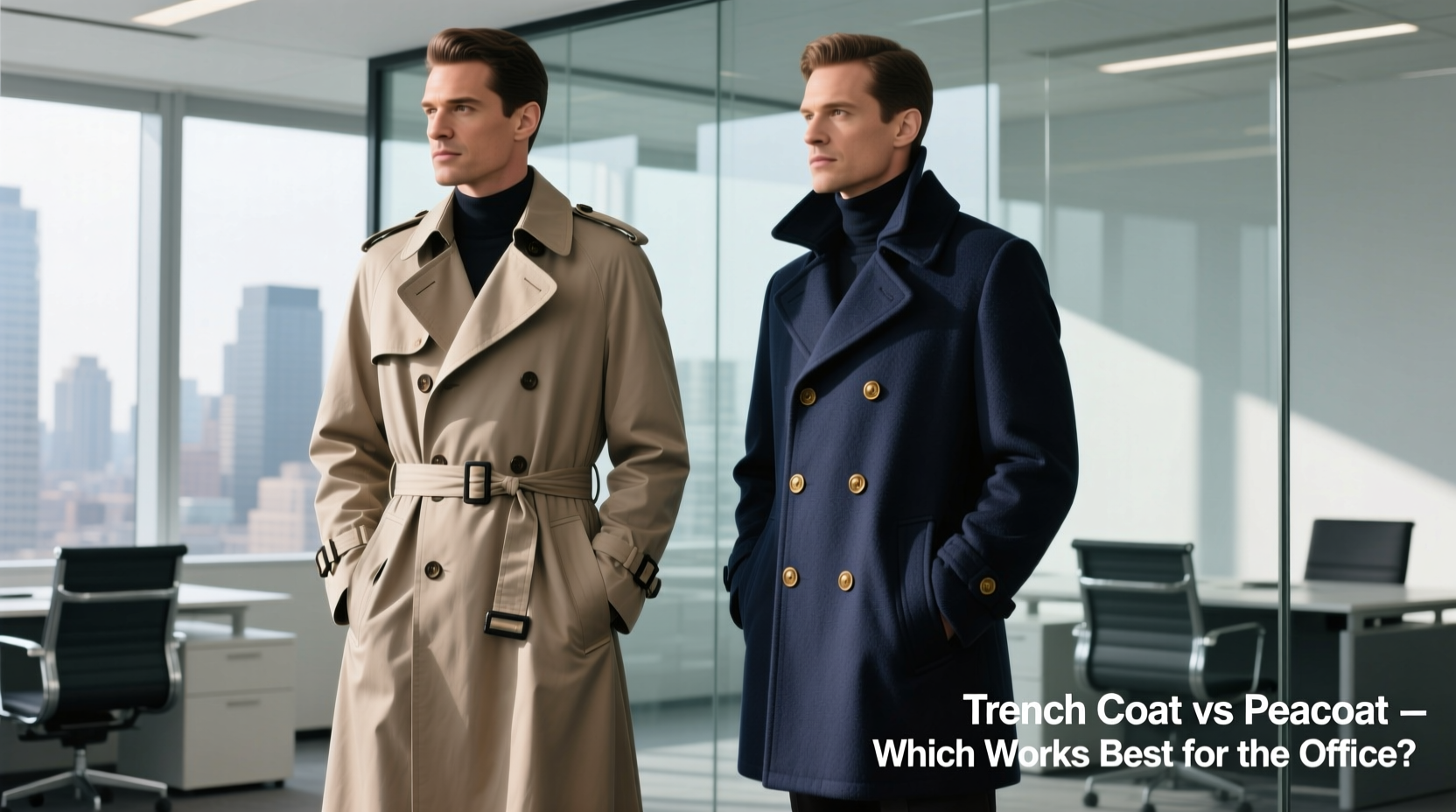
The trench coat was developed during World War I for British officers who needed a lightweight, waterproof garment suitable for trench warfare. Designed by Thomas Burberry, it featured a double-breasted front, storm flaps, epaulets, and a belted waist—all functional elements meant to shed rain and provide utility in damp conditions. Its signature gabardine fabric, tightly woven and water-resistant, made it ideal for unpredictable weather.
In contrast, the peacoat originated in the 18th century as part of naval uniforms across European and American fleets. Made from heavy wool melton, it was built to withstand cold, wet sea conditions. The short cut (typically ending at the hip), broad lapels, and large wooden or anchor-shaped buttons were designed for warmth and ease of movement on deck. Over time, its utilitarian roots gave way to a sleek, structured silhouette favored in urban environments.
These origins still influence how each coat performs today. The trench remains synonymous with spring showers and transitional seasons, while the peacoat excels in colder months thanks to its dense insulation and wind-blocking construction.
Design & Structure: How They Fit and Feel
The structural differences between trench coats and peacoats significantly affect their wearability in professional settings.
| Feature | Trench Coat | Peacoat |
|---|---|---|
| Length | Knee-length (average) | Hip-length |
| Fabric | Gabardine cotton (often treated), sometimes blended synthetics | Wool melton (dense, warm, durable) |
| Weight | Light to medium | Heavy |
| Lining | Partial or removable liner | Full inner lining, often quilted |
| Closure | Belted waist, double-breasted front, storm flap | Double-breasted button front |
| Pockets | Flap pockets, internal pockets | Slant pockets, interior compartments |
| Formality Range | Bridges business casual to formal | Sits comfortably in smart casual to business |
The trench coat's longer length offers more coverage, making it effective against wind and light rain—ideal for walking to transit or navigating city streets during drizzly mornings. However, its belted design can feel restrictive if worn over bulky sweaters or tailored suits. The peacoat, though shorter, provides superior thermal performance and moves easily under arm due to its cropped fit. This makes it easier to wear seated at a desk or driving without bunching.
Versatility in Professional Settings
Versatility isn't just about how many outfits a coat matches—it's about how well it adapts across seasons, occasions, and dress codes.
A trench coat shines in early spring and late fall, especially in cities where sudden downpours are common. Worn over a tailored suit, it projects authority and refinement. Paired with chinos and a knit sweater, it softens into business casual elegance. Its neutral palette—typically beige, navy, or black—makes it easy to coordinate with most office wardrobes. However, in deep winter, even a lined trench may fall short unless layered heavily underneath.
The peacoat, meanwhile, thrives in colder climates. Wool naturally regulates temperature and resists odors, making it ideal for multi-day wear in dry cold. It pairs effortlessly with both suits and casual separates. A navy peacoat over gray trousers and a turtleneck creates a modern executive look, while the same coat over dark jeans maintains professionalism in creative industries. But in rainy environments, untreated wool can absorb moisture and take hours to dry—limiting its all-weather appeal.
“Outerwear should complement your lifestyle, not fight against it. A trench is elegant, but only if you’re not freezing through meetings.” — Daniel Hart, Menswear Stylist & Wardrobe Consultant
Climate Considerations
Your local weather plays a decisive role. In cities like London, Seattle, or Vancouver, where precipitation is frequent and temperatures hover between 40–60°F (4–15°C), the trench coat proves indispensable. Its water resistance and breathability prevent overheating while keeping you dry.
In contrast, New York, Boston, or Chicago demand heavier insulation during winter. Here, the peacoat’s dense wool construction becomes essential. Layer it over a fine-gauge merino sweater and a shirt, and you’ll stay warm without sacrificing mobility. Just avoid wearing it in sustained rain unless treated with a water-repellent spray.
Styling Flexibility: From Boardroom to Brunch
True versatility means transitioning seamlessly from one context to another without requiring a full outfit change.
The trench coat has an inherent formality. With its clean lines and military-inspired details, it elevates any ensemble. It works equally well with a silk tie and oxfords as it does with loafers and a cashmere scarf. Because of its length, it balances proportions on taller individuals and elongates shorter frames when worn open.
The peacoat, while sharp, leans slightly more casual. Its naval heritage gives it a rugged charm, which some conservative offices may perceive as too relaxed—especially in black-tie adjacent environments. That said, in tech, media, finance, or design sectors, it’s widely accepted as part of a modern professional aesthetic. When tailored precisely (with minimal shoulder padding and a close fit), it conveys confidence without stiffness.
- Trench styling tip: Wear belted to define the waist and avoid looking boxy.
- Peacoat styling tip: Button only the top two buttons for a balanced, authentic naval look.
- Navy remains the most versatile color for both styles, followed by black and charcoal.
- Beige trenches require careful coordination to avoid clashing with darker suiting.
Real-World Example: Two Professionals, Two Needs
Consider Sarah, a marketing director in Portland, Oregon. Her workweek includes outdoor client events, walking between buildings, and variable weather. She owns both a beige trench and a navy peacoat. From March to May, she wears the trench almost daily—it handles mist, light rain, and breezy afternoons. But once December hits, she switches to the peacoat, which keeps her warm during early commutes and evening networking events.
Compare that to James, a financial analyst in Minneapolis. He rarely sees temperatures above freezing in winter and deals with snow and wind. His trench gathers dust in the closet—he tried wearing it once in February and nearly missed his train because he was too cold to wait outside. Instead, his peacoat, paired with thermal layers, gets him through the season reliably. For spring, he uses a lightweight wool overcoat instead of a trench, avoiding the latter’s lack of insulation.
Their experiences highlight a key truth: versatility depends on environment and routine. Neither coat wins universally—it depends on your calendar and climate.
Maintenance & Longevity
Both coats require care, but different kinds.
Trench coats, especially those made from cotton gabardine, need protection from prolonged moisture. While water-resistant, they aren’t fully waterproof. After exposure to rain, hang to dry naturally away from direct heat. Spot-clean stains promptly, and reproof the fabric annually with a silicone-free spray to maintain water repellency. Store on a wide wooden hanger to preserve shoulder shape.
Peacoats benefit from airing out between wears, as wool naturally resists odor but can retain humidity. Brush regularly with a clothes brush to remove dust and restore texture. Avoid frequent washing; instead, use a professional dry cleaner experienced with wool garments every few seasons. Moth prevention is crucial—store with cedar blocks or lavender sachets in low-humidity areas.
Checklist: Choosing the Right Work Coat
- Assess your typical commute: Do you walk, bike, or drive?
- Evaluate your local climate: Is rain or cold the dominant challenge?
- Review your office dress code: Are ties expected, or is smart casual acceptable?
- Try both coats over your most-worn work layers (suit, sweater, shirt).
- Check range of motion: Can you type, gesture, and sit comfortably?
- Ensure proper fit: Shoulders align, sleeves end at wrist bone, no pulling when buttoned.
- Consider color coordination with existing wardrobe.
FAQ
Can I wear a peacoat to a formal meeting?
Yes, provided it’s well-fitted, made from high-quality wool, and paired with a suit. Opt for navy or black and keep the rest of the outfit crisp. Avoid overly distressed or oversized cuts.
Is a trench coat appropriate for winter?
Only in mild winters or with significant layering. Most trench coats lack sufficient insulation for sub-40°F (4°C) conditions. Consider a thermal vest or heavy sweater underneath, but expect reduced comfort in extreme cold.
Which coat lasts longer?
With proper care, both can last 10+ years. Wool peacoats generally endure better over time due to fabric density, while trench coats may degrade faster if exposed frequently to heavy rain without reproofing.
Final Verdict: Which Is More Versatile for Work?
If forced to choose one coat for year-round office wear, the **trench coat edges ahead**—but only narrowly, and with caveats.
Its ability to handle spring and fall conditions, bridge multiple dress codes, and project timeless professionalism gives it broader situational utility. In moderate climates, it serves as a reliable, stylish companion across nine months of the year. Add a midweight layer beneath, and it extends into cooler periods.
However, in regions with harsh winters or highly casual workplaces, the peacoat proves more consistently useful. It delivers unmatched warmth, pairs easily with contemporary menswear, and ages gracefully with wear.
The ideal solution? Own both. Use the trench from April to November and the peacoat from November to March. Together, they cover the full spectrum of professional outerwear needs. But if budget or space limits you to one, prioritize based on your dominant seasonal challenge: rain favors the trench; cold favors the peacoat.
“The most versatile coat isn’t the one that looks best in photos—it’s the one you actually wear.” — Lena Choi, Fashion Editor, *Urban Professional*
Take Action: Build Your Smarter Work Wardrobe
Don’t let tradition dictate your choices. Test both coats in real-world scenarios: wear them to work, walk in the rain, sit at your desk, take public transit. Pay attention to comfort, warmth, and ease of movement. Then decide based on experience, not expectation.




 浙公网安备
33010002000092号
浙公网安备
33010002000092号 浙B2-20120091-4
Comments
No comments yet. Why don't you start the discussion?