
When it comes to projecting sophistication, authority, and quiet luxury, few wardrobe choices carry as much weight as a well-tailored suit. But within that category, a subtle yet significant debate emerges: Is a tweed suit set or a classic pantsuit more effective at making you look genuinely expensive? The answer isn’t just about fabric or cut—it’s about context, craftsmanship, and the unspoken signals your clothing sends.
While both styles can elevate an outfit, they do so in fundamentally different ways. One leans into heritage and tactile richness; the other into streamlined modernity. Understanding their nuances helps not only in dressing well but in dressing strategically—especially when you want to appear polished, put-together, and effortlessly affluent.
The Psychology of Looking “Expensive”
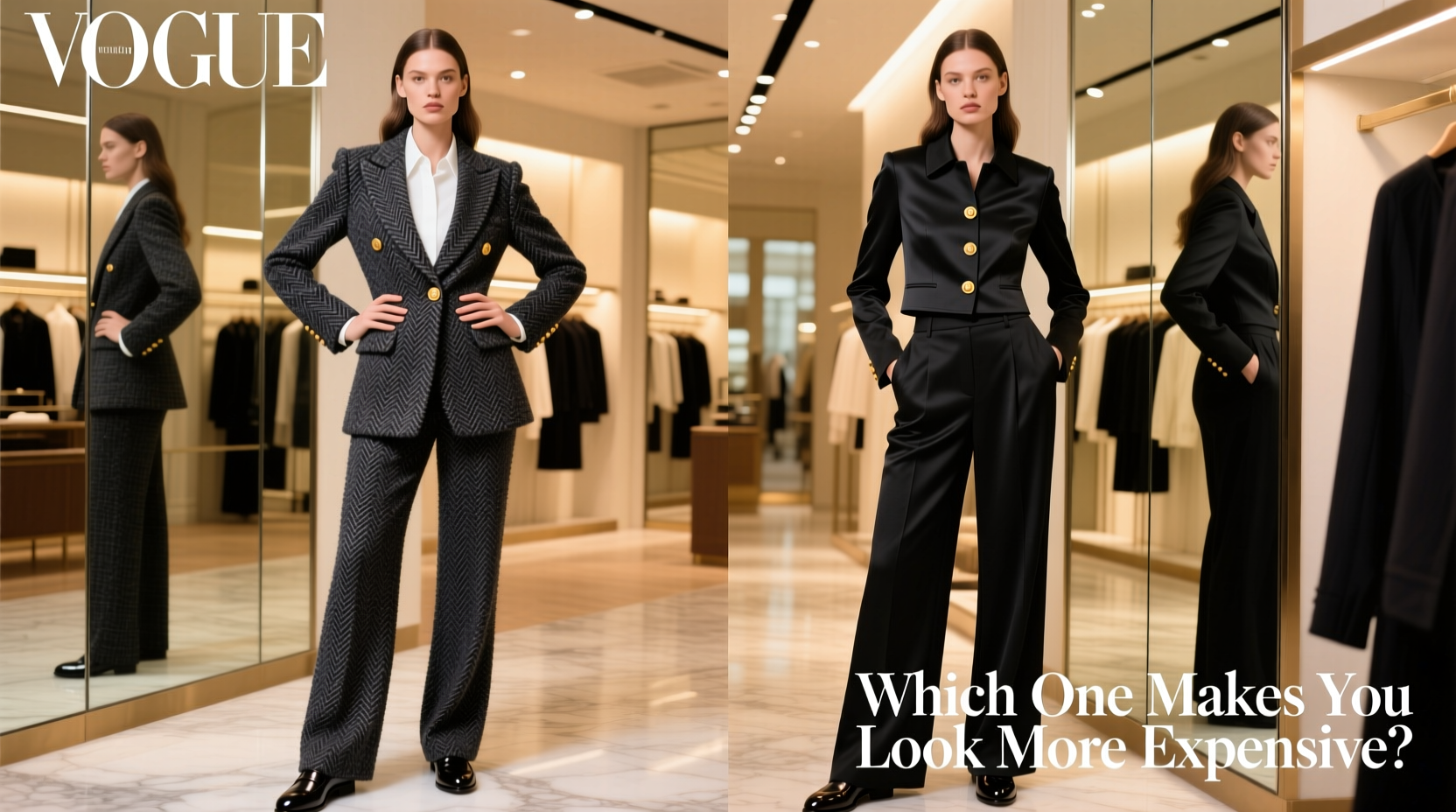
Looking expensive isn’t solely about price tags. It’s about perceived value—the impression that what you’re wearing is rare, well-made, and intentional. Key factors include:
- Fabric quality: Natural fibers like wool, cashmere, and high-grade cotton signal care and investment.
- Fit precision: Even modest garments gain status when tailored to the body.
- Color and texture: Muted tones, tonal layering, and rich textures (like herringbone or bouclé) suggest refinement over trend-chasing.
- Coordination: Matching sets imply thoughtfulness and access to custom or curated pieces.
A garment doesn’t need to be designer-labeled to project luxury—it needs to communicate intentionality. This is where the tweed suit set and the pantsuit diverge in impact.
Tweed Suit Sets: Heritage, Texture, and Craft
Tweed has long been associated with British aristocracy, countryside estates, and timeless sartorial tradition. Originating as a rugged outdoor fabric, it evolved into a symbol of understated wealth—particularly in full suit sets.
A complete tweed suit (jacket and matching trousers) commands attention through texture. The weave—whether herringbone, houndstooth, or flecked melange—adds depth and visual interest. Unlike flat, solid fabrics, tweed catches light differently across its surface, creating dimension that reads as complex and costly.
Moreover, tweed suits are rarely mass-produced in exact co-ord sets. Finding a perfectly matched jacket and pant combo suggests either bespoke tailoring or a discerning eye for detail—both markers of elevated taste.
“Tweed is armor disguised as elegance. It says you value durability, history, and subtlety—all hallmarks of true luxury.” — Julian Hart, Menswear Archivist & Textile Historian
Pantsuits: Power, Precision, and Modern Minimalism
The pantsuit emerged as a symbol of professional empowerment, particularly for women entering corporate spaces. Its strength lies in clean lines, sharp silhouettes, and monochromatic simplicity.
A well-cut pantsuit in fine wool or crepe fabric projects control and clarity. It’s less about texture and more about proportion—narrow lapels, structured shoulders, and trousers with a crisp break. These details signal access to expert tailoring and a deliberate aesthetic.
In modern fashion, minimalist pantsuits in black, navy, or camel have become staples of “quiet luxury”—a movement defined by restraint, quality materials, and absence of logos. Think The Row, Loro Piana, or Khaite. Here, the costliness is implied rather than displayed.
However, because pantsuits are widely available in fast-fashion versions, the baseline expectation is lower. To look truly expensive, the fit must be impeccable and the fabric unmistakably premium.
Key Differences That Influence Perceived Value
| Feature | Tweed Suit Set | Pantsuit |
|---|---|---|
| Fabric Uniqueness | High – textured, often limited-run weaves | Moderate – common in solids; harder to distinguish quality at a glance |
| Fit Tolerance | Moderate – texture distracts from minor flaws | Low – poor fit ruins the sleek aesthetic |
| Rarity of Matching Set | High – full sets are uncommon off-the-rack | High – but often sold as separates |
| Contextual Flexibility | Niche – best for fall/winter, creative or traditional settings | Broad – works in corporate, urban, formal environments |
| Perceived Investment | Strong – implies curation or bespoke origin | Variable – depends entirely on fabric and tailoring |
Real-World Example: The Interview Scenario
Consider two candidates arriving for a high-stakes consulting interview:
- Candidate A wears a charcoal gray pantsuit in smooth virgin wool. Tailored precisely, with a slight taper and matte buttons. Minimal jewelry. Polished oxfords.
- Candidate B wears a heather-brown tweed suit set with a subtle herringbone pattern. Jacket features patch pockets and a half-lined construction. Trousers are straight-leg with turn-ups. Brown leather loafers.
Both look professional. But Candidate A reads as efficient, modern, and competent—ideal for a corporate environment. Candidate B, however, stands out as distinctive, thoughtful, and possibly more experienced or senior. The tweed suggests confidence in standing out, a trait often associated with established professionals who don’t need to conform.
In a setting that values innovation and individuality (e.g., design, academia, luxury branding), Candidate B may subconsciously be perceived as having higher status. In contrast, the pantsuit excels in environments where uniformity equals professionalism.
How to Maximize the “Expensive” Effect: A Step-by-Step Guide
Regardless of which style you choose, certain steps ensure your suit reads as high-value:
- Start with fabric weight: Choose mid-to-heavy weight wools (300–450gsm). Lightweight suits often feel flimsy, even if expensive.
- Ensure perfect fit: Shoulders should lie flat, sleeves show 1/4 inch of shirt cuff, trousers break cleanly at the shoe.
- Avoid obvious branding: Logos or visible labels reduce perceived exclusivity.
- Invest in complementary pieces: A silk blouse, fine-gauge turtleneck, or handmade shoes elevate the entire ensemble.
- Pay attention to finishing: Functional buttonholes, lined sleeves, and pick stitching indicate superior construction.
Checklist: Does Your Suit Look Expensive?
- ✅ Fabric is natural fiber (wool, cotton, linen, or blend with high natural content)
- ✅ No visible wrinkles, pilling, or fraying
- ✅ Jacket fits snugly across the back without pulling
- ✅ Trousers hang straight without bagging at the knee
- ✅ Color complements skin tone and isn’t overly trendy
- ✅ Shoes are clean, polished, and stylistically aligned (e.g., brogues with tweed, pumps with pantsuit)
Frequently Asked Questions
Can a pantsuit ever look as expensive as a tweed suit set?
Yes—but only if the fabric is exceptional (e.g., double-faced wool, cashmere blend) and the fit is flawless. A $2,000 minimalist pantsuit will outshine a poorly made tweed set. However, tweed has a built-in advantage in texture and rarity.
Is a tweed suit too old-fashioned for a modern wardrobe?
Not if styled intentionally. Pair a tweed blazer with dark jeans for a casual take, or wear the full set with a turtleneck and ankle boots for contemporary edge. The key is balancing heritage fabric with modern proportions.
Do I need to wear the full tweed suit together to look expensive?
No. In fact, mixing the jacket with contrasting trousers can heighten the impression of curated personal style. But when worn as a set, it signals a level of coordination that suggests access to custom or high-end ready-to-wear.
Final Verdict: Which Makes You Look More Expensive?
The tweed suit set holds a distinct edge in making you look genuinely expensive—provided it’s well-made and appropriately styled. Its inherent texture, historical prestige, and relative scarcity in coordinated forms create an aura of considered elegance that’s hard to replicate with a standard pantsuit.
That said, a masterfully tailored pantsuit in a premium fabric remains one of the most powerful tools for projecting modern affluence, especially in professional or urban environments. It’s sleek, authoritative, and universally respected.
If your goal is to stand out as someone with taste, tradition, and perhaps a bit of eccentric confidence, the tweed suit set wins. If you aim to blend seamlessly into elite corporate or cosmopolitan circles while radiating quiet power, the pantsuit is unmatched.
In the end, looking expensive isn’t about choosing one over the other—it’s about understanding what each communicates and wearing them with purpose.




 浙公网安备
33010002000092号
浙公网安备
33010002000092号 浙B2-20120091-4
Comments
No comments yet. Why don't you start the discussion?