
Your Grade Point Average (GPA) is more than just a number—it’s a key indicator of academic performance used by colleges, employers, and scholarship committees. Yet, many students remain confused about how it's calculated, what the differences are between weighted and unweighted GPAs, and how to interpret their own scores. This guide breaks down everything you need to know in a straightforward, practical way.
What Is GPA and Why It Matters
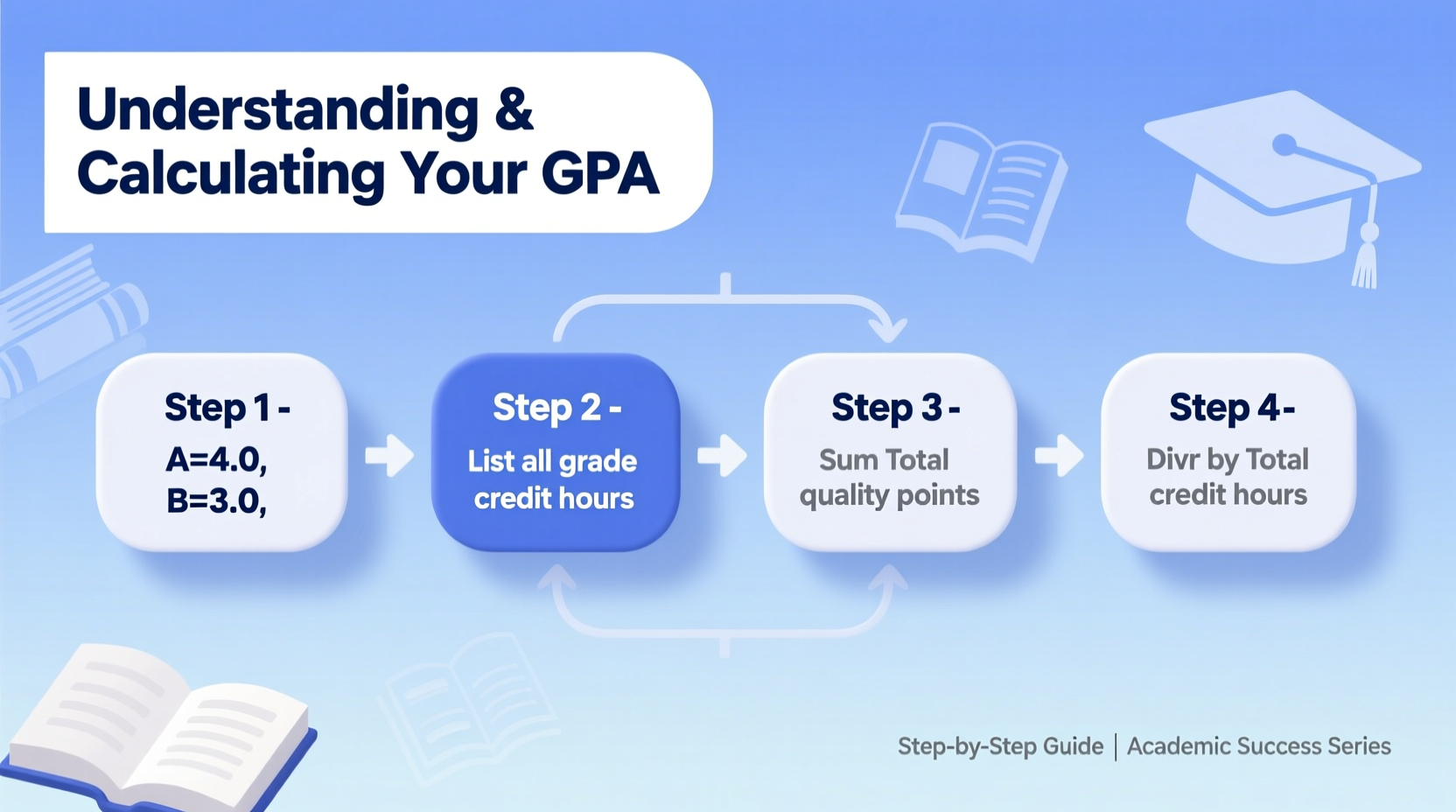
GPA stands for Grade Point Average. It converts letter grades into numerical values and averages them over time to reflect overall academic achievement. Most institutions use a 4.0 scale, though variations exist. A high GPA can open doors to competitive programs, honors societies, financial aid, and graduate schools. Conversely, a low GPA may limit opportunities unless offset by strong test scores, extracurriculars, or personal growth.
The importance of GPA extends beyond transcripts. Admissions officers often use it as a quick benchmark to assess consistency and rigor. However, context matters: taking advanced courses with slightly lower grades can sometimes reflect stronger academic commitment than straight As in easier classes.
“GPA is not just a summary of grades—it reflects discipline, time management, and intellectual curiosity.” — Dr. Linda Park, Educational Assessment Specialist
Understanding Grading Scales: Unweighted vs Weighted
Not all GPAs are calculated the same way. The two most common systems are unweighted and weighted GPAs, each serving a different purpose.
- Unweighted GPA: Uses a standard 4.0 scale regardless of course difficulty. An A in a regular class and an A in an AP class both equal 4.0.
- Weighted GPA: Accounts for course rigor. Honors, AP, IB, or dual-enrollment classes receive extra points (e.g., an A might be worth 5.0 instead of 4.0).
Schools vary in how they apply weighting. Some add 0.5 points for honors and 1.0 for AP; others use different multipliers. Always check your school’s policy to understand how your courses are factored in.
Common Letter Grade to GPA Conversions
| Letter Grade | Percentage Range (Typical) | Unweighted GPA |
|---|---|---|
| A+ | 97–100% | 4.0 |
| A | 93–96% | 4.0 |
| A− | 90–92% | 3.7 |
| B+ | 87–89% | 3.3 |
| B | 83–86% | 3.0 |
| B− | 80–82% | 2.7 |
| C+ | 77–79% | 2.3 |
| C | 73–76% | 2.0 |
| C− | 70–72% | 1.7 |
| D | 65–69% | 1.0 |
| F | Below 65% | 0.0 |
Note: Some schools include A+ = 4.3, especially in weighted systems. Others cap all As at 4.0. Confirm your institution’s method before calculating manually.
Step-by-Step Guide to Calculating Your GPA
Whether you're verifying your transcript or planning future semesters, knowing how to calculate GPA empowers better academic decisions. Follow this six-step process.
- List All Courses and Grades: Gather report cards or transcripts showing all completed classes and corresponding letter grades.
- Convert Grades to Points: Use the standard conversion table above to assign point values to each grade.
- Determine Credit Hours: Note the credit value of each course. Most high school courses are 1 credit; some electives or labs may differ.
- Multiply Grade Points by Credits: For each course, multiply the GPA point value by the number of credits to get quality points.
- Sum Total Quality Points: Add up all quality points across courses.
- Divide by Total Credits: Divide total quality points by total credits attempted to find your cumulative GPA.
Example Calculation
Suppose a student completes four semester-long courses, each worth 1 credit:
- Math: B (3.0)
- English: A− (3.7)
- Science: B+ (3.3)
- History: A (4.0)
Total quality points: (3.0 + 3.7 + 3.3 + 4.0) = 14.0
Total credits: 4
GPA = 14.0 ÷ 4 = 3.5
This is a semester GPA. To calculate cumulative GPA, repeat the process using all semesters’ data together.
Special Cases and Adjustments
Real-world scenarios often complicate GPA calculations. Here’s how to handle common exceptions:
Pass/Fail or Credit/No-Credit Courses
These typically don’t affect GPA since no letter grade is assigned. However, failing a pass/fail course may still impact academic standing or eligibility.
Repeated Courses
Policies vary. Some schools replace the original grade in GPA calculation; others average both. Check institutional rules—repeating a course can improve GPA but won’t erase past records entirely.
Different Grading Systems Abroad or in Dual Programs
If studying internationally or in non-traditional programs (e.g., IB), convert foreign grades using official equivalency charts. Universities often recalculate GPAs during admissions review based on standardized conversions.
Mini Case Study: Improving GPA Over Time
Jamal entered high school with inconsistent study habits. His freshman year GPA was 2.8 due to Bs and Cs in core subjects. Determined to improve, he met with his counselor, enrolled in tutoring, and prioritized time management. By sophomore year, his grades rose to mostly As and Bs. He also took two honors courses junior year, earning As that contributed to a weighted GPA of 4.2.
By graduation, Jamal’s cumulative unweighted GPA reached 3.4, and his weighted GPA was 3.9. Though not top of his class, his upward trend impressed admissions officers at several state universities. One acceptance letter noted: “We value resilience and improvement—your progress demonstrates academic maturity.”
His story highlights that GPA isn’t fixed. Strategic effort, support, and course selection can significantly shift outcomes over time.
Checklist: How to Accurately Track and Improve Your GPA
- ✅ Obtain a complete list of all courses and final grades
- ✅ Confirm your school’s grading scale and weighting policy
- ✅ Calculate semester GPAs individually before combining
- ✅ Include only graded courses (exclude pass/fail unless specified)
- ✅ Re-calculate after retaking courses, if allowed
- ✅ Monitor progress each term to identify trends early
- ✅ Use online GPA calculators cautiously—verify formulas match your school’s system
FAQ
Can I calculate my GPA without credit hours?
Yes, if all your courses carry equal weight (e.g., one credit each). Simply average the GPA points from each grade. But if course weights differ (e.g., lab vs. lecture), credit-based calculation is essential for accuracy.
Does an incomplete grade (I) affect my GPA?
No, not immediately. An \"I\" doesn’t count in GPA until replaced with a final grade. However, unresolved incompletes can delay graduation or financial aid disbursement.
How do colleges view weighted versus unweighted GPA?
Admissions teams typically consider both. They look at unweighted GPA for consistency and compare weighted GPA to assess willingness to challenge oneself academically. Context—like school profile and available course offerings—is critical in interpretation.
Final Thoughts: Take Control of Your Academic Record
Your GPA is a reflection of your academic journey—but it doesn’t define your potential. Understanding how it’s calculated gives you the power to make informed choices: selecting appropriate courses, seeking help when needed, and tracking progress meaningfully. Whether you’re aiming for a 4.0 or working to recover from a rough start, every semester offers a chance to grow.




 浙公网安备
33010002000092号
浙公网安备
33010002000092号 浙B2-20120091-4
Comments
No comments yet. Why don't you start the discussion?