
Military dog tags have long served as more than just identification—they are lifelines in combat, historical records, and personal artifacts of service. Worn around the necks of service members across generations, these small metal discs carry vital information encoded in standardized formats. While they may appear simple at first glance, dog tags contain a wealth of data structured through symbols, abbreviations, and numbering systems unique to each branch and era. Understanding how to read them offers insight into military protocols, medical needs, and individual service history.
This guide breaks down the anatomy of modern and historical dog tags, explains common codes and markings, and provides tools for interpreting what each line means—whether you're a veteran, historian, collector, or family member seeking clarity about a loved one’s service.
The Purpose and Evolution of Military Dog Tags
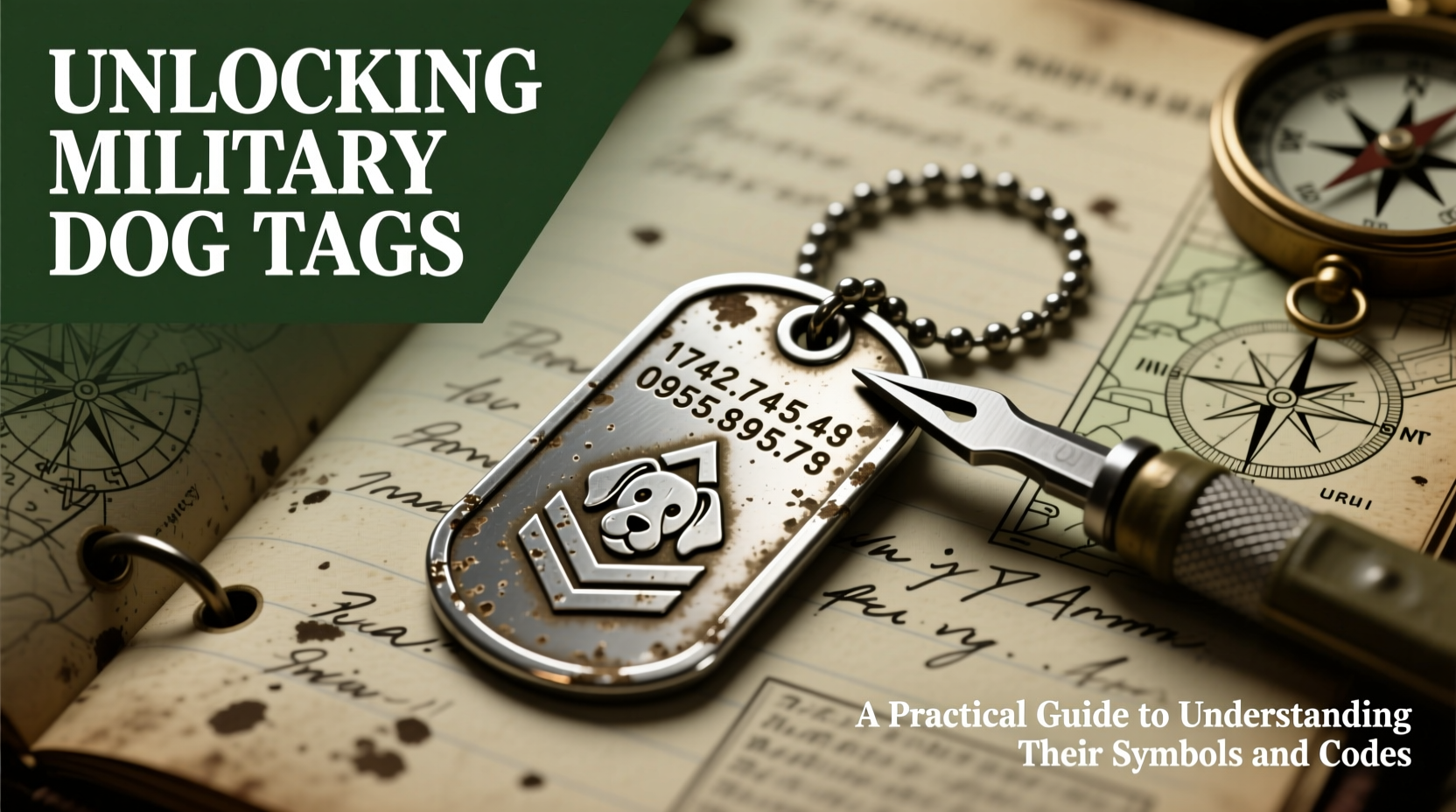
Dog tags originated during the American Civil War when soldiers began inscribing basic details on pieces of wood or metal to ensure proper identification if killed in battle. The term “dog tag” itself was coined during World War I, inspired by the similar identification tags used for military dogs. Over time, standardization improved, especially after World War II, when the U.S. military adopted durable stainless steel tags with stamped lettering designed to survive extreme conditions.
Today, every active-duty service member receives two identical dog tags. One remains with the body in case of fatality; the other is collected for record-keeping. Beyond identification, they provide immediate access to critical medical information such as blood type and religious preference—details that can influence emergency treatment decisions under battlefield stress.
“Dog tags aren’t just metal—they’re a soldier’s last official communication. Decoding them correctly honors both protocol and personhood.” — Colonel Richard Mallory, U.S. Army (Ret.)
Anatomy of a Modern U.S. Military Dog Tag
A standard U.S. military dog tag issued today follows a precise format. Though slight variations exist between branches, most conform to Department of Defense specifications. Below is a breakdown of the typical layout:
| Line | Information | Description |
|---|---|---|
| 1 | Name | Full legal name (last, first, middle initial) |
| 2 | Service Number / DoD ID | Unique identifier (SSN phased out post-2011; replaced by EDIPI number) |
| 3 | Blood Type & Rh Factor | e.g., O+, A-, etc. Critical for transfusions |
| 4 | Religious Preference | Optional code or full word (e.g., \"Protestant\", \"No Preference\") |
The tags are usually oval-shaped, made from corrosion-resistant stainless steel, and feature a notch near one end—a relic from the WWII-era stamping machines that prevented misalignment during embossing. Despite popular myth, this notch was never intended to fit into dental impressions or rifle slots.
Decoding Common Codes and Abbreviations
While names and blood types are straightforward, other elements require interpretation. Here are some frequently encountered codes:
- USN: United States Navy
- USMC: United States Marine Corps
- USA: United States Army
- USAF: United States Air Force
- USCG: United States Coast Guard
- POS: Pay Grade or Rate (e.g., E-4, O-3)
- IV, V, VI: Roman numerals sometimes used for unit identifiers or draft classification in older tags
In earlier versions (pre-1960s), Social Security Numbers were commonly used as identifiers. Since 2011, the U.S. military transitioned to using the Electronic Data Interchange Personal Identifier (EDIPI), a ten-digit number linked to the Defense Enrollment Eligibility Reporting System (DEERS). This change enhanced privacy and reduced identity theft risks.
Religious preferences follow standardized abbreviations:
- CATH – Catholic
- PROT – Protestant
- JEW – Jewish
- NONE or NO PREFERENCE – No religious affiliation
- WICCA, BUDD, MUSL – Recognized minority faiths
Step-by-Step Guide to Interpreting a Found or Inherited Dog Tag
If you’ve come across a dog tag—through estate clearance, collection, or field discovery—follow this process to extract meaningful information responsibly:
- Preserve Condition: Handle with clean hands or gloves. Avoid cleaning unless absolutely necessary.
- Photograph Both Sides: Capture clear images showing all engraved lines and any wear patterns.
- Identify Branch and Era: Look for service branch initials (USA, USN, etc.) and stylistic clues like font or shape.
- Transcribe All Text: Write down every visible line exactly as it appears, including partial or faded characters.
- Research Service Number or Name: Use public databases like the National Archives’ Virtual Wall or Fold3 (subscription-based) to cross-reference.
- Contact Veteran Organizations: Groups like the VFW or American Legion may assist in locating next of kin or verifying authenticity.
- Report If Recently Lost: If the tag appears new or recently issued, contact local military installations or base exchanges.
Mini Case Study: Identifying a Korean War-Era Tag
In 2022, a metal detectorist in Oregon uncovered a corroded dog tag marked:
SMITH J R
US ARMY 1234567
O POS
METHODIST
Using the prefix \"US ARMY\" and seven-digit number, researchers determined it predated the EDIPI system and likely dated to the early 1950s. Cross-referencing the name and number in the National Archives’ Korean War Casualty File revealed John R. Smith, enlisted in 1950, honorably discharged in 1953. His family was located through genealogical records and expressed deep gratitude for the return of the tag, which had been lost during a hiking trip decades prior.
This case underscores how even partial data, when interpreted correctly, can reconnect families with lost pieces of personal history.
Do’s and Don’ts When Handling Military Dog Tags
| Do’s | Don’ts |
|---|---|
| Store in a dry, acid-free container | Submerge in liquid cleaners |
| Document provenance and photos | Sell tags without verifying ownership status |
| Respectfully return to family or museum | Alter or engrave additional text |
| Use archival tape for mounting displays | Display in direct sunlight or humid areas |
Frequently Asked Questions
Can civilians own military dog tags?
Yes, but ethically, only replica or officially deaccessioned tags should be collected. Original tags tied to living personnel or unreturned remains should be reported and returned to appropriate authorities or families.
What does “POS” mean on old dog tags?
It stands for “Positive” in reference to blood type (e.g., O Positive). On modern tags, it appears as “O+”. Some older tags use “NEG” for Rh-negative types.
Are dog tags still used today?
Absolutely. All U.S. military branches continue issuing dog tags alongside newer technologies like the DD Form 214 and digital medical records. Physical tags remain essential due to their reliability in austere environments where electronic systems may fail.
Conclusion: Honor Through Understanding
Unlocking the meaning behind military dog tags goes beyond translation—it's an act of respect. Each stamped character represents a person who served, sacrificed, or survived. Whether you're preserving a family heirloom, researching history, or supporting veterans, knowing how to interpret these small but powerful tokens connects us to broader narratives of duty and identity.




 浙公网安备
33010002000092号
浙公网安备
33010002000092号 浙B2-20120091-4
Comments
No comments yet. Why don't you start the discussion?