
For athletes, coaches, and fitness enthusiasts, timing is everything. Whether you're sprinting the final 100 meters, pacing intervals during a swim, or monitoring recovery between sets, accurate time measurement can make the difference between plateauing and progressing. The chronograph watch—often mistaken for a mere aesthetic upgrade—holds serious functional power when used correctly. More than just a stopwatch on the wrist, it's a tool for refining performance through precise data capture.
Yet many users only scratch the surface of what a chronograph can do. Pushers are pressed haphazardly, subdials go unread, and results are misinterpreted. This guide breaks down how to read and use a chronograph effectively in real-world athletic scenarios, transforming it from an underutilized accessory into a cornerstone of your training toolkit.
The Anatomy of a Chronograph Watch
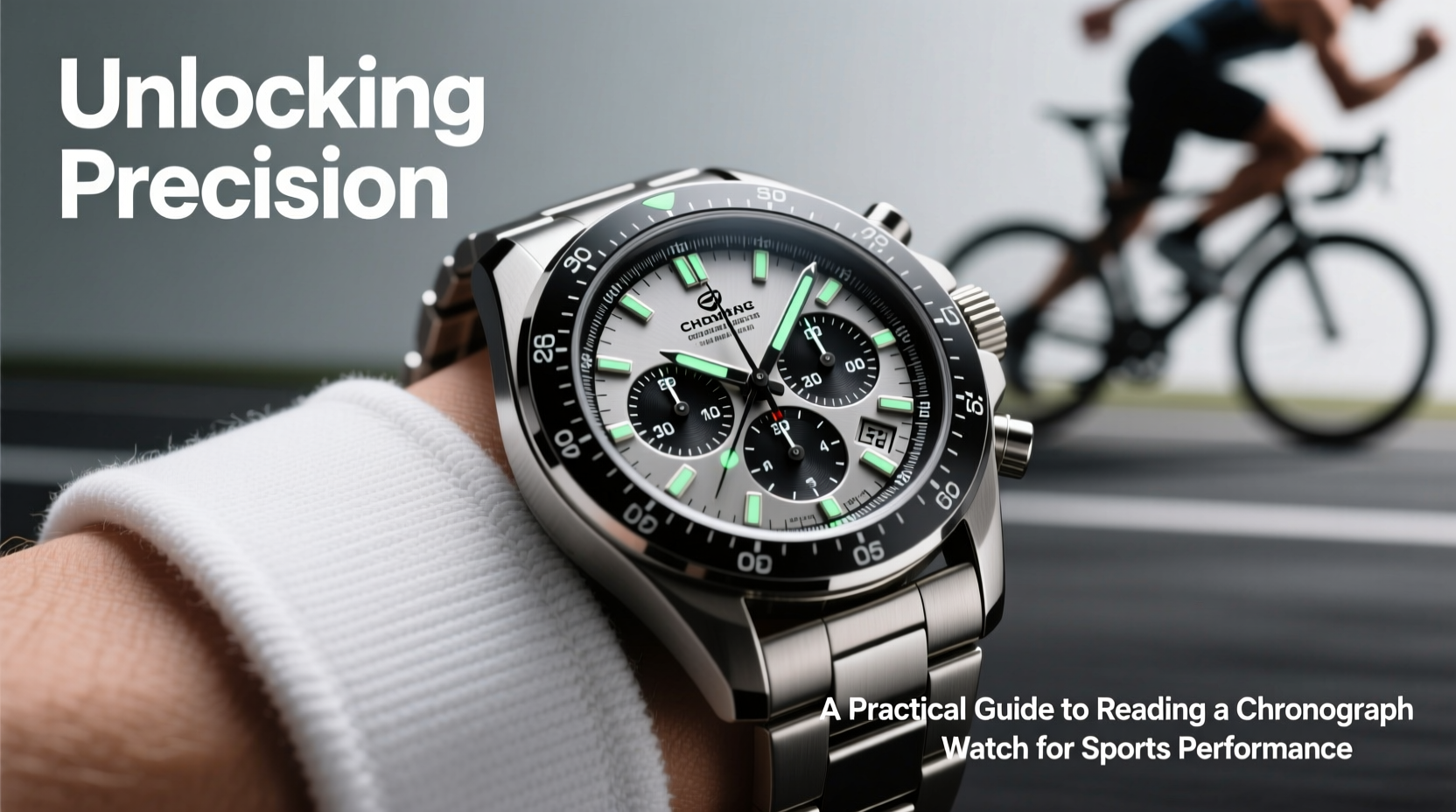
A chronograph combines a standard timepiece with integrated stopwatch functionality. Understanding its components is essential before diving into usage:
- Main dial: Displays regular time (hours, minutes, seconds).
- Subdials (registers): Track elapsed seconds, minutes, and sometimes hours from the start of the chronograph function.
- Start/Stop pusher: Located at 2 o’clock; activates and halts the chronograph hand.
- Reset pusher: At 4 o’clock; returns all chronograph hands to zero after stopping.
- Central chronograph hand: Sweeps around the main dial, measuring elapsed seconds.
Unlike digital stopwatches, analog chronographs offer continuous visual feedback. The sweeping motion of the central hand allows for microsecond-level estimation between markers, which can be critical in close splits or reaction drills.
Step-by-Step Guide to Measuring Athletic Intervals
Using a chronograph effectively requires more than pressing buttons—it demands intentionality and consistency. Follow this sequence to measure intervals with confidence:
- Prepare the watch: Pull the crown to set accurate time if needed, then push it back in. Confirm all subdials read zero.
- Position yourself: Stand where you can clearly see the athlete’s start and finish points (e.g., track lane, pool edge).
- Start the timer: Press the top pusher precisely as the athlete begins movement. Anticipate slightly—reaction lag costs milliseconds.
- Monitor splits (optional): If your model supports split times, press the start/stop button mid-run to record lap time without pausing the overall clock.
- Stop the timer: Press the same pusher as the athlete crosses the finish line.
- Read the result: Note the position of the central second hand (main dial), minute register, and hour counter if applicable.
- Reset: Only after recording the time, press the bottom pusher to return all hands to zero.
This process works equally well for track sprints, swim laps, cycling intervals, or agility drills. The key lies in consistent trigger timing and proper interpretation of the dials.
Interpreting Subdial Readings Accurately
Misreading subdials leads to incorrect data. Most chronographs feature three common registers:
| Subdial Position | Function | Scale |
|---|---|---|
| Top (12 o'clock) | Elapsed minutes | Typically 30 or 60-minute scale |
| Bottom left (9 o'clock) | Running seconds (independent of chronograph) | 60-second scale |
| Bottom right (3 o'clock) | Elapsed hours | 12-hour scale (on some models) |
Example: If the central hand points to 45 seconds, the top subdial shows 7 minutes, and the right subdial reads 0, the total elapsed time is 7 minutes and 45 seconds.
Be cautious not to confuse the running seconds hand (usually in the 9 o’clock subdial) with the chronograph seconds hand (central). One tracks live time; the other measures duration.
Real-World Application: Sprint Training Case Study
Consider Coach Maria Alvarez, who trains high school sprinters in San Diego. For years, she relied on smartphone timers but noticed inconsistencies in recorded 40-meter dash times. After switching to a mechanical chronograph, her data stabilized significantly.
She discovered that phone app delays—due to screen unlock time and touch latency—added up to 0.3 seconds per trial. With a chronograph, her average reaction delay dropped to 0.1 seconds, and because she could estimate between tick marks, she gained resolution down to ~0.05 seconds.
Within six weeks, using consistent manual timing, she identified two athletes whose acceleration phase improved by 0.2 seconds despite similar overall times—a nuance missed previously. Adjusting their block setup based on this insight led to personal bests at regionals.
“The precision isn’t about replacing electronic systems,” says Alvarez. “It’s about having reliable, immediate feedback when tech fails or isn’t allowed.”
“The human element in timing adds variability, but with practice, a skilled user with a chronograph can rival digital tools in accuracy—especially in field settings.” — Dr. Lin Wei, Sports Biomechanics Researcher, University of Calgary
Do’s and Don’ts of Chronograph Use in Sports
| Do’s | Don’ts |
|---|---|
| Calibrate your trigger response with known intervals (e.g., metronome). | Press the reset button while the chronograph is still running. |
| Use split timing to monitor intermediate pace without interrupting the clock. | Assume all subdials track chronograph time—some show regular seconds. |
| Record times immediately after stopping to prevent memory errors. | Operate pushers underwater unless the watch is rated for dive use. |
| Practice regularly to minimize human error. | Ignore manufacturer instructions for resetting sequences. |
Frequently Asked Questions
Can I use a chronograph for heart rate estimation?
Yes, manually. Time 15 seconds using the chronograph and count pulse beats, then multiply by four. The precision sweep hand improves accuracy over standard second hands.
What’s the difference between a chronograph and a tachymeter?
A chronograph measures elapsed time. A tachymeter is a scale on the bezel or dial that converts elapsed time (for a fixed distance) into speed or frequency. For example, if you travel one kilometer in 30 seconds, the tachymeter reads 120 km/h. It relies on the chronograph for input.
Are automatic chronographs more accurate than quartz?
Quartz chronographs typically have higher timekeeping accuracy (±15 seconds/month vs. ±5 seconds/day for mechanical). However, both can deliver precise interval timing if well-maintained. Mechanical watches offer smoother sweep hands, aiding visual estimation between seconds.
Essential Checklist for Athletes and Coaches
- ✅ Verify all chronograph hands are reset to zero before each use.
- ✅ Identify which subdials track elapsed time versus continuous time.
- ✅ Practice start-stop timing with a partner to reduce reaction bias.
- ✅ Use split functions to evaluate segment performance (e.g., first vs. second 200m).
- ✅ Record times immediately to avoid recall errors.
- ✅ Clean pushers periodically to prevent sticking, especially after outdoor sessions.
- ✅ Store the watch away from magnetic fields to maintain movement integrity.
Conclusion: Precision Starts with Practice
A chronograph watch is more than a symbol of sophistication—it's a precision instrument capable of elevating athletic development. When read correctly and used deliberately, it provides insights no app notification can replicate: the rhythm of effort, the margin of improvement, the truth behind fractions of a second.
Mastery doesn’t come overnight. It comes from repetition, attention to detail, and respect for the mechanics at play. Whether you’re timing youth athletes or optimizing your own triathlon transitions, the discipline of accurate manual timing sharpens both mind and body.




 浙公网安备
33010002000092号
浙公网安备
33010002000092号 浙B2-20120091-4
Comments
No comments yet. Why don't you start the discussion?