
The cycle repeats every year: a new flagship drops, the marketing machine kicks in, and suddenly your barely-year-old phone feels outdated. If you're on a Samsung Galaxy S20 and eyeing the S21, you're not alone. But is the upgrade truly transformative, or just incremental polish wrapped in hype? Let’s cut through the noise with real comparisons, user experiences, and practical advice to help you decide—upgrade now or keep saving.
What Changed? Key Differences Between S20 and S21
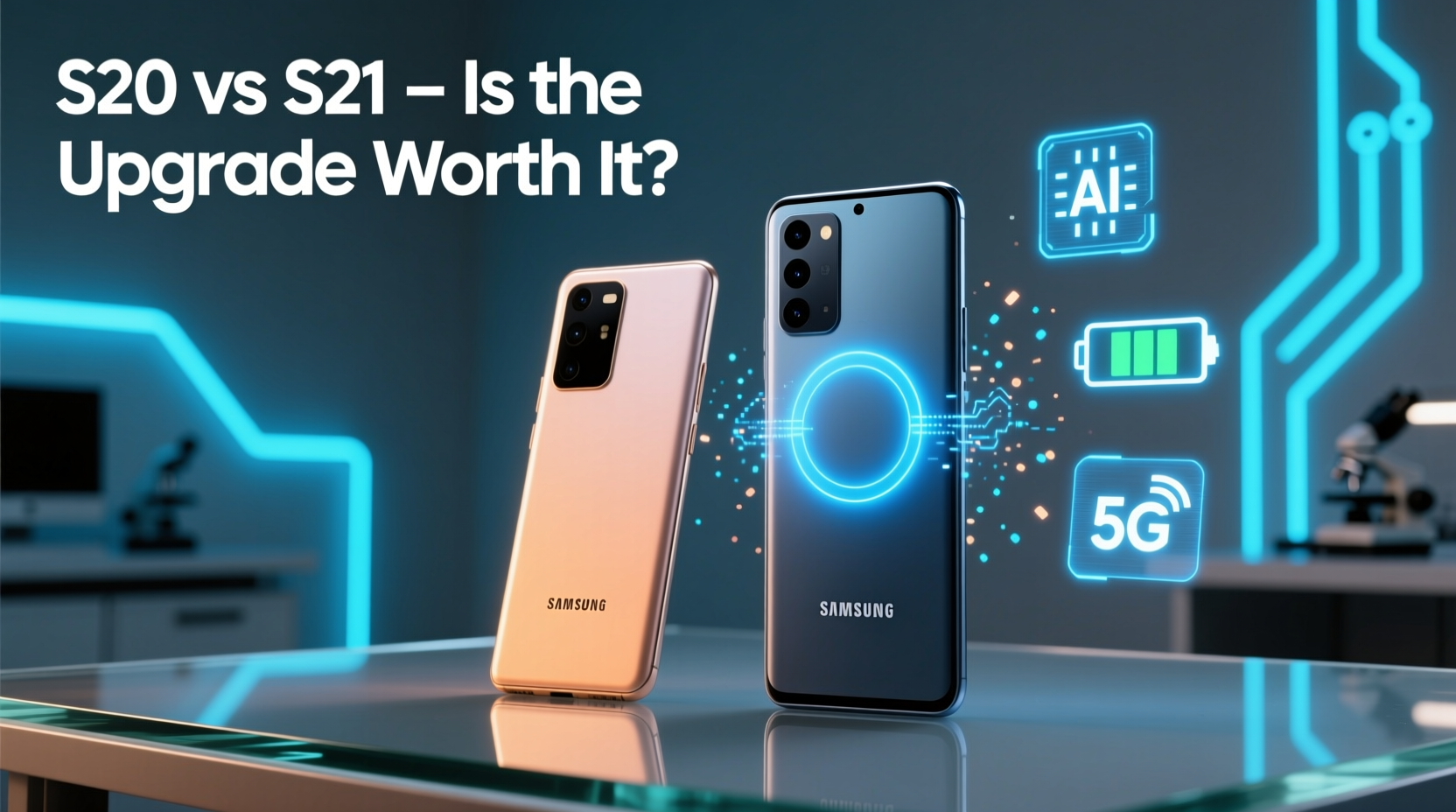
The jump from the Galaxy S20 (released February 2020) to the S21 (January 2021) wasn’t as dramatic as previous generational leaps. Samsung shifted focus from raw specs to refinement, design, and efficiency. Here’s what actually changed:
- Design & Build: The S21 introduced a new \"contour-cut\" camera housing that blends into the metal frame, giving it a sleeker profile. It also uses more recycled materials and ditches the plastic back on base models (S21 still has polycarbonate, but textured to feel premium).
- Display: Both have 6.2” Dynamic AMOLED 2X 120Hz displays, but the S21’s panel is slightly brighter (up to 1300 nits vs. 1200) and more power-efficient thanks to adaptive refresh rate tuning.
- Processor: Depending on region, the S21 uses either the Exynos 2100 or Snapdragon 888—both newer than the S20’s Exynos 990 or Snapdragon 865. Real-world performance gains are modest, though gaming and multitasking see slight improvements.
- Camera System: Same 12MP main, 64MP telephoto, and 12MP ultrawide sensors, but the S21 adds improved AI processing, better low-light video stabilization, and 8K recording at 24fps (same as S20). Night mode is more consistent.
- Battery & Charging: S21 has a slightly smaller 4000mAh battery vs. S20’s 4000mAh (same capacity), but better power management extends usage by about 5–10% in real conditions. No charger in box—same as S21 trend.
- Software: S21 launched with Android 11 and One UI 3.1; both phones are eligible for four OS updates, so long-term support is equal.
Performance: Is the Speed Boost Noticeable?
On paper, the Snapdragon 888 in the S21 offers about 25% faster CPU performance and 35% better GPU performance over the 865. In practice, daily tasks like scrolling, app launches, and browser navigation feel similarly snappy on both devices. Where the S21 pulls ahead is sustained workloads—editing 4K video, playing graphics-heavy games, or running multiple apps in DeX mode.
However, early Snapdragon 888 units had thermal throttling issues, leading to performance dips during extended use. Later firmware updates mitigated this, but users in warmer climates reported occasional slowdowns. The S20, while older, runs cooler and more consistently under load.
“Flagship processors improve each year, but for most users, the difference between 865 and 888 isn’t life-changing—it’s marginal.” — David Kim, Mobile Hardware Analyst at TechPulse Asia
Camera Comparison: Better Photos or Just Marketing?
Samsung marketed the S21’s camera as “AI-optimized,” but sensor hardware remains nearly identical. The real improvements come in software:
- Better HDR processing in high-contrast scenes
- More natural skin tones in portrait mode
- Improved zoom stability at 3x and 10x (though quality degrades past that)
- Director’s View mode lets you preview all lenses simultaneously when recording
In side-by-side tests, the S21 produces slightly cleaner night shots and handles backlit scenes better. But if you’re not a mobile photographer or content creator, these differences are unlikely to impact your daily experience.
Real Example: A Week of Side-by-Side Testing
Jamie, a travel blogger using an S20, borrowed an S21 for a week-long trip to Seoul. She shot dozens of photos in varied lighting—street markets at dusk, indoor cafes, cityscapes at night. While she appreciated the S21’s smoother video transitions and quicker autofocus in low light, she noted: “My S20 photos were only slightly noisier. For Instagram, they’d both pass. I wouldn’t spend $700 just for that small bump.”
Cost vs. Value: Should You Upgrade Now?
Let’s be realistic: the Galaxy S21 launched at $799, just like the S20. If you’re paying full price today, you’re likely buying secondhand or refurbished. Used S21 prices range from $350–$500 depending on condition, while the S20 can be found for $250–$350.
Consider this: spending $400+ to gain slightly better cameras, a refined design, and one extra year of potential software support may not offer strong ROI. Especially since both phones will receive Android 14 and likely Android 15.
| Feature | Galaxy S20 | Galaxy S21 |
|---|---|---|
| Release Year | 2020 | 2021 |
| Display | 6.2” 120Hz AMOLED | 6.2” 120Hz AMOLED (brighter) |
| Processor | Snapdragon 865 / Exynos 990 | Snapdragon 888 / Exynos 2100 |
| Main Camera | 12MP f/1.8 | 12MP f/1.8 (improved processing) |
| Battery | 4000mAh | 4000mAh (better efficiency) |
| Software Support | Android 10 → Up to Android 15 | Android 11 → Up to Android 15 |
| Current Resale Value | $250–$350 | $350–$500 |
Checklist: Should You Upgrade?
Answer these before deciding:
- Is your S20 experiencing battery degradation (drops below 20% by evening)?
- Do you frequently record 4K video or play heavy games where thermal throttling matters?
- Are you frustrated with slow autofocus or poor low-light photos?
- Can you get the S21 at a steep discount (under $400)?
- Do you plan to keep the phone for 2+ more years?
If you answered “no” to most, hold off. If “yes” to three or more, an upgrade could make sense.
When to Save Your Money
The S21 isn’t a revolutionary upgrade. It’s an evolution—one that makes more sense for someone coming from a Galaxy S10 or earlier. If your S20 still boots quickly, charges fully, and takes photos you’re happy with, the financial logic leans toward saving.
Instead of upgrading now, consider:
- Replacing the battery (~$60 official service) for another 1–2 years of solid use.
- Using a protective case and screen protector to extend device lifespan.
- Waiting for the S23 or S24 series, where upgrades in AI, battery tech, and software integration are more substantial.
Frequently Asked Questions
Will the S21 get updates longer than the S20?
No. Both phones are promised four major Android OS upgrades and five years of security patches. Since the S20 launched with Android 10 and the S21 with Android 11, they’ll likely reach end-of-support around the same time—possibly with Android 15.
Is the S21 waterproof like the S20?
Yes. Both have IP68 rating—survives up to 1.5 meters underwater for 30 minutes. However, water resistance degrades over time, especially after drops or repairs.
Can I expect better battery life on the S21?
Slightly. Despite the same capacity, the S21’s processor and display are more efficient. Most users report 5–10% longer screen-on time. Not groundbreaking, but welcome.
Final Verdict: Hype or Worth It?
The hype around the S21 was real—but mostly driven by Samsung’s aggressive branding and the post-pandemic demand for new tech. As a standalone device, it’s excellent. As an upgrade from the S20? Overkill for most.
Unless you’re a power user who needs every ounce of camera optimization and future-proofing, or you can snag the S21 at a deep discount, your money is better spent elsewhere. The S20 remains a capable flagship in 2024, handling everything from streaming to productivity with ease.
Upgrade cycles are getting longer for a reason: smartphones are mature. Incremental changes don’t always warrant full-price renewals. Wait for meaningful innovation—or until your current device truly shows its age.




 浙公网安备
33010002000092号
浙公网安备
33010002000092号 浙B2-20120091-4
Comments
No comments yet. Why don't you start the discussion?