
The Samsung Galaxy S7 was a benchmark in smartphone excellence when it launched—waterproof design, excellent camera, and reliable performance made it a fan favorite. Years later, many users still hold on to their S7s, not because they’re outdated, but because they simply work. So when considering an upgrade to the Galaxy S8, the question isn’t just about new features—it’s whether those improvements deliver meaningful value over a device that already performs well.
This article examines the practical differences between the Galaxy S7 and S8, focusing on real-world usability, longevity, and return on investment. If you're debating whether to make the switch, this breakdown will help you determine if the Galaxy S8 truly elevates your experience—or if holding onto your S7 remains the smarter choice.
Design and Display: A Leap Forward
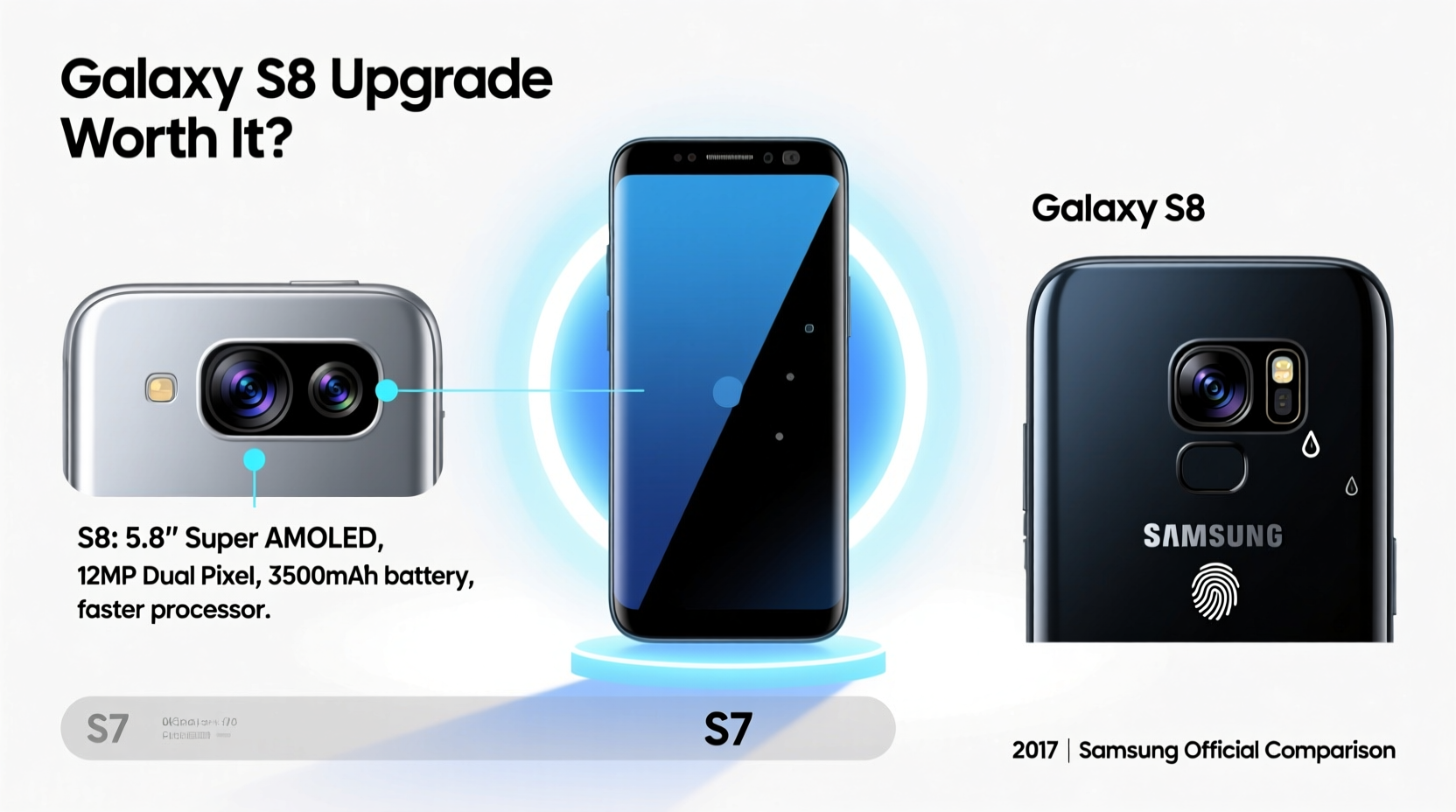
The most noticeable change between the S7 and S8 is the design language. The S8 introduced Samsung’s Infinity Display—a nearly bezel-less, edge-to-edge 5.8-inch Quad HD+ Super AMOLED screen with an 18.5:9 aspect ratio. Compared to the S7’s 5.1-inch 16:9 display, the S8 offers more screen real estate in a slightly taller but similarly compact frame.
This shift wasn't just aesthetic. The elongated screen improves multitasking, enhances video viewing, and makes scrolling through feeds smoother. The glass back (now Gorilla Glass 5) gives the S8 a premium feel and enables wireless charging—something the S7 lacked despite its IP68 rating.
Physical Comparison at a Glance
| Feature | Galaxy S7 | Galaxy S8 |
|---|---|---|
| Display Size | 5.1 inches | 5.8 inches |
| Resolution | 2560 x 1440 | 2960 x 1440 |
| Aspect Ratio | 16:9 | 18.5:9 |
| Build Material | Glass front, aluminum back | Glass front and back |
| Water Resistance | IP68 | IP68 |
| Wireless Charging | Yes (Qi/PMA) | Yes (Qi only) |
The S8 feels more modern and immersive, especially for media consumption. However, some users found the larger size less comfortable for one-handed use—though the taller screen actually fits more content vertically, reducing the need to scroll as often.
Performance and Software: Incremental Gains
Under the hood, both phones were powered by high-end chipsets of their time—the S7 used either Snapdragon 820 or Exynos 8890, while the S8 upgraded to Snapdragon 835 or Exynos 8895. In real-world usage, the performance jump is subtle. Apps open slightly faster, multitasking is smoother, and thermal management improved due to better power efficiency in the newer chipset.
RAM remained at 4GB, so there’s no advantage in multitasking capacity. However, the S8 shipped with Android 7.0 Nougat and received updates up to Android 9 Pie with One UI, offering longer software support than the S7, which topped out at Android 8.0 Oreo.
“While raw specs matter, long-term software support is what defines a phone’s usable lifespan. The S8’s extended update cycle gave users two extra years of security patches and feature improvements.” — David Kim, Mobile Analyst at TechPulse Asia
Battery Life: Trade-offs in Efficiency
The S7 packed a 3000mAh battery; the S8 stepped down to 3000mAh despite a larger screen. This raised concerns at launch, but thanks to the more efficient Snapdragon 835 and adaptive battery modes, real-world endurance is comparable. Both devices last a full day with moderate use.
However, the S8’s addition of wireless charging adds convenience, particularly for users building smart homes or using Qi-enabled furniture and cars. Fast charging is retained, though USB-C remains limited to 15W (Adaptive Fast Charging), same as the S7.
Camera: Refined, Not Revolutionized
The S7’s 12MP Dual Pixel rear camera set a high bar for low-light photography and autofocus speed. The S8 uses the same sensor but tweaks processing algorithms for improved dynamic range and color accuracy. In daylight, photos are sharper with better HDR handling. In low light, gains are marginal—some shots appear slightly brighter, but noise control doesn’t leap ahead.
The front-facing camera sees a bigger upgrade: 8MP on the S8 versus 5MP on the S7, with autofocus and better skin tone rendering. This benefits video calls and selfies, especially in varied lighting.
One notable addition is the bokeh effect simulation via software, enabled by facial recognition depth mapping. While not as accurate as dual-lens systems, it added a fun creative tool missing on the S7.
Camera Feature Comparison
- S7 Camera: 12MP f/1.7 rear, 5MP f/1.7 front, optical image stabilization (OIS), phase-detection autofocus
- S8 Camera: 12MP f/1.7 rear (same sensor), 8MP f/1.7 front with autofocus, OIS, improved HDR and face detection
- New Features: Portrait mode (software-based), intelligent scene detection (beta), AR Emoji precursor
User Experience and Ecosystem Integration
The S8 marked Samsung’s deeper push into ecosystem services. It was the first phone to include Bixby, Samsung’s AI assistant, alongside Samsung DeX—a desktop extension that turns the phone into a PC-like interface when connected to a monitor.
DeX was revolutionary for productivity-focused users. With a keyboard and mouse, the S8 could run multiple app windows, manage files, and even edit documents like a laptop. For professionals or students, this added tangible value beyond typical smartphone functions.
Bixby, however, had a rocky start. Voice commands were inconsistent, and many users preferred Google Assistant. Still, Bixby Routines (later updated) offered automation options that the S7 never received.
Mini Case Study: From S7 to S8 in Daily Use
Lena, a freelance graphic designer based in Berlin, held onto her Galaxy S7 for three years before upgrading to the S8. Her decision wasn’t driven by hardware failure but by workflow limitations.
“I loved my S7,” she said. “But editing mockups on that small screen became frustrating. When I got the S8, the bigger display alone changed how I worked. And DeX? Game-changer. I connected it to a second-hand monitor at my co-working space and ran Photoshop Express alongside email and Slack. I didn’t need to carry a laptop anymore.”
For Lena, the upgrade paid off not in flashier specs, but in expanded functionality that aligned with her mobile-first lifestyle.
Should You Upgrade? A Practical Checklist
Before making the move, consider these factors:
- Are you frustrated by the smaller screen size during media or work tasks?
- Do you want wireless charging capability?
- Have you encountered slow app launches or lag in recent months?
- Are you interested in using desktop-mode productivity (DeX)?
- Is your current phone showing battery degradation (e.g., drops from 100% to 50% in 2 hours)?
- Can you get a good trade-in value or discounted upgrade through your carrier?
If you answered “yes” to three or more, the S8 likely offers meaningful improvements. If your S7 still performs well and meets daily needs, the upgrade may be more cosmetic than functional.
Frequently Asked Questions
Can the Galaxy S8 still receive software updates?
No. Official security updates for the Galaxy S8 ended in 2020. While the phone remains functional, it lacks the latest protections and compatibility with newer apps that require recent Android versions.
Is the S8 significantly better in low light than the S7?
Not dramatically. Both share the same excellent 12MP sensor with Dual Pixel technology. The S8 applies slightly brighter processing, but the difference is minor. Lens quality and aperture (f/1.7) are identical.
Does the S8 fix the S7’s overheating issues during gaming?
Partially. The Snapdragon 835 runs cooler than the 820, reducing throttling during extended use. However, intensive games still generate heat, especially without proper ventilation. Using performance mode moderation helps maintain stability.
Final Verdict: Value Over Novelty
Upgrading from the Galaxy S7 to the S8 isn’t essential—but it can be worthwhile depending on your needs. The S8 delivers a modern design, a vastly superior display, enhanced front camera, and access to Samsung’s evolving ecosystem like DeX and Bixby. For users seeking a more immersive, future-ready experience, the upgrade makes sense.
However, if your S7 is still running smoothly, holds its charge, and meets your daily demands, the practical benefits may not justify the cost—especially given today’s availability of newer, more powerful models at similar price points on the secondhand market.
The Galaxy S8 wasn’t a revolution over the S7, but an evolution: sleeker, smarter, and more integrated. It honored the S7’s legacy while paving the way for the design and functionality standards we now expect in flagship phones.




 浙公网安备
33010002000092号
浙公网安备
33010002000092号 浙B2-20120091-4
Comments
No comments yet. Why don't you start the discussion?