
For new players stepping into the world of tactical first-person shooters, the decision between Valorant and Counter-Strike 2 (CS2) isn’t just about preference—it’s about understanding which game will challenge them more, reward precision, and demand long-term mastery. Both titles are elite in their own right, but when it comes to the skill ceiling for beginners, the answer isn't straightforward. While CS2 is rooted in raw mechanical execution and map control, Valorant layers strategy with agent abilities and tighter feedback loops. The real question is: which game asks more from a novice player over time?
The Foundations of Skill Ceiling
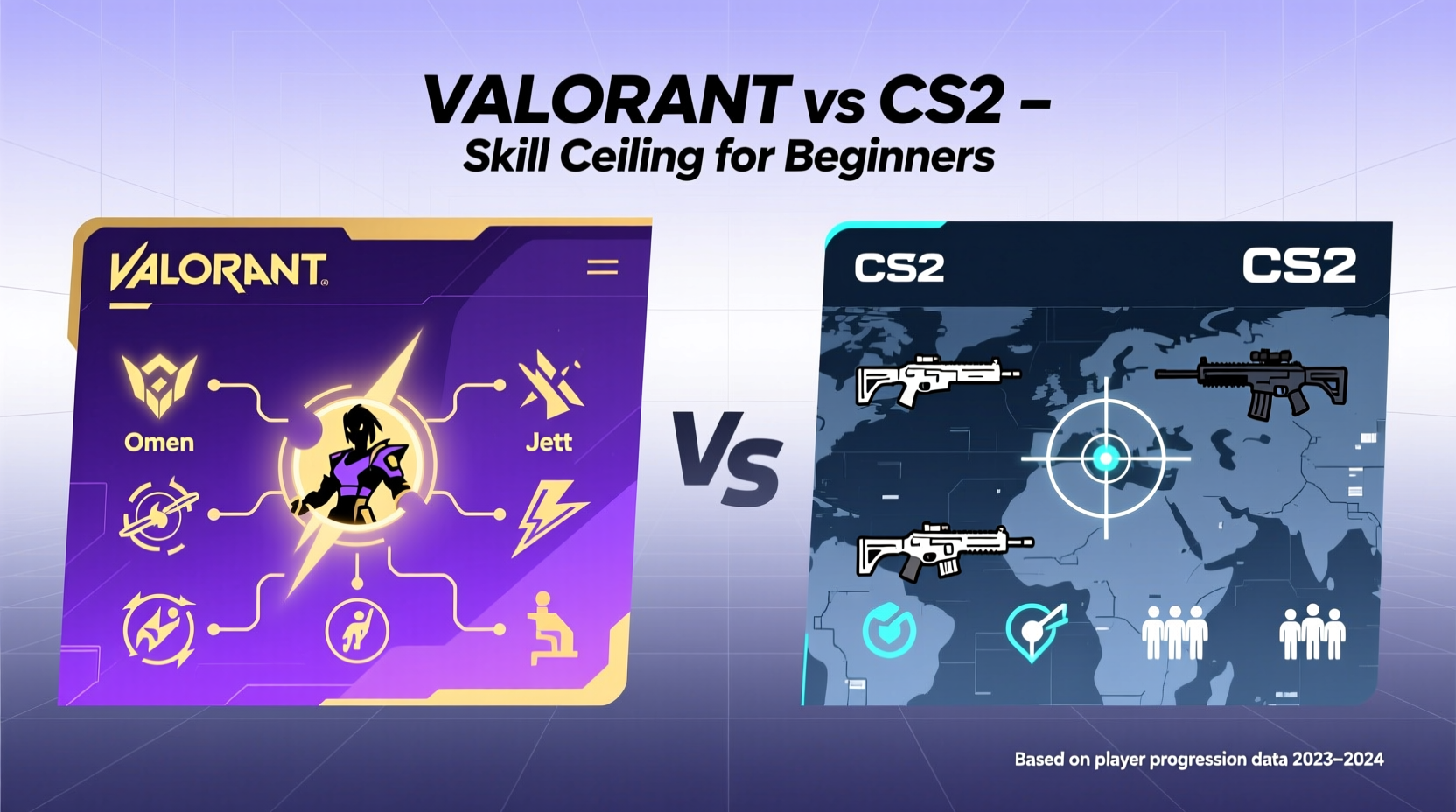
Skill ceiling refers to the upper limit of performance improvement possible within a game. A high skill ceiling means that even after thousands of hours, players can still refine mechanics, decision-making, positioning, and teamwork. For beginners, this translates to how steep the learning curve is and whether early progress feels rewarding or discouraging.
CS2, as the latest evolution of a franchise dating back to 2000, inherits a legacy of mechanical rigor. It emphasizes precise aiming, recoil control, economy management, and spatial awareness—all without the aid of character-specific powers. In contrast, Valorant, released in 2020 by Riot Games, introduces agent-based abilities, tighter gunplay tuning, and round-based pacing designed to be more accessible while still demanding strategic depth.
Beginners often mistake accessibility for lower skill ceilings. However, ease of entry doesn’t negate long-term complexity. The true test lies in how much room exists for growth beyond fundamentals—and here, both games diverge significantly.
Mechanical Demands: Aim, Movement, and Gunplay
At the core of any shooter is gunplay. How weapons handle, how movement affects accuracy, and how quickly players can acquire targets define the mechanical foundation of a game.
In CS2, weapon behavior is unforgiving. Each firearm has unique recoil patterns that must be mastered manually—there’s no aim assist, and minimal crosshair correction. Even slight mouse movements during spray control can mean the difference between a kill and death. Furthermore, movement penalties are severe: shooting while moving drastically reduces accuracy, and peeking techniques like jiggle peeking or quick peeks are essential for survival.
sv_cheats 1 and
bot_kick_all to isolate drills on empty maps.
Valorant, by design, reduces some of these mechanical burdens. Weapons have predictable, consistent recoil patterns, and many can be \"tamed\" through practice. While spray control matters, the system is more forgiving than CS2’s ballistic model. Additionally, movement while firing is less penalized, allowing newer players to stay mobile without sacrificing all accuracy.
However, this doesn’t mean Valorant lacks mechanical depth. One-shot headshot mechanics, faster time-to-kill (TTK), and pixel-perfect flick shots mean that elite-level play still demands exceptional hand-eye coordination. But for beginners, the initial barrier to landing kills is lower, making early progression feel more attainable.
Comparative Breakdown: Core Mechanics
| Mechanic | CS2 | Valorant |
|---|---|---|
| Recoil Control | Highly variable per weapon; manual compensation required | Predictable patterns; easier muscle memory development |
| Time-to-Kill (TTK) | ~500ms–700ms (AWP excluded) | ~400ms–500ms (higher lethality) |
| Movement Penalty | Severe; accuracy drops sharply while moving | Moderate; partial accuracy retention |
| Headshot Multiplier | 2.25x damage | 2.0x damage |
| Crouch Speed | Slower than walking | Same as walking |
The data shows that CS2 places heavier emphasis on precision and discipline. Beginners must learn not only how to aim but also when to move, when to hold, and how to manage micro-adjustments under pressure. Valorant streamlines some of this, prioritizing consistency and readability over realism.
Strategic Depth: Abilities, Economy, and Team Roles
Where CS2 relies almost entirely on player skill and communication, Valorant introduces a layer of systemic complexity through agent abilities. Each of the 20+ agents brings utility such as smokes, flashes, heals, or reconnaissance tools—requiring players to master not just gunplay, but also ability timing, cooldown management, and synergistic team composition.
This adds a cognitive load that CS2 does not impose. A beginner in CS2 needs to focus on positioning, utility usage (limited to grenades), and economy. In Valorant, they must simultaneously track ability charges, understand role responsibilities (duelist, initiator, sentinel, controller), and adapt strategies based on enemy agent picks.
“Valorant rewards strategic foresight as much as twitch reflexes. You can lose a round despite winning every gunfight if your utility is outplayed.” — Adrian Lin, Esports Analyst at BLAST.tv
Yet, this added complexity doesn’t necessarily raise the *absolute* skill ceiling above CS2—it redistributes where skill is applied. In CS2, excellence is concentrated in individual execution. In Valorant, success emerges from coordinated systems: did the team execute the site take correctly? Was the spike planted with proper cover? Did the defender rotate in time?
For beginners, this means failure isn’t always due to poor aim. Misusing an ability, misunderstanding callouts, or misreading a teammate’s intent can cost rounds just as easily. This broader range of failure points makes early learning more multidimensional—but also more frustrating when things go wrong without clear cause.
Mini Case Study: Two New Players, Two Paths
Consider two hypothetical players: Alex starts with CS2, Jamie with Valorant. Both have no prior FPS experience.
Alex struggles for weeks. Early matches are brutal—enemies seem to react faster, land impossible shots, and vanish behind corners. Spray control feels inconsistent. After 20 hours, Alex finally lands a clutch 1v2 by mastering the FAMAS burst pattern and executing a well-timed flashbang. The victory feels earned, but progress remains slow.
Jamie, meanwhile, enters Valorant and immediately uses Sage’s wall to block an attacker. They die frequently, but small wins accumulate: planting the spike unseen, blinding an opponent before a team push, surviving a round thanks to a heal. By hour 20, Jamie understands basic agent roles and can contribute meaningfully even without high kill counts.
Both players are growing, but their experiences differ. Alex faces a steeper initial climb with fewer positive reinforcements. Jamie enjoys quicker feedback but may plateau earlier without dedicated aim training.
Learning Curve and Long-Term Mastery
The skill ceiling isn’t just about how hard a game is to start—it’s about how far a player can go. Here, CS2 arguably holds a higher peak.
Professional CS2 players exhibit near-superhuman levels of consistency: hitting 200+ DPI flicks with sub-10ms reaction times, executing multi-layered executes with perfect sync, and reading opponents through minute audio cues and positional tells. The margin for error at the top is microscopic. Mastery requires thousands of hours of aim training, demo review, and in-game repetition.
Valorant’s pro scene, while highly skilled, operates under tighter constraints. Agent abilities create predictable patterns—certain smokes are thrown the same way every time. Rotations follow established meta paths. While mechanical skill is still paramount (watch any Sentinels highlight reel), the presence of ability cooldowns and fixed utility limits introduces more predictability into high-level play.
That said, Valorant’s evolving meta—new agents, balance changes, map updates—keeps strategic innovation alive. The game challenges players to adapt faster than CS2, where fundamentals change very slowly. So while CS2 may demand more from pure shooters, Valorant demands greater flexibility and tactical awareness.
Step-by-Step Guide: Building Skills as a Beginner
Regardless of which game you choose, structured progression increases your chances of breaking through plateaus. Follow this timeline to build competence:
- Week 1–2: Master the Basics
Play Deathmatch daily. Focus on crosshair placement, mouse sensitivity, and one-tap headshots. Learn weapon handling and reload mechanics. - Week 3–4: Learn Map Fundamentals
Study callouts, common angles, and bombsite layouts. Practice grenade throws (smokes, flashes) until consistent. - Month 2: Join Custom Games
Play with friends or in low-pressure lobbies. Work on rotations, communication, and role-specific tasks (e.g., entry fragging, support). - Month 3: Analyze Your Gameplay
Record demos or VODs. Identify recurring mistakes: Are you peeking too early? Missing sprays? Wasting utility? - Month 4+: Specialize and Refine
Focus on 1–2 agents (Valorant) or 1–2 rifles (CS2). Drill specific scenarios like 1v1 retakes or eco-round executions.
Frequently Asked Questions
Is Valorant easier than CS2 for beginners?
Yes, in terms of immediate accessibility. Valorant’s consistent gunplay, helpful UI, and agent abilities allow new players to contribute meaningfully faster than in CS2. However, reaching high ranks still requires significant effort in both games.
Can I transfer skills from CS2 to Valorant?
Absolutely. Crosshair placement, map awareness, and game sense translate directly. However, you’ll need to adjust to faster TTK, ability timing, and different grenade mechanics. Many CS veterans succeed in Valorant due to strong fundamentals.
Which game has more room for improvement at the highest level?
CS2 likely has a slightly higher absolute skill ceiling due to its reliance on pure mechanical execution and minimal abstraction. However, Valorant offers deeper team-based strategy and adaptive gameplay, making mastery multifaceted rather than purely reactive.
Conclusion: Choose Based on Your Growth Goals
The debate over which game has the higher skill ceiling isn’t settled by mechanics alone. CS2 demands more from individuals—its purity of gunplay creates a taller peak for mechanical mastery. Valorant spreads skill across multiple domains: aim, utility, communication, and macro-strategy—making it more complex in structure but slightly more forgiving in execution.
For beginners who thrive on incremental progress and enjoy contributing to team outcomes beyond just kills, Valorant may feel more rewarding early on. Those drawn to precision, realism, and raw competitive intensity will find CS2’s challenges deeply satisfying—even if the journey is longer and lonelier.
Ultimately, both games offer rich, enduring experiences. The best choice depends not on which has the higher ceiling, but which environment inspires you to keep climbing.




 浙公网安备
33010002000092号
浙公网安备
33010002000092号 浙B2-20120091-4
Comments
No comments yet. Why don't you start the discussion?