
The debate between Valorant and CS:GO (Counter-Strike: Global Offensive) isn't just about graphics, maps, or popularity—it's also about how difficult each game is to learn and master. Both are tactical first-person shooters with high skill ceilings, but they approach gameplay differently. One emphasizes raw mechanical precision and economy management; the other blends gunplay with character-based abilities. So which has a steeper learning curve? The answer depends on what kind of player you are, your experience level, and what aspects of gameplay you find most challenging.
While both games demand excellent aim, map knowledge, communication, and strategic thinking, their mechanics diverge in ways that significantly affect how quickly new players can become competent—and eventually competitive.
The Core Differences That Shape Learning Difficulty
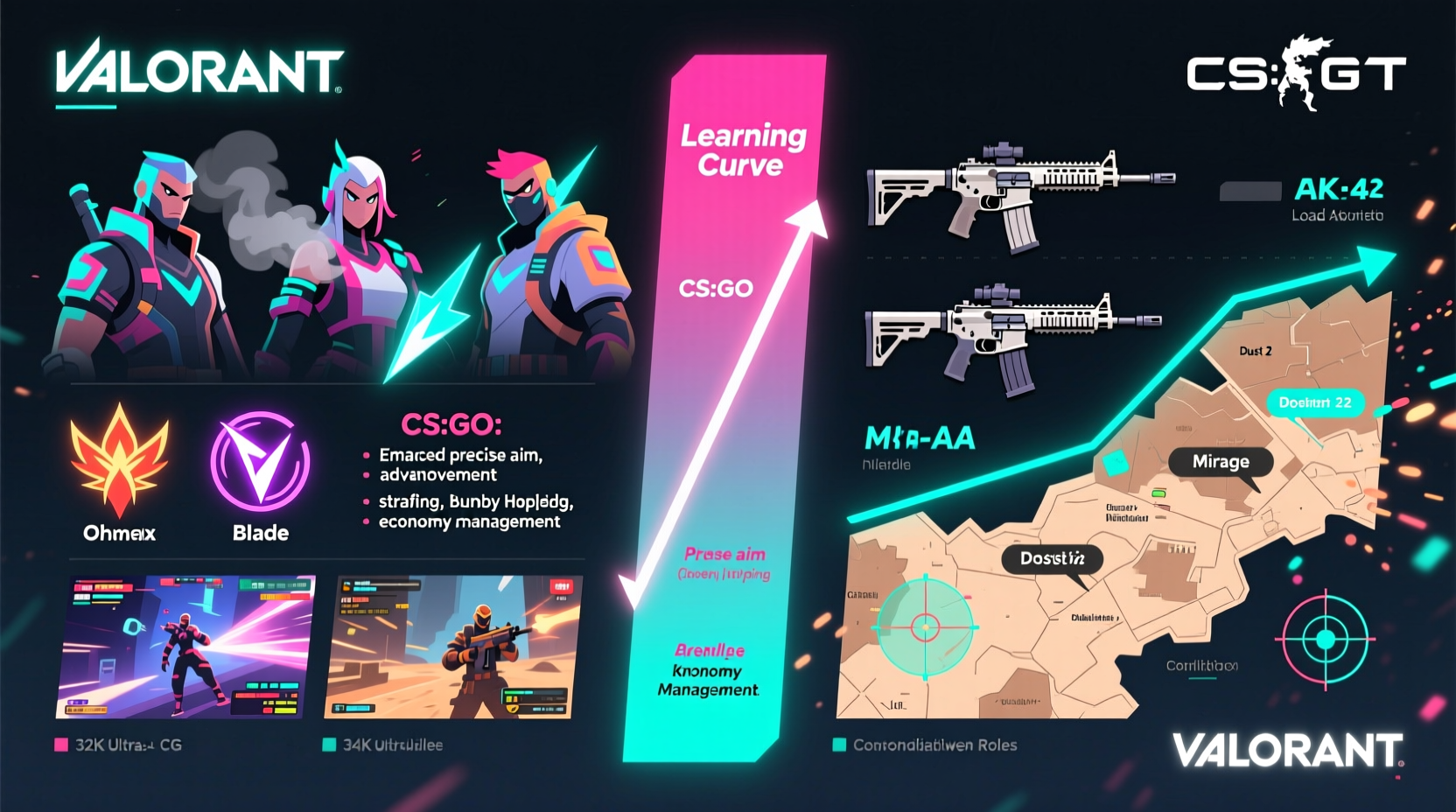
At first glance, Valorant and CS:GO may seem nearly identical: 5v5 team-based modes, bomb defusal objectives, buy phases, and intense one-life rounds. But beneath the surface, key design decisions create vastly different experiences for newcomers.
CS:GO strips away almost all non-gunplay elements. There are no abilities, no characters, no cooldowns—just weapons, utility (smokes, flashes, HE grenades), movement mechanics like jump throws, and an unforgiving economy system. Mastery comes from repetition: learning recoil patterns, mastering spray control, understanding timings, and internalizing map callouts.
Valorant, developed by Riot Games, introduces agent-based abilities. Each of the 20+ agents has unique skills—affecting vision, mobility, area denial, or information gathering. This adds a layer of complexity absent in CS:GO. New players must not only learn how to shoot but also understand when and how to use abilities effectively, manage ability cooldowns, and synergize with teammates’ kits.
“CS:GO rewards consistency above all. You don’t get second chances if your crosshair placement is off by five pixels.” — Marcus Tran, Former Pro Coach (Team Liquid Academy)
Breaking Down the Learning Curve Components
To fairly compare the two games, it helps to break down the learning curve into core components:
- Aim and Mechanics
- Game Sense and Map Knowledge
- Economy Management
- Communication and Team Coordination
- Ability Usage (in Valorant)
Let’s examine each category across both titles.
Aim and Gunplay Precision
In CS:GO, weapon behavior is highly realistic. Weapons have strong recoil patterns that require muscle memory to control. Spray tracking is essential, especially at long range. Even slight mouse sensitivity mismatches or poor crosshair placement can lead to instant elimination.
Additionally, CS:GO lacks damage indicators. If you're shot, you won’t see where the bullets came from unless someone calls it out. This forces players to develop spatial awareness through sound cues and positioning alone.
Valorant simplifies some aspects of gunplay. Recoil patterns exist, but they’re more predictable and consistent. Most weapons reset after a brief pause during sustained fire, making burst firing or short taps easier to manage. Also, every bullet hit produces a visual tracer and audio cue, helping players adjust aim mid-fight.
Map Knowledge and Positioning
Both games require deep map knowledge, but CS:GO demands near-perfect recall of angles, common peek spots, and grenade lineups. Because there are no abilities to reveal enemies, players rely heavily on pre-planned strategies and predictive play.
For example, executing a successful flashbang up B site stairs on de_dust2 requires precise mouse angle, jump timing, and throw arc—all practiced hundreds of times. Mistakes are punished instantly.
Valorant reduces this burden slightly. Agents like Sova or Skye can scout ahead with recon darts or trackers, revealing enemy positions without direct line of sight. While knowing map geometry remains critical, the availability of intel tools lowers the pressure on individual prediction skills.
Economy and Resource Management
CS:GO’s economy system is notoriously complex. Teams earn money based on round outcomes, kills, and objectives. Deciding whether to full-buy, eco, or force-buy requires constant calculation and coordination. Poor economic decisions—even by one player—can cripple a team for multiple rounds.
New players often struggle with when to save, when to spend, and how to recover from a loss streak. Misunderstanding the value of utility (e.g., buying a flash instead of a vest) leads to inefficient spending.
Valorant streamlines this. Every player gets a base amount each round, plus bonuses for kills and objective success. Abilities recharge over time, eliminating the need to purchase utility. While there’s still strategy in saving for powerful guns like the Operator sniper rifle, the overall economic pressure is reduced.
Communication and Team Role Clarity
Both games thrive on communication, but CS:GO places heavier emphasis on verbal coordination due to lack of active feedback systems. Without voice comms, surviving even low-rank matches becomes extremely difficult.
Valorant includes built-in ping systems and visual ability markers, allowing silent players to contribute meaningfully. While voice chat enhances performance, it’s less mandatory than in CS:GO.
Moreover, Valorant assigns clearer roles via agent selection. Initiators gather info, controllers block sites, duelists push angles, and sentinels defend. This structure helps newer players understand their responsibilities within a team.
Comparative Breakdown: Where the Difficulty Lies
| Skill Area | CS:GO Difficulty | Valorant Difficulty | Notes |
|---|---|---|---|
| Aim & Spray Control | High | Medium-High | CS:GO has harsher recoil; Valorant offers reset windows. |
| Map Lineups & Grenades | Very High | Medium | CS:GO relies on perfect grenade throws; Valorant uses agent abilities as alternatives. |
| Economy Management | Very High | Low-Medium | CS:GO requires strict budgeting; Valorant auto-recharges abilities. |
| Agent/Class System | N/A | High | Valorant requires learning 20+ agents and their synergy. |
| Game Sense Development | High | High | Both require pattern recognition, but CS:GO gives fewer clues. |
| Entry Fragging Pressure | Extreme | High | Mistakes in entry duels are fatal in both, but CS:GO offers no recovery. |
Real Player Experience: A Mini Case Study
Jamie, a 24-year-old player transitioning from Overwatch to tactical shooters, tried both games over six months. Starting with Valorant, she found early success thanks to intuitive aiming and helpful agent tools. Within three weeks, she reached Silver rank and felt confident in basic fights.
When she switched to CS:GO, progress stalled immediately. “I kept dying before I even saw anyone,” she said. “There was no ping system, no drones, no flashes that guaranteed a blind. I didn’t know where to look. And when I finally got a kill, I’d waste my money on the wrong gear.”
After two months of daily practice, Jamie improved her spray control and learned basic smokes for de_mirage. Still, she ranked up slower than in Valorant. “It felt like I had to relearn everything—not just shooting, but how to think, move, and communicate.”
Her experience reflects a broader trend: players accustomed to ability-driven shooters often find CS:GO’s minimalism disorienting and punishing.
Step-by-Step Progression Timeline for New Players
Here’s a realistic timeline showing how a dedicated new player might progress in each game:
- Week 1–2: Learn basic movement, weapon handling, and agent roles (Valorant) or pistol/buy phases (CS:GO).
- Week 3–4: Begin practicing aim in deathmatch; memorize one map layout; start using voice chat.
- Month 2: Understand economy basics; execute simple strategies; recognize common enemy setups.
- Month 3: Master one primary weapon type; learn at least two grenade lineups (CS:GO) or one full agent kit (Valorant).
- Month 4–6: Develop consistent crosshair placement; improve game sense; climb into mid-tier ranks (Gold in Valorant, MG-Eagle in CS:GO).
Note: Reaching competitive proficiency (top 20%) takes **6–12 months** in CS:GO versus **3–6 months** in Valorant for most players.
Expert Insight: What Coaches Say About the Learning Gap
“The fundamental difference is forgiveness. Valorant allows mistakes—missed shots, bad ability usage—to be recovered from. CS:GO doesn’t. One slip-up ends your round. That psychological pressure slows down learning.” — Lena Park, Esports Performance Analyst
Another factor cited by coaches is the role of feedback loops. In Valorant, ability hits register clearly. A Sova bolt hitting an enemy provides confirmation and data. In CS:GO, unless you land a visible shot or hear a death sound, you often don’t know if your spray went wide or the enemy simply survived with low health.
This delayed or missing feedback makes self-correction harder, slowing skill acquisition.
Frequently Asked Questions
Is Valorant easier than CS:GO overall?
For beginners, yes—especially those unfamiliar with tactical shooters. Valorant’s guided mechanics, visual feedback, and agent utilities reduce initial frustration. However, mastering top-tier play in Valorant still requires elite aim and coordination.
Can CS:GO players adapt easily to Valorant?
Generally, yes. Strong fundamentals in crosshair placement, map awareness, and game sense transfer well. Many pro CS:GO players who’ve switched to Valorant (like ShahZaM and Ethan) adapted quickly, though they initially underestimated the importance of ability timing and cooldown management.
Which game has a higher skill ceiling?
Both have extremely high ceilings, but in different areas. CS:GO’s ceiling lies in mechanical perfection and micro-decisions under pressure. Valorant’s ceiling involves macro-strategy, ability combos, and team composition synergy. Neither is objectively “harder” at the highest level—but CS:GO’s path to competence is longer and steeper.
Final Verdict: Which Shooter Has the Steeper Learning Curve?
If we define \"steeper learning curve\" as the rate at which a beginner improves toward functional competency, then CS:GO clearly has the steeper curve.
The absence of quality-of-life aids, reliance on memorized grenade lineups, harsh economic penalties, and minimal feedback make early progression slow and often discouraging. New players face a wall of complexity with little guidance.
Valorant, while still demanding, lowers several barriers. Agent abilities compensate for imperfect aim. Visual hit indicators help refine accuracy. Built-in pings allow participation without voice chat. These features don’t dumb down the game—they make foundational concepts more accessible.
That said, reaching the highest levels in either title requires thousands of hours of deliberate practice. The gap narrows significantly once players surpass intermediate ranks. At Radiant (Valorant) or Global Elite (CS:GO), differences in mechanical skill, decision-making speed, and teamwork dominate over systemic advantages.
Actionable Checklist for New Players
Whether you're starting with Valorant or CS:GO, follow this checklist to accelerate your growth:
- ✅ Spend 15 minutes daily in the aim trainer or deathmatch mode
- ✅ Learn one map at a time—focus on callouts and common rotations
- ✅ Watch pro gameplay to study positioning and utility usage
- ✅ Play with voice chat or use pings to stay engaged in team strategy
- ✅ Review your deaths—were you outgunned, outpositioned, or unaware?
- ✅ Stick to one primary role or agent/class until comfortable
- ✅ Avoid tilting—take breaks after tough losses to maintain focus
Conclusion: Choose Based on Your Goals, Not Just Difficulty
The question of which game has a steeper learning curve matters, but so does enjoyment. If you crave a pure test of mechanical skill and thrive under pressure, CS:GO will challenge you like few other games. If you prefer structured progression, creative ability usage, and faster feedback, Valorant offers a more welcoming—but still deeply competitive—experience.
Neither is inherently better. But if you're asking which will take longer to get good at, the answer is clear: CS:GO demands more time, patience, and resilience from newcomers. Its learning curve isn’t just steep—it’s rocky, unmarked, and relentless.




 浙公网安备
33010002000092号
浙公网安备
33010002000092号 浙B2-20120091-4
Comments
No comments yet. Why don't you start the discussion?