
In an era where digital downloads dominate game distribution, the debate over value retention between vintage gaming cartridges and modern digital titles has never been more relevant. While convenience favors digital, longevity, scarcity, and cultural sentiment often tip the scales toward physical media—especially retro cartridges. The question isn't just about playability or nostalgia; it's about investment, preservation, and what truly endures in a rapidly shifting technological landscape.
Unlike downloadable games tied to platforms, accounts, or servers that may vanish, vintage cartridges are tangible artifacts. They can be bought, sold, stored, and passed down like heirlooms. But does this tangibility translate into lasting financial and cultural value? To answer that, we must examine durability, market trends, ownership rights, and collector behavior across decades.
The Tangible Advantage: Why Cartridges Retain Value
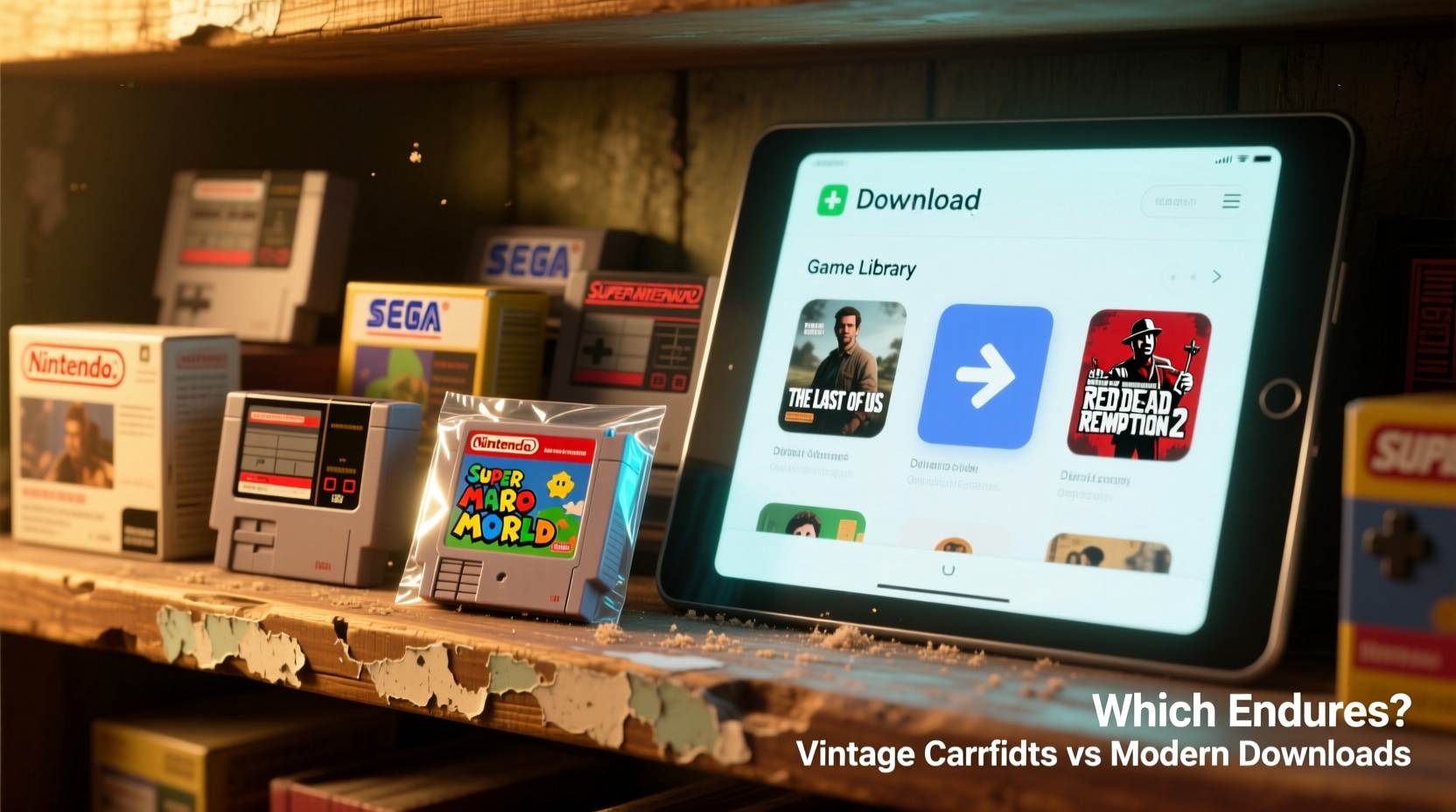
Vintage gaming cartridges, particularly from systems like the NES, SNES, Game Boy, and Sega Genesis, have demonstrated remarkable staying power in both cultural relevance and monetary worth. Their physical nature allows for independent ownership—no account logins, no platform dependency, no risk of delisting. A sealed copy of *The Legend of Zelda* for the NES recently sold for over $800,000 at auction, a staggering figure driven by rarity, condition, and historical significance.
Cartridges are built to last. Constructed with durable plastic casings and ROM chips shielded from moisture and electromagnetic interference, they resist degradation far better than optical discs or cloud-based files. When stored properly, a cartridge from the 1980s can still boot up flawlessly today. This resilience contributes directly to their long-term value.
Moreover, the scarcity of original, factory-sealed games creates a competitive collector’s market. Limited print runs, regional exclusives, and promotional variants (like Nintendo Power Fandom Club editions) amplify desirability. Unlike digital games, which can be replicated infinitely on servers, each physical cartridge is a finite object—once lost or damaged, it cannot be replaced identically.
Digital Downloads: Convenience at a Cost
Modern digital downloads offer instant access, save space, and eliminate wear and tear. Platforms like Steam, PlayStation Store, and Nintendo eShop allow gamers to build vast libraries without shelves. However, this convenience comes with significant trade-offs in terms of ownership and longevity.
When you \"buy\" a digital game, you're typically purchasing a license to use it—not the file itself. That license is bound to your account and subject to the policies of the platform holder. If a service shuts down, a game gets delisted, or your account is banned, access disappears. Consider the delisting of *Mass Effect: Legendary Edition* from digital storefronts due to expiring music licenses—a reminder that digital availability is not guaranteed.
Digital games also lack physical scarcity. There’s no “rare” version of a PS5 download unless artificially created through timed exclusives or cosmetic bundles. Without scarcity, there’s little room for appreciation in value. In fact, prices trend downward due to frequent sales and subscription models like Xbox Game Pass or PlayStation Plus.
“Digital ownership is an illusion. You don’t own the game—you rent access to it.” — Jason Schreier, investigative journalist and author of *Press Reset*
Market Trends: Collector Demand vs. Digital Obsolescence
Over the past decade, the retro gaming market has exploded. According to data from Heritage Auctions, video game collectibles generated over $30 million in sales in 2022 alone, with cartridges making up the bulk of high-value transactions. Grading services like WATA have professionalized the market, assigning condition scores that directly influence resale prices.
In contrast, digital games show no secondary market. You can’t resell a Steam purchase or gift a downloaded title on PSN (outside limited gifting features). This absence of transferability undermines long-term value. A game purchased in 2010 for $60 may now be worth nothing if it’s delisted or forgotten.
Meanwhile, well-preserved cartridges appreciate. A loose copy of *Super Mario Bros.* in good condition might sell for $50–$100. The same game in factory-sealed, graded 9.8 condition can exceed $10,000. This kind of appreciation is impossible in the digital realm.
Comparison Table: Cartridges vs. Downloads
| Factor | Vintage Cartridges | Modern Downloads |
|---|---|---|
| Ownership | Full physical ownership | Licensed access only |
| Resale Value | High (especially sealed/graded) | None (no secondary market) |
| Durability | Decades-long lifespan with care | Dependent on servers and hardware |
| Rarity & Scarcity | Natural scarcity increases value | No inherent scarcity |
| Platform Risk | Playable on original or flash carts | Requires active platform support |
| Long-Term Appreciation | Proven track record | None observed |
Real Example: The Case of EarthBound
No discussion of cartridge value is complete without mentioning *EarthBound* for the SNES. Released in 1995 to poor sales, it was nearly forgotten in North America. Original copies were common and cheap throughout the 2000s. But as cult interest grew online, demand surged. By 2013, unopened copies began selling for thousands. Today, a WATA 9.8 graded sealed copy has fetched over $70,000.
This transformation wasn’t driven by gameplay alone—it was fueled by nostalgia, community mythos, and the game’s status as a rare physical artifact. Contrast this with its digital re-release on the Wii U and Switch Online. While accessible, the digital version carries none of the cultural weight or investment potential. It’s available to millions simultaneously, stripping away exclusivity.
The *EarthBound* phenomenon illustrates a broader truth: emotional resonance combined with physical scarcity creates enduring value. Digital versions, while convenient, fail to replicate this dynamic.
Preserving Value: A Step-by-Step Guide for Collectors
If you’re considering building a collection with long-term value in mind, follow this practical timeline to maximize returns and preservation:
- Identify High-Potential Titles: Focus on games with strong fanbases, limited releases, or historical significance (e.g., launch titles, RPGs, or system exclusives).
- Assess Condition Honestly: Use grading standards (like WATA’s) to evaluate box, manual, cartridge, and seal integrity. Even minor wear affects value.
- Store Properly: Keep cartridges in climate-controlled environments. Avoid basements or attics with humidity fluctuations.
- Consider Professional Grading: Services like WATA or VGA add credibility and can significantly boost resale price—especially for sealed items.
- Monitor Market Trends: Track auction results on eBay, Heritage Auctions, and PriceCharting to understand demand cycles.
- Hold Long-Term: Like fine art or classic cars, vintage games appreciate over time. Avoid selling during short-term spikes unless necessary.
Common Myths About Digital Preservation
Many assume digital games are “safer” because they aren’t prone to physical damage. This is a misconception. Digital obsolescence is real. Consider:
- Games delisted due to licensing (e.g., *Tony Hawk’s Pro Skater 2* on GBA).
- Servers shut down (e.g., *Flower, Sun, and Rain* on Wii).
- Hardware incompatibility (e.g., early iPhone games lost after iOS updates).
Even emulated versions rely on legal gray areas and technical expertise. Meanwhile, a cartridge can be played decades later with minimal effort—just plug it in.
Expert Insight: The Future of Game Ownership
As streaming and subscription models grow, the idea of owning individual games fades. Microsoft and Sony increasingly push Game Pass and PS Plus, where access expires if you cancel. This shift alarms preservationists.
“The greatest threat to gaming history isn’t decay—it’s disappearance. If we don’t preserve physical copies, future generations won’t experience these games at all.” — Frank Cifaldi, founder of the Video Game History Foundation
Cifaldi’s work highlights how cartridges serve as time capsules. They preserve not just code, but packaging, manuals, and cultural context. Digital downloads offer none of this. A Steam library tells you what you played—but a shelf of cartridges tells a story.
FAQ: Your Questions Answered
Can digital games ever gain value?
Currently, no. Without scarcity, transferability, or ownership rights, digital games don’t function as collectibles. Some NFT-based experiments have attempted to create digital scarcity, but these remain niche and controversial.
Are all vintage cartridges valuable?
No. Only a small percentage—particularly rare, sealed, or culturally iconic titles—are worth significant money. Common games in poor condition may only be worth a few dollars. Research is essential before investing.
Will modern physical games (like Switch cartridges) become valuable?
Possibly, but less likely than retro titles. Modern production volumes are higher, and many games receive re-releases. However, first-print runs of popular titles (e.g., *The Legend of Zelda: Breath of the Wild*) or region-exclusive editions could appreciate over decades.
Checklist: Building a Valuable Retro Game Collection
- ✅ Focus on games from 1980–2000 (peak cartridge era)
- ✅ Prioritize sealed or mint-condition items
- ✅ Include box, manual, and inserts for full value
- ✅ Grade high-value items through WATA or similar
- ✅ Store in UV-protected, temperature-stable environment
- ✅ Track purchases and maintain provenance records
- ✅ Join collector communities for market insights
Conclusion: Value Beyond the Screen
The choice between vintage cartridges and modern downloads isn’t just about how we play—it’s about what we preserve. Cartridges represent ownership, history, and scarcity—three pillars of lasting value. Downloads offer ease and immediacy but lack permanence, transferability, and investment potential.
While digital gaming will continue to dominate, the collectors’ market proves that physical media still matters. For those who value legacy, authenticity, and long-term worth, vintage cartridges are not just nostalgic relics—they’re appreciating assets. Whether you’re a casual player or serious collector, understanding this distinction empowers smarter decisions about what to buy, keep, and pass on.




 浙公网安备
33010002000092号
浙公网安备
33010002000092号 浙B2-20120091-4
Comments
No comments yet. Why don't you start the discussion?