
Every ornament on a tree tells a story—not just about the season, but about who placed it there, when, and why. Some gleam with factory-fresh precision; others bear faint scratches, faded paint, and the quiet weight of decades. The question isn’t whether one is more beautiful than the other. It’s whether sentiment, like fine wine, deepens with age—or if it blooms brightest in the moment it’s created. Sentimental value doesn’t reside solely in material or era; it lives in the interplay of memory, continuity, and intention. Understanding how vintage ornaments and modern bling accrue, retain, and transmit emotional meaning reveals something deeper about how we anchor ourselves in time.
The Anatomy of Sentimental Value
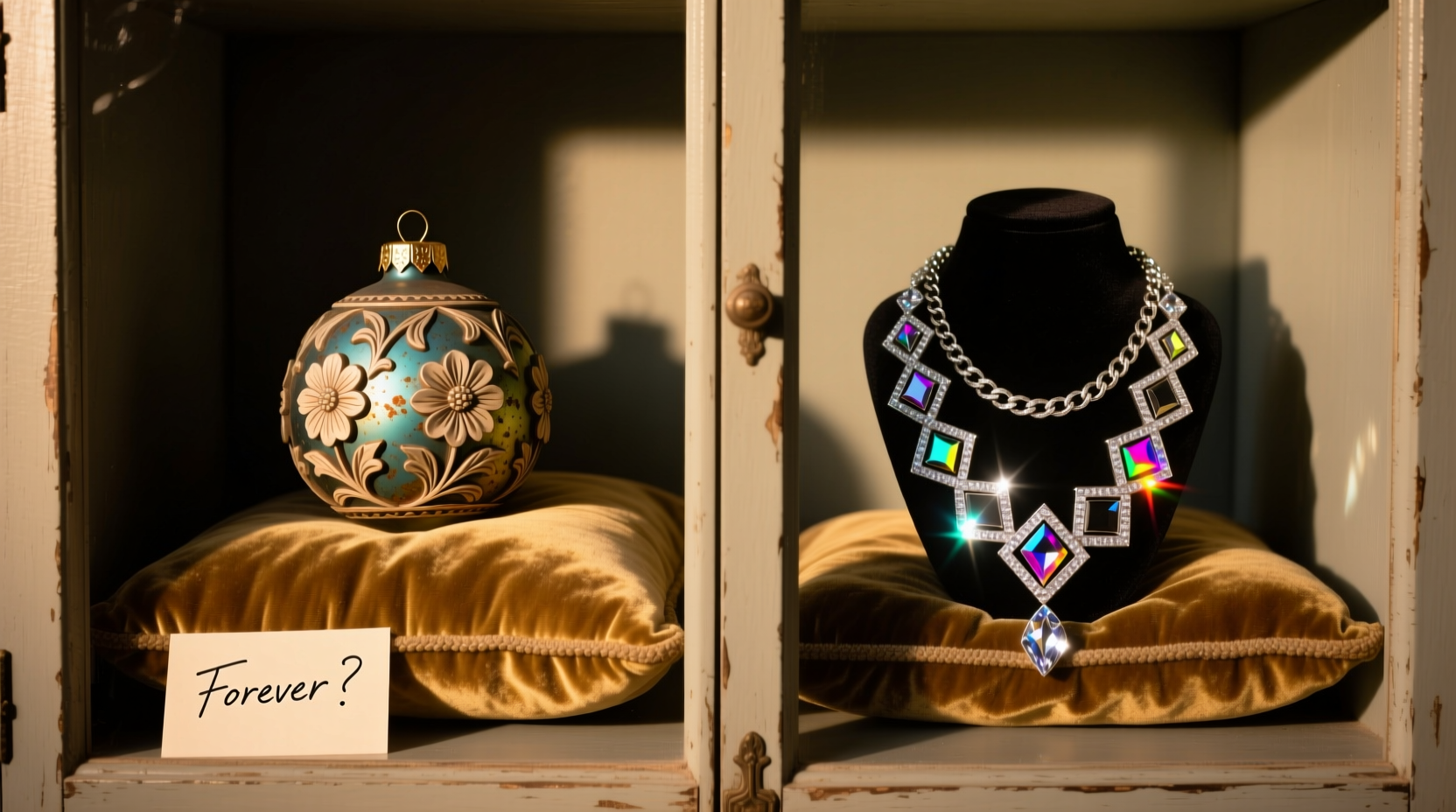
Sentimental value isn’t inherent—it’s conferred. Psychologists describe it as “associative value”: an object becomes meaningful because it’s tethered to a person, event, identity, or period of life. Three elements consistently strengthen that tether: biographical linkage (e.g., “This was Grandma’s first Christmas in America”), material continuity (the physical object persists across years), and intergenerational transmission (it’s passed down, not purchased anew). When all three align, sentiment doesn’t just endure—it compounds.
Vintage ornaments—typically defined as those made before 1980, especially hand-blown glass, hand-painted wood, or early pressed tin—often arrive pre-loaded with biographical linkage. They carry maker’s marks, regional motifs, or stylistic signatures that place them in a specific cultural moment. Modern bling—think LED-lit acrylic baubles, metallic resin stars, or personalized photo ornaments—usually begins with a clean slate: its meaning is assigned at acquisition, not inherited. That doesn’t make it shallow. But it does shift the burden of meaning-making onto the owner, not the object’s history.
How Vintage Ornaments Accumulate Emotional Resonance Over Time
Vintage ornaments rarely enter a home as isolated objects. They arrive embedded in narrative: “This angel came from the church bazaar in ’53,” “These glass icicles were hung by my father’s hands every year until he passed.” Their physical imperfections—tiny chips, clouded silvering, slight warping from heat exposure—don’t diminish value. They authenticate time’s passage. A 1947 Shiny Brite bulb isn’t prized for perfection; it’s revered because it survived the postwar era, the baby boom, divorce, relocation, and multiple generations’ hands.
This durability creates what heritage scholars call “tactile memory”—the way repeated handling imprints subtle traces of use that later owners feel, even if they can’t name them. Holding a worn wooden nutcracker carved in 1922 carries different psychological weight than unboxing a factory-sealed replica. The original bears evidence of real lives lived, not curated aesthetics.
Why Modern Bling Often Peaks Early—Then Fades
Modern bling excels at capturing immediate, high-intensity meaning: a first apartment ornament, a baby’s first Christmas, a wedding year keepsake. Its strength lies in precision personalization—names laser-etched, photos embedded, colors matched to nursery palettes. That specificity makes it profoundly meaningful *at the time of gifting or acquisition*. But that same precision can limit longevity. A “Baby’s First Christmas 2023” ornament loses associative flexibility as the child grows. Its meaning is chronologically bound, not expandable.
Materially, many modern ornaments prioritize visual impact over heirloom durability. Acrylic yellows, metallic coatings flake, battery compartments corrode, and adhesives fail. Unlike vintage glass—which was annealed for structural integrity—much contemporary ornament production optimizes for low-cost mass appeal, not multi-decade survival. Without physical endurance, sentimental continuity fractures.
That said, exceptions exist. Hand-thrown ceramic ornaments signed by local potters, engraved brass stars commissioned for milestone anniversaries, or heirloom-quality sterling silver pieces designed for engraving and passing down operate on a different axis—they’re modern in origin but vintage in *intention*. Their longevity hinges less on era and more on deliberate craftsmanship and transmission planning.
A Comparative Framework: What Sustains Meaning Across Decades?
| Factor | Vintage Ornaments | Modern Bling |
|---|---|---|
| Origin of Meaning | Embedded in historical context, craftsmanship, and prior ownership | Assigned at point of purchase or gifting; highly personal but temporally narrow |
| Material Longevity | Often glass, wood, metal—designed for reuse; degrades slowly with care | Frequent use of plastics, resins, electronics—prone to yellowing, cracking, battery failure |
| Adaptability of Meaning | Meaning expands: from family ritual to cultural artifact to teaching tool for grandchildren | Meaning often contracts: tied to specific life stage or relationship phase |
| Transmission Readiness | Often accompanied by oral history; physically built for handling and display over generations | Rarely includes documentation; may lack physical sturdiness for long-term handling |
| Risk of Obsolescence | Low—stylistic shifts don’t erase historical significance | Moderate to high—designs date quickly; tech-dependent pieces become unusable |
Mini Case Study: The Two Ornaments on One Tree
In Portland, Oregon, Maya Chen displays two ornaments side-by-side on her Douglas fir each December. One is a hand-blown glass robin, circa 1938, purchased by her great-grandmother at a Woolworth’s counter during the Depression. Its silvering has dulled to a soft pewter, and a hairline crack runs vertically—repaired with clear archival glue in 1972 by Maya’s grandfather. The second is a custom acrylic snowflake engraved with “Maya & Leo — Married 2019,” lit by micro-LEDs powered by a CR2032 battery.
Each year, Maya tells her daughter about the robin: how her great-grandmother saved dimes for months to buy it, how it survived the move from Shanghai to San Francisco in ’49, how it hung on every tree from 1938 to 2023—even during wartime blackouts, lit only by candlelight. The story evolves. Last year, her daughter asked, “Did Great-Grandma miss China when she hung it?” That question wouldn’t arise with the snowflake.
The snowflake remains beautiful—and deeply meaningful—but its narrative hasn’t expanded beyond its origin point. When the battery died last December, Maya replaced it, but didn’t tell her daughter why it flickered. There’s no inherited lore to pass on. The robin, however, now serves as a bridge between three generations’ experiences of displacement, resilience, and quiet joy. Its sentimental value isn’t static; it’s accretive.
Expert Insight: What Conservation Science Tells Us About Emotional Longevity
“Objects that survive decades intact don’t just hold memories—they *generate* new ones through continued use. A chipped teacup gains meaning each time it’s filled; a scratched ornament earns significance every time it’s unwrapped and held. Durability enables repetition, and repetition builds ritual. Ritual is where sentiment takes root and spreads.” — Dr. Lena Petrova, Material Culture Historian, Winterthur Museum
Dr. Petrova’s research confirms that sentimental longevity correlates more strongly with *continued physical engagement* than with initial emotional intensity. An ornament handled annually—unwrapped, admired, placed deliberately—builds layers of micro-memories: the scent of cedar storage boxes, the sound of glass clinking, the tactile familiarity of a specific shape in the palm. Modern bling, often displayed but rarely touched (due to fragility or tech components), misses this somatic reinforcement.
Practical Strategies to Extend the Sentimental Lifespan of Any Ornament
Whether you collect vintage pieces or invest in modern keepsakes, intentional stewardship determines how long meaning endures. Here’s how to build longevity—not just preserve objects, but cultivate their emotional potential.
- Document at Acquisition: For every new ornament, write one sentence about why it matters *now*—who gave it, what it celebrates, what feeling it evokes. Store this note with the ornament.
- Designate a “Story Box”: Keep a small, labeled box beside your ornament storage. Add handwritten notes, photos, or short voice memos (transcribed) each year describing what the ornament meant during that season.
- Involve Next Generations in Curation: At age 6+, let children choose one ornament to “adopt”—they learn its story, help dust it, and eventually add their own note to the Story Box.
- Repair, Don’t Replace: If a vintage piece chips or a modern LED fails, seek conservation-grade repair (not DIY fixes) and record the restoration as part of its timeline.
- Create a “Meaning Map”: Sketch your tree layout annually. Note which ornaments go where and why—the robin always near the top, the snowflake at eye level for the child. Spatial consistency reinforces memory.
FAQ: Clarifying Common Misconceptions
Does “vintage” automatically mean “more valuable sentimentally”?
No. A 1950s ornament bought at a flea market with no known history holds less inherent sentimental weight than a handmade clay star crafted by your child in 2022—even if the latter is technically “modern.” Provenance and personal connection matter more than age alone. Vintage provides fertile ground for meaning, but it’s the stories planted there that grow.
Can I make modern bling more enduring?
Yes—by shifting from consumption to curation. Choose pieces made with heirloom materials (solid brass, borosilicate glass, kiln-fired ceramic). Avoid battery-dependent or glued assemblies. Most importantly: attach narrative *immediately*. Engrave not just names and dates, but brief phrases (“For our rainy Seattle winters,” “When we finally adopted Luna”). These become anchors for future meaning.
Is it emotionally unhealthy to prefer modern bling?
Not at all. Preference reflects personal values and life stage. Someone building their first home may find profound comfort in fresh, intentional symbols of new beginnings. The issue arises only when we assume novelty guarantees lasting resonance—or dismiss vintage pieces as irrelevant relics. Sentimental health lies in conscious choice, not era allegiance.
Conclusion: Sentiment Is a Practice, Not a Property
Vintage ornaments don’t hold sentimental value longer because they’re old. They hold it longer because they’ve been *used* as vessels—for memory, for teaching, for quiet reflection across decades. Modern bling doesn’t fade because it’s new; it risks fading when treated as decorative punctuation rather than narrative seed. The real distinction isn’t between eras, but between objects that are *invited into continuity*, and those kept at arm’s length as seasonal accessories.
You don’t need a century-old collection to cultivate enduring meaning. You need presence: the willingness to unwrap slowly, to speak aloud the story behind the shape in your hand, to invite a child to trace a chip with their finger and ask, “What happened here?” That act—of attention, narration, and tactile continuity—is where sentiment takes root and sends down deep roots. Start tonight. Pull out one ornament—vintage or modern—and write its first sentence in your Story Box. Then pass the pen to someone younger. Meaning isn’t preserved in glass or acrylic. It’s carried—in hands, in voices, in the quiet space between unwrapping and hanging.




 浙公网安备
33010002000092号
浙公网安备
33010002000092号 浙B2-20120091-4
Comments
No comments yet. Why don't you start the discussion?