
The boundary between digital and physical worlds is dissolving. Two technologies leading this transformation are virtual reality (VR) headsets and augmented reality (AR). While both immerse users in digitally enhanced experiences, they do so in fundamentally different ways. VR replaces reality with a fully simulated environment, typically through a headset that blocks out the physical world. AR overlays digital information—like text, images, or 3D models—onto the user’s view of the real world, often via smart glasses or mobile devices. As industries from healthcare to education adopt immersive tech, a critical question emerges: Which has more future potential—VR headsets or AR?
Understanding the Core Differences
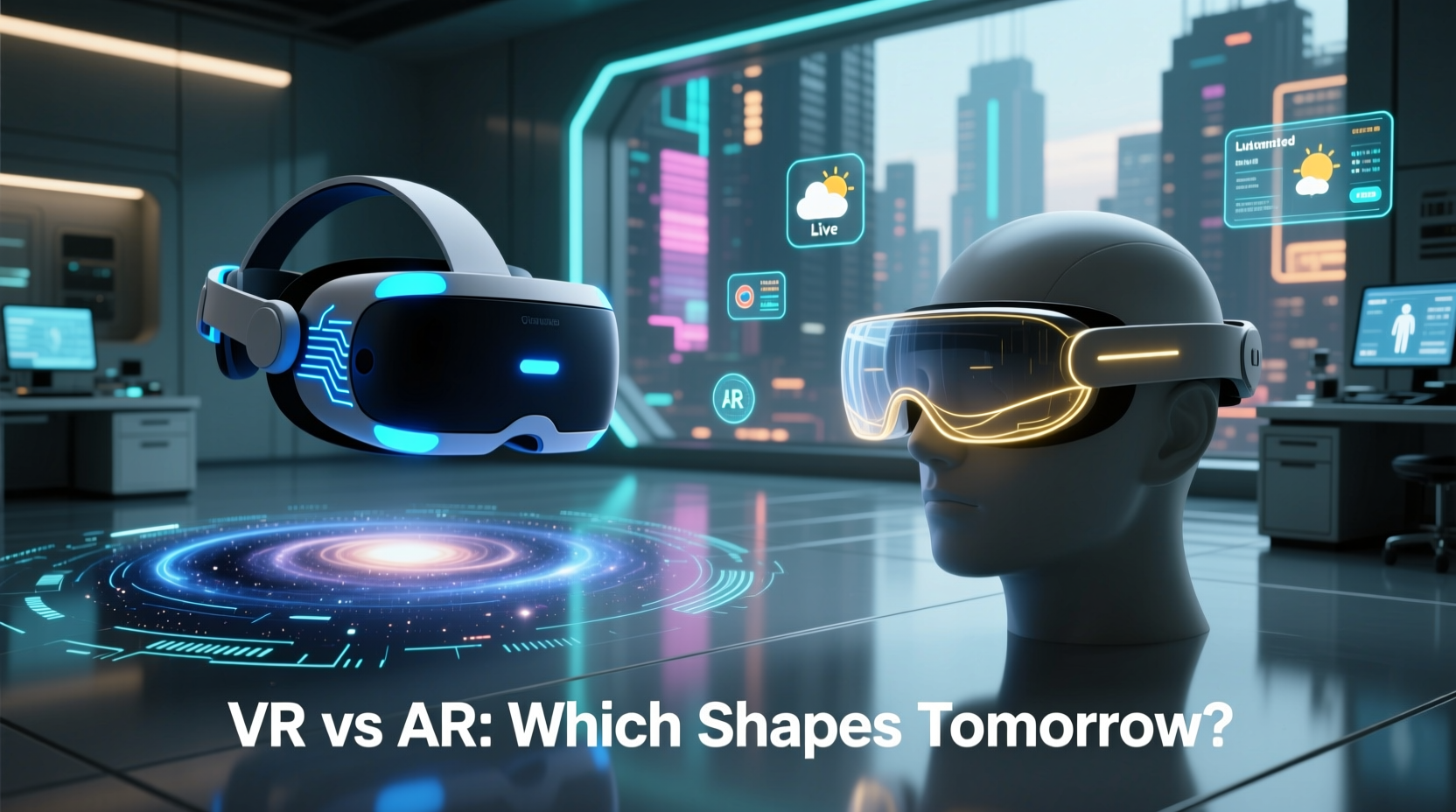
Before evaluating long-term potential, it's essential to distinguish how each technology functions and where it excels.
Virtual Reality (VR) creates a completely artificial environment. Users wear a headset that covers their eyes and ears, isolating them from the real world. High-end systems like Meta Quest 3, HTC Vive, and PlayStation VR2 offer room-scale tracking, hand controllers, and spatial audio, enabling deep immersion. These are ideal for gaming, virtual training, architectural walkthroughs, and therapeutic simulations.
Augmented Reality (AR), by contrast, enhances the real world rather than replacing it. Devices like Microsoft HoloLens, Magic Leap, and consumer-focused apps on smartphones (e.g., Apple’s ARKit or Google’s ARCore) superimpose digital elements onto physical surroundings. A mechanic might see repair instructions overlaid on an engine, or a shopper could visualize how a sofa fits in their living room using a phone camera.
The divergence in purpose shapes their adoption paths. VR demands dedicated time and space, making it episodic—a session here and there. AR integrates seamlessly into daily life, offering continuous utility without disconnection from reality.
Market Trends and Investment Trajectories
Global spending on AR and VR combined is projected to exceed $50 billion by 2027, according to IDC. However, the growth distribution is not equal. AR is expected to capture nearly 60% of that market, driven by enterprise applications and consumer-facing tools.
Major tech companies reflect this shift in strategy. Apple’s Vision Pro, though technically a \"spatial computing\" device blending AR and VR, emphasizes passthrough capabilities—showing the real world enhanced with digital layers. Microsoft continues investing heavily in HoloLens for industrial use. Meanwhile, Meta remains committed to VR but acknowledges that AR glasses are the ultimate goal, even if still years away from mass adoption.
In contrast, standalone VR headsets face challenges. Despite strong sales in gaming and fitness, user retention drops after initial excitement. Many consumers treat VR as a novelty rather than a necessity. AR, especially when delivered through familiar devices like smartphones, benefits from lower barriers to entry and broader accessibility.
Real-World Applications: Where Each Shines
Success isn’t measured solely by hype—it’s defined by practical impact. Let’s examine key sectors and how VR and AR perform within them.
Healthcare
VR is widely used for surgical simulation, pain management, and mental health therapy. For example, clinicians use VR exposure therapy to treat PTSD by safely recreating traumatic scenarios. However, AR offers transformative advantages during live procedures. Surgeons wearing AR glasses can view patient vitals, MRI data, or anatomical guides overlaid directly onto the operating field, reducing reliance on external monitors.
Manufacturing & Field Service
AR dominates here. Technicians equipped with AR headsets receive step-by-step repair instructions, detect equipment faults via thermal imaging overlays, and collaborate remotely with experts who annotate their field of view. Boeing reported a 25% reduction in wiring assembly time using AR guidance. VR plays a role in safety training but lacks the immediacy needed for real-time problem solving.
Education
VR enables students to explore ancient Rome or dive into the human bloodstream—experiences impossible in a traditional classroom. Yet these are limited to scheduled sessions. AR brings interactivity into everyday learning: textbooks come alive with 3D models, chemistry experiments simulate reactions on desks, and language learners see translated labels hovering over objects. The scalability of AR via tablets and phones makes it more sustainable for schools.
Retail and E-commerce
AR allows customers to try on clothes virtually or preview furniture at home using smartphone cameras. IKEA Place and Snapchat’s AR try-ons have proven effective in boosting conversion rates. VR shopping environments exist but feel clunky and underused. Consumers prefer quick, context-aware tools over full immersion for routine purchases.
“AR will become invisible infrastructure—like GPS—woven into how we interact with the world. VR will remain a powerful but niche medium.” — Dr. Leah Sutton, MIT Media Lab Researcher
Comparative Analysis: Strengths and Limitations
| Factor | Virtual Reality (VR) | Augmented Reality (AR) |
|---|---|---|
| User Immersion | High – complete sensory engagement | Moderate – selective enhancement |
| Daily Usability | Low – requires setup and isolation | High – integrates with real-world tasks |
| Adoption Barrier | High – cost, motion sickness, space needs | Low – accessible via smartphones |
| Enterprise ROI | Moderate – best for training | High – improves efficiency in real time |
| Future Scalability | Limited by form factor | Potential for wearable ubiquity (e.g., smart glasses) |
This comparison reveals a pattern: VR excels in depth, while AR wins in breadth. For sustained integration into work and life, breadth often matters more.
The Road Ahead: A Timeline of Realistic Development
Predicting the future requires grounding expectations in technological feasibility and user behavior. Here’s a realistic timeline for both technologies over the next decade.
- 2024–2025: Continued refinement of mixed-reality headsets. Apple Vision Pro sets a benchmark for high-fidelity AR, but high price limits reach. Meta focuses on lowering VR costs. AR apps proliferate on iOS and Android, especially in retail and navigation.
- 2026–2027: First-generation lightweight AR glasses emerge from major OEMs. Battery life and field of view remain constraints, but early adopters in logistics and field service begin large-scale deployment. VR stabilizes as a premium entertainment and training tool.
- 2028–2030: AR glasses approach sunglasses-like design with all-day comfort. AI-powered contextual awareness enables real-time translation, object recognition, and personalized alerts. Integration with voice assistants deepens. VR evolves into social metaverse platforms but fails to achieve mainstream traction beyond enthusiasts.
- Post-2030: AR becomes ambient intelligence—constantly available, minimally intrusive. Neural interfaces may begin supplementing visual overlays. VR remains relevant in specialized domains like architecture visualization and immersive storytelling.
The trajectory suggests AR will become pervasive, while VR remains situational.
Mini Case Study: Transforming Warehouse Operations with AR
A mid-sized logistics company in Ohio struggled with order fulfillment errors and slow picking times. Workers relied on handheld scanners and paper lists, leading to frequent misreads and delays. In 2023, the company piloted AR smart glasses from RealWear for 50 warehouse staff.
The new system displayed pick lists directly in the worker’s field of view. Voice commands allowed hands-free operation, and barcode scanning was automated via built-in cameras. Within three months, picking accuracy improved by 38%, and average task completion time dropped by 22%. Employees reported less fatigue due to reduced cognitive load.
When asked why they didn’t consider VR for training instead, the operations manager noted: “We don’t need people to practice in a fake warehouse. We need them to work faster and smarter in the real one.” This insight underscores AR’s edge in operational efficiency.
Actionable Checklist: Evaluating Immersive Tech for Your Organization
- ✅ Define whether your use case requires full immersion (VR) or real-world augmentation (AR).
- ✅ Assess user mobility needs—will workers be stationary or moving through environments?
- ✅ Consider device ergonomics—can users wear the hardware for extended periods?
- ✅ Evaluate integration with existing software (ERP, CRM, etc.).
- ✅ Start with a pilot program focused on measurable KPIs like error rate or throughput time.
- ✅ Prioritize solutions with strong developer ecosystems and API support.
FAQ: Common Questions About VR and AR Futures
Will VR headsets ever replace smartphones?
Unlikely. VR headsets are too isolating and impractical for constant use. Smartphones serve communication, productivity, and casual browsing—functions VR doesn’t optimize. Instead, VR will complement mobile devices for specific experiences like gaming or virtual meetings.
Can AR function without internet or GPS?
Basic AR can work offline—such as preloaded 3D models in educational apps—but advanced features like location-based overlays or real-time collaboration require connectivity. Edge computing and local AI processing are improving offline capabilities, but cloud integration remains essential for dynamic content.
Are AR glasses safe for prolonged use?
Current models are designed with eye safety in mind, using waveguide displays that reduce strain. However, extended use may cause discomfort due to weight or cognitive overload from information density. Manufacturers are addressing this with better weight distribution, adaptive brightness, and attention-aware interfaces that minimize distractions.
Conclusion: Why Augmented Reality Holds the Greater Future
While virtual reality headsets deliver unmatched immersion, their limitations in usability, accessibility, and real-world integration constrain their long-term dominance. They will continue to thrive in entertainment, therapy, and controlled training environments—but as specialized tools, not universal platforms.
Augmented reality, by enhancing rather than escaping reality, aligns more closely with how humans naturally interact with the world. Its ability to deliver timely, context-aware information without disconnection positions it as the more scalable and socially acceptable technology. As hardware shrinks, AI matures, and networks accelerate, AR will fade into the background of daily life—like Wi-Fi or GPS—ubiquitous yet unobtrusive.
The future isn’t about escaping reality; it’s about enriching it. And in that evolution, augmented reality stands poised to lead.




 浙公网安备
33010002000092号
浙公网安备
33010002000092号 浙B2-20120091-4
Comments
No comments yet. Why don't you start the discussion?