
In the evolving landscape of immersive technologies, virtual reality (VR) and augmented reality (AR) are often mentioned in the same breath. Both alter our perception of reality, but they do so in fundamentally different ways. VR immerses users in a fully digital environment, replacing the physical world with a simulated one. AR overlays digital elements—such as images, text, or 3D models—onto the real world through devices like smartphones or smart glasses. While both have captured public imagination, their current utility varies significantly across industries and everyday use. The question isn't just about technological capability—it's about practical impact. So, which technology delivers greater usefulness today?
Understanding the Core Differences
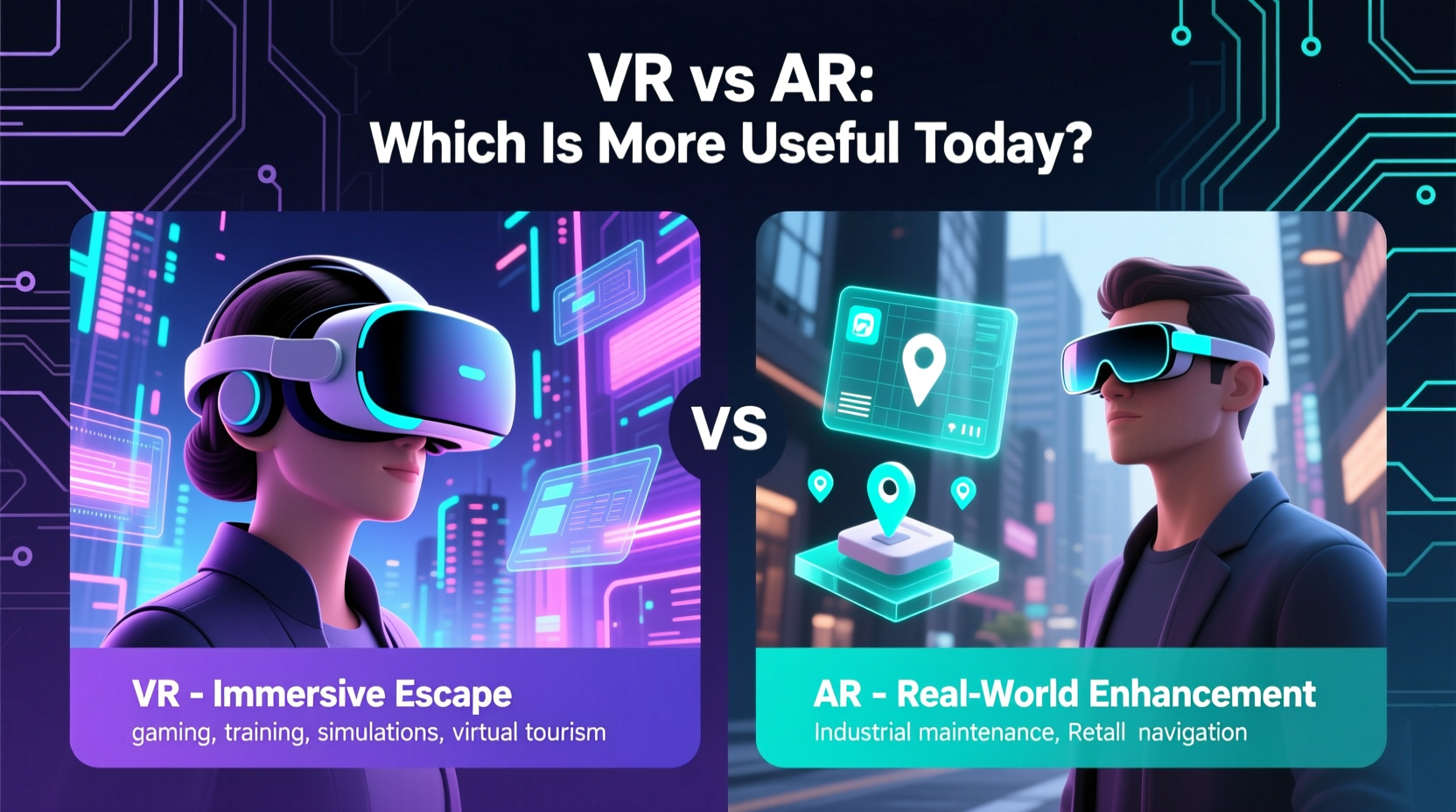
The foundational distinction between VR and AR lies in how they interact with reality. Virtual reality requires a complete sensory disconnect from the physical world. Users wear headsets that block out external stimuli and transport them into computer-generated environments. These can range from lifelike simulations to fantastical realms, depending on the application. Interaction within VR is typically mediated through hand controllers or motion tracking systems.
Augmented reality, by contrast, enhances rather than replaces reality. It uses cameras, sensors, and display technology to superimpose digital information onto the user’s view of the real world. This can be as simple as a navigation arrow appearing on a smartphone screen while walking down the street or as complex as a surgeon viewing real-time anatomical data during an operation via AR glasses.
“AR integrates digital intelligence into the real world without removing us from it. That makes it inherently more compatible with daily tasks.” — Dr. Lena Torres, Human-Computer Interaction Researcher at MIT
This integration gives AR a distinct advantage in scenarios where awareness of the physical environment remains essential. VR excels in controlled, isolated experiences such as training simulations or entertainment, where immersion is the goal. But for most real-world workflows, AR’s ability to layer information over existing processes proves more immediately valuable.
Current Applications Across Industries
To assess which technology is more useful today, we must examine their deployment across key sectors: healthcare, education, manufacturing, retail, and field service.
Healthcare: Precision Meets Practicality
In medicine, AR has already demonstrated tangible benefits. Surgeons use AR headsets like Microsoft HoloLens to visualize patient anatomy in real time during procedures. For example, during spinal surgery, AR can project CT scan data directly onto the patient’s back, guiding precise screw placement. This reduces operative time and improves accuracy.
VR, meanwhile, is primarily used for medical training and mental health therapy. Medical students practice complex surgeries in risk-free virtual environments, and patients with PTSD undergo exposure therapy in controlled VR settings. While impactful, these applications remain supplementary rather than integrated into daily clinical workflows.
Manufacturing & Field Service: Efficiency Through Overlay
Industrial maintenance teams increasingly rely on AR for equipment repair. Technicians wearing AR glasses receive step-by-step instructions overlaid directly onto machinery. They can see wiring diagrams, torque specifications, or fault indicators without consulting manuals or tablets. Companies like Boeing report up to 30% faster assembly times using AR-assisted guidance.
VR is used in design prototyping and safety training—for instance, simulating hazardous factory conditions to train workers. However, these are periodic activities. AR supports day-to-day operations, reducing errors and downtime. When a technician needs to fix a malfunctioning turbine on-site, AR provides immediate context; VR cannot offer that in-the-moment support.
Retail & Consumer Experience: Engagement vs Utility
Consumer-facing applications highlight a divergence in usefulness. VR powers immersive shopping experiences—users can walk through virtual stores or try on clothes in digital avatars. Yet adoption remains low due to hardware costs and setup complexity.
AR, however, thrives in mobile apps. Furniture retailers like IKEA allow customers to place virtual sofas in their living rooms via smartphone cameras. Beauty brands let users “try on” makeup through facial filters. These tools influence purchasing decisions directly and require no additional hardware beyond a phone.
Comparative Analysis: VR vs AR Today
To clarify the present-day utility, consider the following comparative table outlining key dimensions:
| Factor | Virtual Reality (VR) | Augmented Reality (AR) |
|---|---|---|
| Hardware Accessibility | Requires dedicated headset (Oculus, HTC Vive); higher cost and setup barrier | Accessible via smartphones; growing support in smart glasses (e.g., Ray-Ban Meta) |
| User Environment | Isolated; not suitable for multitasking or real-world interaction | Integrated; allows simultaneous engagement with physical surroundings |
| Primary Use Cases | Gaming, training simulations, virtual tours | Navigation, remote assistance, product visualization, instructional overlays |
| Deployment Scale | Limited to specialized or recreational settings | Widely adopted in enterprise and consumer apps |
| Learning Curve | Moderate to high; requires acclimatization to motion controls and immersion | Low; intuitive interfaces built on familiar mobile interactions |
| Real-Time Decision Support | Minimal; used for pre-planning or post-analysis | High; delivers actionable insights during live tasks |
The data shows that AR consistently scores higher on accessibility, integration, and immediate utility. While VR creates compelling experiences, its reliance on isolation limits its applicability in routine professional or personal contexts.
Real-World Example: Remote Technical Support
Consider a telecommunications engineer dispatched to repair a fiber-optic node in a rural area. She lacks experience with this specific model. Using AR-enabled smart glasses, she initiates a call with a senior technician at headquarters. Through her camera feed, he sees exactly what she sees. He draws digital annotations—circles around faulty components, arrows indicating disassembly steps—that appear in her field of view in real time.
This scenario, deployed by companies like Verizon and Siemens, reduces resolution time by up to 40%. The same outcome cannot be achieved with VR. The engineer cannot afford to be disconnected from her environment; she must handle tools, interpret physical signals, and respond to environmental hazards—all while receiving guidance. AR enables collaboration without compromising situational awareness.
Barriers to Adoption and Limitations
Despite AR’s advantages, neither technology is without constraints.
VR struggles with motion sickness, limited battery life, and social isolation. Prolonged use can cause discomfort, and the need for large, open spaces restricts deployment in crowded or confined areas. Moreover, VR content development is resource-intensive, limiting scalability.
AR faces challenges in display quality, field of view, and ambient lighting interference. Current smart glasses often have narrow visual windows, making it difficult to maintain persistent overlays. Bright sunlight can wash out projections, and privacy concerns arise when recording real-world environments. Nevertheless, because AR builds upon existing behaviors—like checking a map or reading instructions—it encounters less resistance to adoption.
“The killer app for AR isn’t a game or a gimmick—it’s turning every surface into an intelligent interface.” — Mark Chen, Lead Engineer at Niantic Labs
Actionable Guide: How to Leverage AR and VR Effectively
Organizations and individuals should adopt a strategic approach based on current capabilities:
- Evaluate the task environment: If the activity occurs in dynamic, real-world settings (e.g., construction, logistics), prioritize AR solutions.
- Assess hardware readiness: Most businesses already have smartphones capable of AR; investing in VR requires budgeting for headsets and computing infrastructure.
- Start with pilot programs: Test AR for field service or training before scaling. Use VR for employee onboarding simulations or safety drills.
- Measure ROI in efficiency gains: Track reductions in error rates, training time, or service duration to justify investment.
- Train users gradually: Introduce AR interfaces in low-risk scenarios to build confidence and competence.
Checklist: Choosing Between VR and AR for Your Use Case
- ✅ Does the task require full immersion with no real-world interaction? → Choose VR
- ✅ Is real-time data overlay needed during physical work? → Choose AR
- ✅ Will users operate in uncontrolled environments (e.g., outdoors, moving vehicles)? → Favor AR
- ✅ Is the primary goal experiential (e.g., storytelling, gaming)? → VR may be better suited
- ✅ Do users already have access to AR-capable devices (smartphones, tablets)? → AR lowers entry barriers
- ✅ Is collaboration with remote experts necessary during hands-on tasks? → AR enables shared visual context
Frequently Asked Questions
Can AR and VR be used together?
Yes. Mixed reality (MR) blends both technologies, allowing virtual objects to interact with real-world surfaces. For example, a designer might place a holographic car model in a physical studio (AR) and then walk inside it to inspect engine components (VR-like immersion). Devices like the Apple Vision Pro and Microsoft HoloLens 2 support MR, though widespread integration remains in early stages.
Which technology is growing faster?
Market data suggests AR is expanding more rapidly in practical applications. According to Statista, the AR market is projected to reach $88 billion by 2026, driven by enterprise adoption and mobile integration. VR, while growing, remains concentrated in gaming and niche training, with a forecasted $57 billion valuation in the same period.
Do I need special equipment for AR?
Not necessarily. Most modern smartphones support AR through platforms like ARKit (iOS) and ARCore (Android). Apps like Google Maps Live View or Snapchat filters run AR experiences without extra hardware. For advanced use—such as hands-free industrial AR—smart glasses or headsets are required, but these are becoming more affordable and ergonomic.
Conclusion: AR Leads in Present-Day Usefulness
While virtual reality captivates with its immersive potential, augmented reality delivers greater utility in today’s world. Its seamless integration with everyday tasks—from navigating city streets to repairing complex machinery—makes it a practical tool across industries. AR enhances human capabilities without demanding behavioral change or expensive infrastructure. It works with what people already have: their phones, their environments, and their instincts.
VR remains invaluable for scenarios requiring deep simulation or emotional engagement, such as therapeutic interventions or architectural walkthroughs. But for solving real problems in real time, AR holds the edge. As display technology improves and wearable devices become mainstream, AR’s role will only deepen.




 浙公网安备
33010002000092号
浙公网安备
33010002000092号 浙B2-20120091-4
Comments
No comments yet. Why don't you start the discussion?