
When choosing a mobile carrier in the U.S., two names often come up: Verizon and its digital-only sibling, Visible. At first glance, the price difference is striking—Visible plans start at $25/month, while Verizon’s base unlimited plan starts at $60. That gap raises a critical question: Why is Visible so much cheaper than Verizon, and does that lower cost come with meaningful trade-offs?
The answer lies in infrastructure, branding, customer service models, and target audiences. While both services use the same 5G and LTE networks, their approach to delivery, support, and extras diverges sharply. Understanding these differences helps consumers decide whether Visible is truly worth it—or if the savings come at too high a price.
How Visible Leverages the Verizon Network
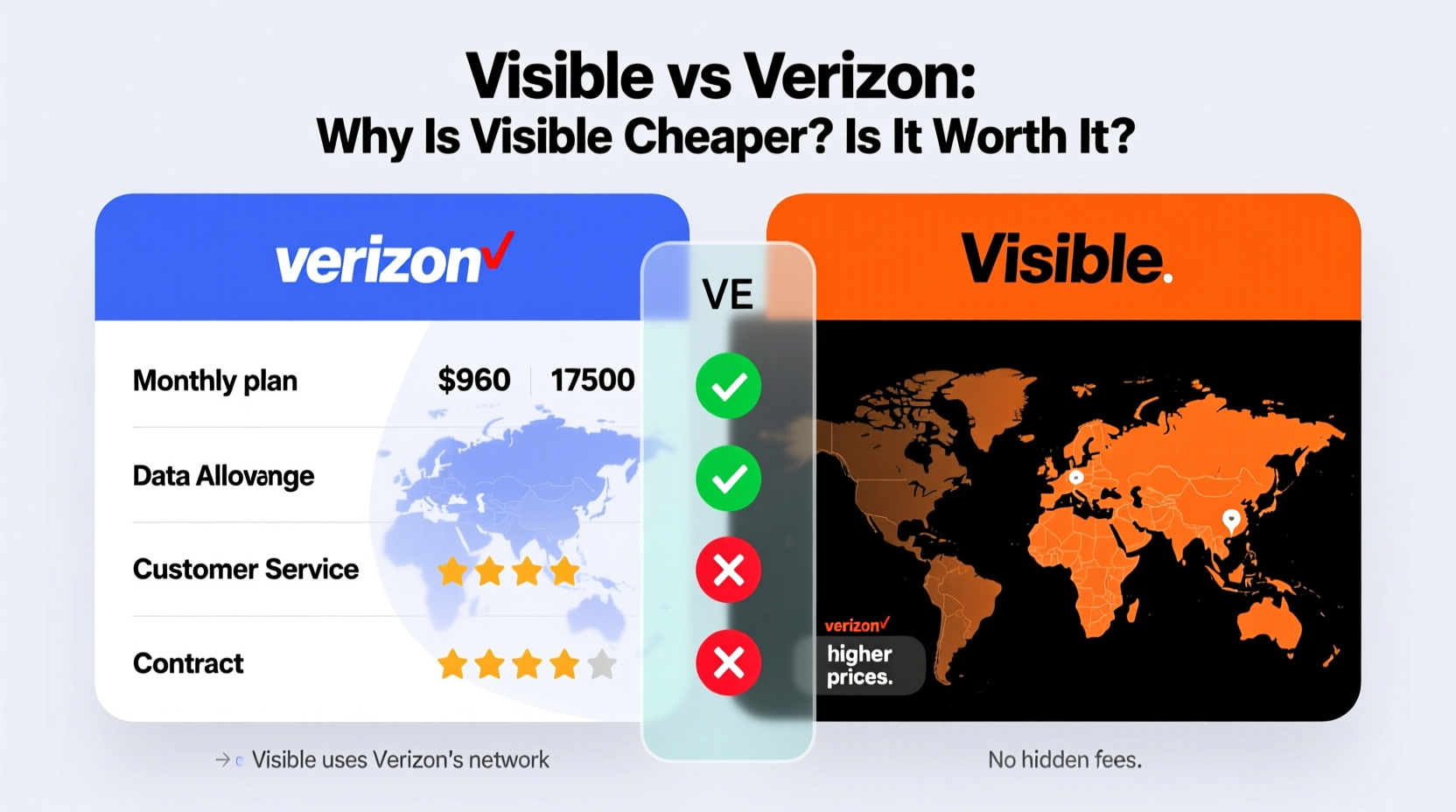
Visible operates as a Mobile Virtual Network Operator (MVNO), meaning it doesn’t own cell towers or spectrum. Instead, it rents access from Verizon Wireless—the nation’s largest and most reliable network by coverage and performance. This arrangement allows Visible to offer nationwide 5G and LTE without the massive capital investment required to build physical infrastructure.
Because Visible piggybacks on Verizon’s network, users get nearly identical signal strength and geographic reach. Independent speed tests show Visible averaging around 30–45 Mbps download speeds in urban areas, comparable to mid-tier Verizon plans. The key distinction isn't connectivity—it's priority.
“MVNOs like Visible provide excellent value for average users who don’t need peak network performance during congestion.” — David Liu, Wireless Industry Analyst at TechInsight Group
On congested towers—such as concerts, rush hour commutes, or densely populated cities—Verizon customers receive higher data prioritization. Visible users are deprioritized after all postpaid Verizon subscribers, which can lead to slower speeds when bandwidth is strained.
Pricing Breakdown: Where the Savings Come From
The most obvious advantage of Visible is cost. Let’s compare standard unlimited plans:
| Feature | Visible (Globe Plan) | Verizon (Do More Unlimited) |
|---|---|---|
| Monthly Price | $25 | $60 (plus taxes/fees ~$75+) |
| Network Access | Verizon Nationwide (Deprioritized) | Verizon Nationwide (High Priority) |
| 5G Access | Yes (Dynamic Spectrum Sharing only) | Yes (mmWave + DSS where available) |
| Mobile Hotspot | Unlimited (5 Mbps max) | Unlimited (Premium: 15 GB at full speed) |
| Customer Support | Digital-only (chat, app) | Phone, chat, retail stores |
| International Roaming | Limited (Canada/Mexico text/call only) | Yes (6 GB in 65+ countries) |
| Taxes & Fees Included? | Yes | No (extra ~$15–$20/month) |
The $35 monthly difference stems primarily from three areas: reduced service overhead, no physical retail presence, and fewer premium features. Visible eliminates call centers, brick-and-mortar stores, and sales commissions. Support is handled entirely through its app and website via chatbots and community forums. This lean model drastically reduces operating costs, allowing them to pass savings directly to customers.
Is Visible Worth It? Real-World Trade-Offs
To assess whether Visible is “worth it,” consider how you use your phone. For many users, especially those in suburban or urban environments with strong Verizon coverage, Visible performs flawlessly for daily tasks: streaming music, video calls, social media, and navigation.
However, there are notable limitations:
- Deprioritization during congestion: In crowded areas, expect slower speeds after 7 PM or at large events.
- No roaming outside North America: Travelers to Europe or Asia lose connectivity unless they switch SIMs.
- Limited hotspot speed: While technically \"unlimited,\" the 5 Mbps cap means HD video won’t stream smoothly over tethering.
- No device financing: You must bring your own phone or pay full price upfront.
Despite these constraints, Visible excels in transparency and simplicity. There are no surprise fees, promotional rate hikes after six months, or confusing tier systems. What you see is what you get—forever.
Mini Case Study: Sarah’s Switch from Verizon to Visible
Sarah, a freelance graphic designer in Austin, Texas, paid $82/month on her Verizon plan for years. She rarely traveled internationally and used less than 8 GB of data monthly. After researching MVNOs, she switched to Visible’s $25 plan.
At first, she noticed slightly longer load times during evening commutes, but her work-from-home setup remained unaffected. Over one year, she saved $684. She now uses a dual-SIM iPhone with a local European eSIM when traveling, bypassing Visible’s roaming limits. For Sarah, the trade-off was clear: minor speed fluctuations for significant financial relief.
Expert Tips for Maximizing Visible’s Value
Getting the most out of Visible requires smart usage habits. Here’s how to optimize performance and avoid common pitfalls:
- Use Wi-Fi whenever possible: Offload streaming and downloads to home or café networks to reduce reliance on cellular data.
- Monitor congestion patterns: Avoid large file uploads during peak hours (6–9 PM) if low latency is crucial.
- Pair with a secondary hotspot: Consider a dedicated mobile hotspot on a different carrier for backup during deprioritization.
- Check compatibility before switching: Ensure your phone is unlocked and supports Verizon’s bands (especially Band 13).
- Join the Visible Community: Active user forums offer troubleshooting tips and unofficial feature requests.
Frequently Asked Questions
Can I keep my current phone number when switching to Visible?
Yes. Visible supports number porting from any major carrier. The process typically takes 24 hours and can be completed during signup in the app.
Does Visible throttle speeds after a certain data threshold?
No. Unlike some budget carriers, Visible does not reduce your base connection speed once you hit a limit. However, all users are subject to network-wide deprioritization during congestion, which affects speeds temporarily.
Is Visible suitable for gaming or live streaming?
For casual mobile gaming and standard-definition streaming, yes. But competitive online gaming or 4K live broadcasts may suffer during peak times due to latency spikes from deprioritization.
Final Verdict: Who Should Choose Visible?
Visible isn’t designed for everyone—but it’s ideal for a growing segment of smartphone users. If you meet most of the following criteria, Visible likely makes sense:
- You live in an area with strong Verizon coverage.
- Your monthly data usage is under 20 GB.
- You prefer self-service tools over talking to agents.
- You want a single, flat-rate bill with no hidden charges.
- You don’t frequently travel outside the U.S., Canada, or Mexico.
For heavy data users, frequent travelers, or those needing guaranteed high-speed access, sticking with Verizon—or upgrading to a premium Visible add-on like “Extra” ($10/month for faster hotspot)—may be wiser.
“The future of wireless is leaner, digital-first brands like Visible. They’re forcing legacy carriers to justify their premiums.” — Maria Tran, Senior Editor at ConnectReview Magazine
Checklist: Before You Switch to Visible
- ✅ Confirm your phone is unlocked and compatible with Verizon’s network.
- ✅ Run a signal test in your neighborhood using a friend’s Verizon-connected device.
- ✅ Back up contacts and prepare account details from your current carrier.
- ✅ Schedule the switch during a low-usage week to troubleshoot calmly.
- ✅ Set up auto-pay to maintain uninterrupted service.
Visible represents a shift in how Americans access mobile service—prioritizing affordability, transparency, and digital convenience over traditional perks. It proves that sometimes, paying less doesn’t mean getting less—just getting smarter.




 浙公网安备
33010002000092号
浙公网安备
33010002000092号 浙B2-20120091-4
Comments
No comments yet. Why don't you start the discussion?