
Great ideas often arrive unannounced—in the shower, on a walk, or in the middle of the night. When inspiration strikes, the method you use to capture it can determine whether that idea becomes something meaningful or fades into oblivion. Today, two tools dominate personal idea capture: the traditional notebook and the modern voice recorder app. Both have passionate advocates, but which one truly helps you preserve thoughts more reliably?
This isn’t just about preference. It’s about reliability—how well each tool supports memory retention, retrieval, organization, and long-term usability. By examining cognitive science, real-world workflows, and practical limitations, we can move beyond nostalgia and tech hype to identify which method consistently delivers when it matters most.
The Cognitive Impact of Idea Capture
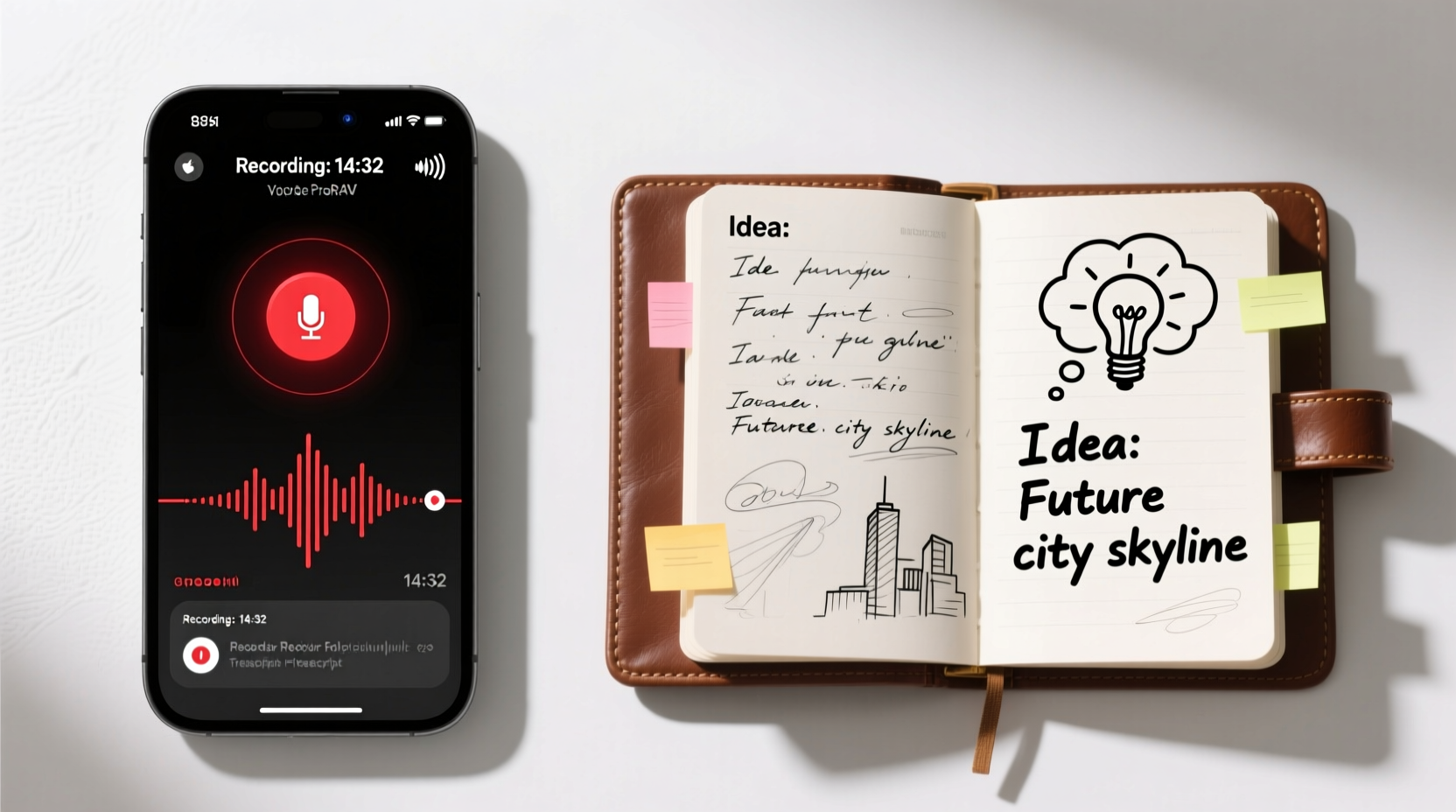
How we record an idea influences how we remember it. Research in cognitive psychology shows that the act of writing by hand engages different neural pathways than speaking or typing. According to Dr. Karin James, a cognitive neuroscientist at Indiana University, “Handwriting activates regions of the brain involved in thinking, language, and memory processing more intensely than keyboard input or speech.” This suggests that using a notebook may enhance comprehension and retention of ideas immediately after capture.
However, voice recording has its own cognitive advantages. Speaking allows for faster expression, especially when emotions or complex narratives are involved. You can convey tone, emphasis, and urgency—nuances often lost in written notes. A fleeting insight during a commute might be too abstract to write clearly but flows naturally when spoken aloud.
“Verbal articulation helps clarify half-formed thoughts. But handwriting forces precision. Each has a role depending on the stage of ideation.” — Dr. Lena Patel, Cognitive Psychologist & UX Researcher
The key is understanding that neither method is universally superior. Reliability depends on context: what kind of idea, when it occurs, and how you plan to use it later.
Speed and Accessibility: Capturing Ideas in the Moment
When inspiration hits, speed is critical. A delay of even 30 seconds can result in partial or total loss of the original thought. Let’s compare how quickly each method gets your idea recorded.
Notebooks: Require physical access—pulling out a pen, opening to a blank page, and forming legible letters. Even fast writers average 20–30 words per minute. If the idea involves technical terms or structure, this slows down further. Plus, if you don’t carry a notebook regularly, you’re left relying on scraps of paper or memory alone.
Voice recorder apps: Are typically available instantly on smartphones. With voice assistants like Siri or Google Assistant, you can say “Hey Google, record a note” and begin speaking within seconds. Most modern apps save recordings automatically to the cloud, reducing risk of data loss. Average speech runs at 120–150 words per minute—up to five times faster than handwriting.
Yet speed comes with trade-offs. Voice recordings require playback time. To review a 90-second idea, you must listen to all 90 seconds. With a handwritten note, you can scan keywords in under five seconds.
Organization and Retrieval: Finding Your Ideas Later
Capturing an idea is only half the battle. The true test of reliability is whether you can find and use it weeks or months later.
Notebooks offer linear, chronological storage. Unless you index them meticulously (which few do), locating a specific idea means flipping through pages. However, many users report a surprising benefit: browsing old entries often sparks new connections. The physical layout—where an idea sits on a page, what was written before and after—creates spatial memory cues that aid recall.
Voice recorder apps integrate with search functions, tags, and folders. Some, like Otter.ai or Apple’s Voice Memos with transcription, convert speech to text, enabling keyword searches. This makes retrieval far more scalable. Imagine searching “marketing strategy Q3” and instantly finding the audio clip where you brainstormed it during a run.
But transcriptions aren’t perfect. Accents, background noise, or rapid speech can lead to errors. A misheard word could make an important concept unsearchable unless manually corrected.
Comparison Table: Key Features at a Glance
| Feature | Notebook | Voice Recorder App |
|---|---|---|
| Recording Speed | Slow (20–30 wpm) | Fast (120–150 wpm) |
| Memory Retention | High (due to motor engagement) | Moderate (passive listening) |
| Searchability | Low (manual scanning) | High (with transcription) |
| Durability | Physical risk (loss, damage) | Digital backup options |
| Distraction Level | Low (no notifications) | High (phone interruptions) |
| Idea Clarity | Forced conciseness | Natural flow, potential rambling |
A Real-World Scenario: The Writer’s Dilemma
Consider Maya, a freelance writer working on a novel. She wakes up with a vivid dream sequence she wants to capture before it vanishes.
She reaches for her notebook. Her handwriting is rushed, and she skips punctuation to keep up with her thoughts. Some sentences trail off. After five minutes, she has a fragmented but structured outline: character names, setting, conflict points. It’s incomplete, but readable.
Alternatively, imagine Maya uses a voice recorder app. She speaks freely for two minutes, describing the scene with emotional detail, dialogue snippets, and sensory descriptions. The recording is rich—but when she listens back the next day, it takes four minutes to replay, and she forgets to transcribe key lines. A week later, she can’t remember which folder it’s in.
In this case, the notebook provided quicker reference and better integration into her workflow. But had she used the voice app *and* taken 90 seconds to jot down three bullet points from the recording immediately after, she’d have gained both depth and accessibility.
This hybrid approach—voice for capture, text for indexing—is increasingly common among creatives and professionals who value both fidelity and function.
Best Practices for Reliable Idea Capture
Reliability doesn’t come from choosing one tool over another—it comes from designing a system that compensates for each method’s weaknesses. Here’s a step-by-step guide to building such a system.
Step 1: Match Tool to Context
- Use a voice recorder app when: ideas are complex, emotional, or time-sensitive (e.g., driving, walking).
- Use a notebook when: clarity, focus, or deep thinking is needed (e.g., meetings, planning sessions).
Step 2: Implement Immediate Processing
- After recording a voice memo, spend 60–90 seconds summarizing the core idea in writing.
- If writing in a notebook, circle or star high-potential ideas for follow-up.
- Name and tag digital recordings right away (e.g., “Podcast Guest Pitch – High Priority”).
Step 3: Weekly Review System
Set aside 20 minutes every week to:
- Scan notebook pages for starred ideas.
- Listen to flagged voice memos and transfer actionable items to a task manager.
- Delete outdated or irrelevant recordings to reduce clutter.
Step 4: Backup and Archive
Digitize notebook entries monthly by photographing pages and storing them in a searchable note app like Evernote or Notion. For voice recordings, ensure automatic cloud sync is enabled and verify backups quarterly.
Checklist: Building a Reliable Idea-Capture Routine
- ✅ Carry a pocket notebook or keep one bedside.
- ✅ Install a voice recorder app with auto-sync and transcription.
- ✅ Set up a home screen shortcut for instant voice capture.
- ✅ Spend 90 seconds daily reviewing and tagging new ideas.
- ✅ Conduct a weekly audit of all captured content.
- ✅ Transfer promising ideas to a project management tool.
- ✅ Back up digital files and digitize handwritten notes monthly.
Frequently Asked Questions
Can voice recordings replace notebooks entirely?
Not reliably. While voice apps excel at speed and emotional nuance, they lack the cognitive benefits of handwriting and are slower to review. Over-reliance on audio can lead to a backlog of unprocessed recordings—what some call “idea hoarding.” A balanced system works best.
Are smart pens a viable alternative?
Yes. Devices like the Livescribe or Moleskine Smart Writing System digitize handwritten notes and sync them with audio recordings. They combine the tactile benefits of writing with the searchability of digital tools. However, they are more expensive and require charging, which may reduce consistency.
What’s the biggest mistake people make with idea capture?
Failing to process ideas promptly. Whether written or spoken, unreviewed ideas lose their context and urgency. The most reliable systems include a habit of immediate summarization and scheduled follow-ups. Capture is just the beginning.
Conclusion: Choose Integration Over Ideology
The debate between voice recorder apps and notebooks isn’t about declaring a winner. It’s about recognizing that reliability in idea capture depends on consistency, clarity, and ease of retrieval—not just the tool itself.
Notebooks foster deeper thinking and better initial retention. Voice recorder apps offer unmatched speed and expressive freedom. But used in isolation, each has critical blind spots.
The most effective thinkers and creators don’t choose one over the other—they integrate both. They speak ideas into existence when inspiration strikes, then distill them into concise written form shortly after. They treat idea capture as a two-stage process: first, preservation; second, refinement.
Start today by assessing your current workflow. Are you losing ideas because you’re not capturing them fast enough? Or are you drowning in unorganized recordings you never revisit? Adjust accordingly. Pair your smartphone with a small notebook. Use each tool where it excels. Build a system that ensures no insight slips through the cracks.




 浙公网安备
33010002000092号
浙公网安备
33010002000092号 浙B2-20120091-4
Comments
No comments yet. Why don't you start the discussion?