
In an age where digital tools dominate note-taking, a fundamental question persists: when it comes to remembering information, is it better to record a lecture or meeting with a voice recorder app, or to write it down in a physical notebook? The answer isn't as straightforward as one might assume. While both methods capture information, they engage the brain in vastly different ways. Memory retention—the ability to store and retrieve information over time—depends not just on how we collect knowledge, but on how deeply we process it. This article examines the cognitive science behind voice recording and handwriting, compares their effectiveness, and offers actionable strategies to maximize memory through either method.
The Cognitive Science of Memory Encoding
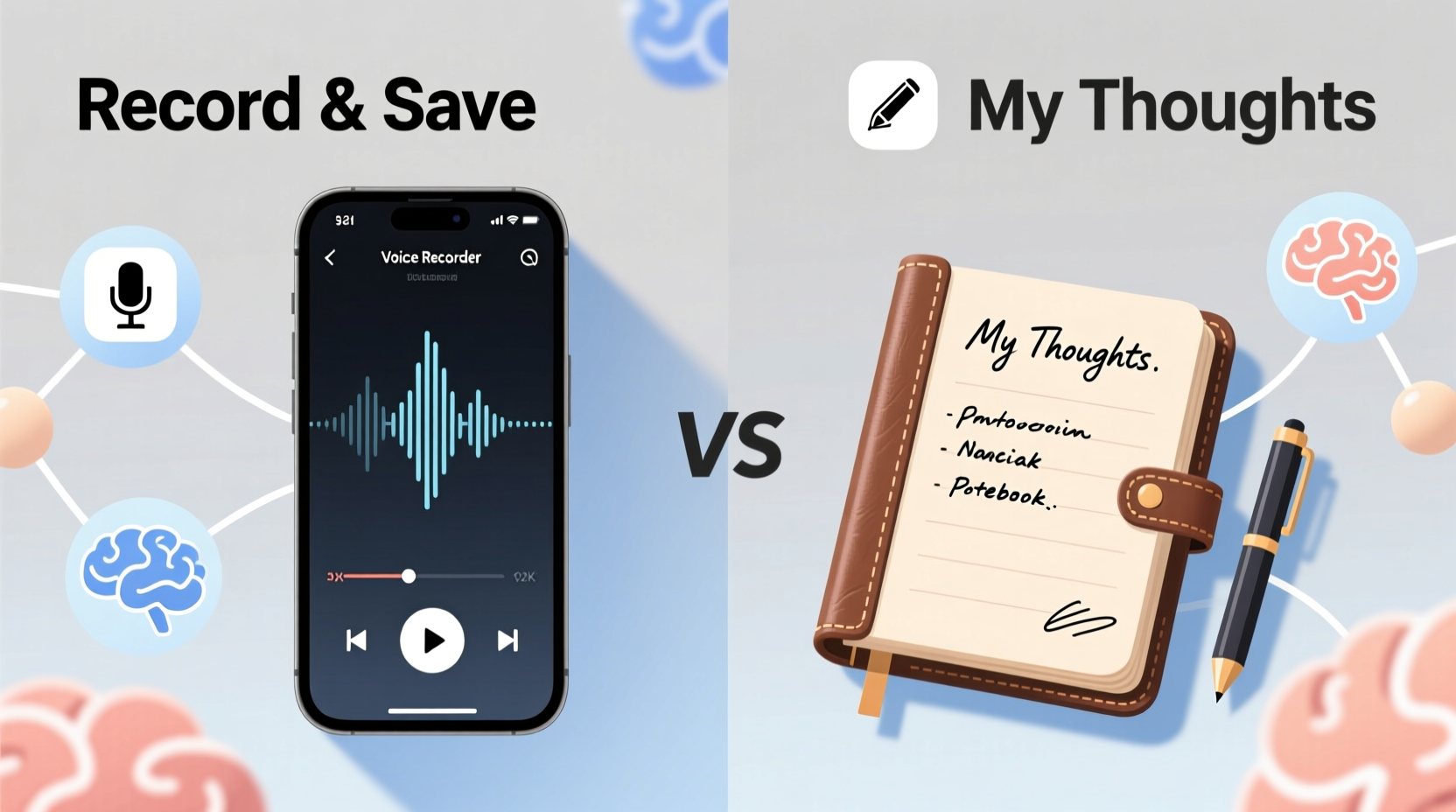
Memory retention begins at the moment of encoding—the process by which sensory input becomes a lasting mental representation. Not all encoding is equal. Shallow processing, such as verbatim transcription without reflection, leads to weak memory traces. Deep processing, involving analysis, summarization, and personal interpretation, strengthens neural pathways and improves recall.
When you write by hand, your brain engages in multiple cognitive functions simultaneously: motor coordination, language processing, decision-making (what to include), and conceptual synthesis. These processes force the brain to slow down, filter, and rephrase information, leading to deeper understanding. In contrast, passively recording audio allows the mind to disengage. You press a button and assume the device will \"remember for you\"—but that doesn’t guarantee you’ll remember it later.
“Writing by hand increases cognitive engagement. It transforms passive reception into active construction of knowledge.” — Dr. Virginia Berninger, Cognitive Psychologist, University of Washington
How Notebooks Enhance Retention Through Active Learning
Handwritten notes are more than just ink on paper—they’re cognitive artifacts shaped by attention and intention. Research from Princeton and UCLA has consistently shown that students who take notes by hand perform better on conceptual questions than those who type or record lectures.
One key reason lies in the limitations of handwriting. Because writing is slower than typing or recording, it forces selectivity. You can’t transcribe every word, so you must listen critically, identify main ideas, and summarize them in your own words. This act of distillation promotes comprehension and long-term retention.
Moreover, spatial memory plays a role. The physical layout of a notebook—where a concept appears on a page, its proximity to diagrams or marginal notes—creates mental anchors. When reviewing, these spatial cues help reconstruct the context in which information was learned, enhancing retrieval.
Voice Recorder Apps: Convenience Versus Cognitive Cost
Voice recorder apps offer undeniable convenience. They allow users to capture full conversations, lectures, or brainstorming sessions with minimal effort. Modern smartphones come equipped with high-quality microphones and cloud-synced storage, making it easy to record, organize, and replay audio files anytime.
However, this ease comes at a cognitive price. A study published in Psychological Science found that students who recorded lectures were less likely to remember key points than those who took handwritten notes—even when given the chance to review the recordings later. Why? Because the expectation of having a recording reduced their motivation to process information in real time.
Additionally, listening to a 60-minute recording after the fact is cognitively taxing. Without visual cues or structure, listeners often zone out or skip sections. Unlike skimming written notes, rewinding and fast-forwarding through audio disrupts flow and reduces efficiency.
That said, voice recorders aren’t inherently flawed. They shine in specific contexts: capturing interviews, preserving verbal instructions, or documenting creative ideas on the go. But for structured learning or meeting retention, they work best when paired with active follow-up.
Comparative Analysis: Notebooks vs. Voice Recorders
| Feature | Notebook | Voice Recorder App |
|---|---|---|
| Cognitive Engagement | High – requires filtering and summarizing | Low – passive recording |
| Retention Rate | Higher for conceptual understanding | Lower unless actively reviewed |
| Review Efficiency | Quick scanning, visual layout aids recall | Time-consuming; requires playback navigation |
| Mobility & Accessibility | Limited to physical access | Cloud sync, searchable transcripts (in some apps) |
| Error Correction | Immediate correction possible | No real-time editing; must re-record |
| Best For | Lectures, meetings, studying, brainstorming | Interviews, verbal instructions, idea capture |
A Real-World Example: Medical Student Study Habits
Consider Maria, a second-year medical student preparing for her physiology exams. During lectures, she experimented with two approaches across different subjects. In neuroscience, she used her iPhone’s voice memo app to record every session. In anatomy, she took detailed notes in a lined notebook.
At exam time, Maria found she recalled anatomy concepts far more clearly. She could visualize her notes—the flowcharts of muscle innervation, the color-coded margins—and mentally \"flip\" through pages. In contrast, her neuroscience recordings sat unreviewed. When she did listen, she struggled to locate specific explanations and often fell asleep during playback.
She adjusted her strategy: for future lectures, she continued using the voice recorder but only to supplement her handwritten notes. She’d jot down key terms and diagrams during class, then mark timestamps in her notebook (“See recording 3:12–4:30 for kidney filtration explanation”). This hybrid method gave her both depth of processing and a safety net for complex details.
Maximizing Memory: A Step-by-Step Strategy
Whether you prefer analog or digital, memory retention improves when you combine capture with deliberate review. Here’s a proven five-step process:
- Capture Actively: If using a notebook, focus on main ideas, not verbatim text. If recording, speak brief summaries into the mic during pauses (“So the key point here is…”).
- Label and Organize: Date your notes or recordings. Use titles, bullet points, or folders to create structure.
- Review Within 24 Hours: Revisit notes or listen to recordings the same day. This reinforces memory before forgetting sets in.
- Summarize and Synthesize: Condense your material into a one-page summary. For audio, write a transcript of key segments.
- Test Yourself: Turn notes into flashcards or quiz questions. Retrieval practice is one of the most effective ways to cement knowledge.
Expert Insight: The Role of Multisensory Learning
Dr. Judy Willis, a neurologist and education specialist, emphasizes that memory thrives on multisensory input. “The more pathways you use—visual, auditory, kinesthetic—the stronger the memory trace,” she explains. This supports a blended approach: recording a lecture (auditory) while sketching diagrams (visual-kinesthetic) creates richer neural connections than either method alone.
“The hand is connected to the brain by more than just nerves—it’s a conduit for understanding. Movement and thought are intertwined.” — Dr. Judy Willis, Neurologist and Author
Checklist: Optimizing Your Note-Taking System
- ✅ Decide the purpose: Are you capturing facts or building understanding?
- ✅ Choose the right tool: Notebook for deep learning; voice recorder for detail preservation.
- ✅ Combine methods when possible: Record while taking concise notes.
- ✅ Review within 24 hours to prevent decay.
- ✅ Summarize in your own words to reinforce meaning.
- ✅ Use timestamps in notebooks to link to audio clips.
- ✅ Test recall regularly through self-quizzing.
Frequently Asked Questions
Can voice recordings replace note-taking entirely?
No. While recordings preserve content, they lack the cognitive engagement of writing. Without active processing, retention suffers. Recordings are best used as supplements, not substitutes.
Is typing notes on a laptop better than recording?
Typing still involves more engagement than passive recording, but research shows it often leads to shallow verbatim transcription. Handwriting typically results in better conceptual retention because it forces summarization.
Are there voice recorder apps with features that improve retention?
Yes. Some apps like Otter.ai provide AI-generated transcripts, searchable keywords, and speaker identification. These features make audio more navigable and review-friendly, bridging the gap between passive capture and active learning.
Conclusion: Choosing the Right Tool for Lasting Memory
The debate between voice recorder apps and notebooks isn’t about declaring a winner—it’s about matching the tool to the goal. If your aim is deep understanding and long-term memory, handwriting remains unmatched in its ability to engage the brain meaningfully. The physical act of writing transforms information into knowledge. Voice recorders, meanwhile, excel at preserving completeness and nuance, especially in dynamic or fast-moving situations.
The most effective learners don’t rely on a single method. They combine the strengths of both: capturing spoken detail with technology while reinforcing comprehension through handwritten synthesis. By understanding how each tool affects memory encoding and retrieval, you can design a personalized system that enhances both efficiency and retention.




 浙公网安备
33010002000092号
浙公网安备
33010002000092号 浙B2-20120091-4
Comments
No comments yet. Why don't you start the discussion?