
When shopping for a diamond, clarity is one of the most scrutinized of the 4Cs—carat, cut, color, and clarity. Among high-clarity grades, VS1 and VVS2 often stand out as top contenders for buyers seeking near-perfect stones without the premium price of internally flawless (IF) or flawless (FL) diamonds. But with a noticeable price gap between them, many wonder: is upgrading from VS1 to VVS2 actually worth the extra cost?
The answer isn't always straightforward. It depends on your priorities—whether you value visible perfection, investment potential, or budget efficiency. Let’s break down what these clarity grades mean, how they compare in real-world appearance, and when paying more makes sense.
Understanding Diamond Clarity: What Do VS1 and VVS2 Mean?
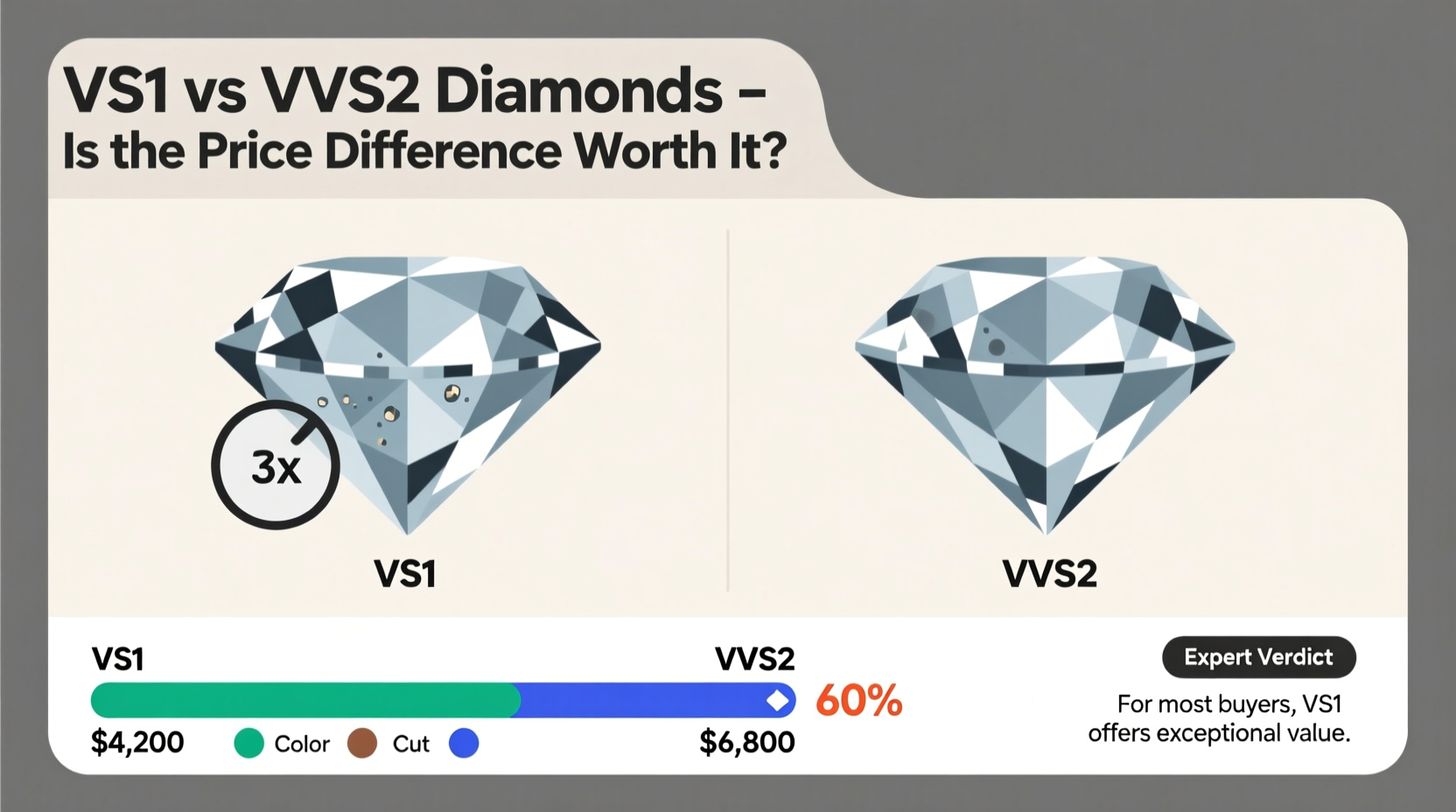
Diamond clarity refers to the presence of internal inclusions and surface blemishes. The Gemological Institute of America (GIA) grades clarity on a scale from Flawless (FL) to Included (I3). VS1 and VVS2 fall within the \"very slightly included\" and \"very, very slightly included\" categories, respectively.
- VVS2 (Very, Very Slightly Included 2): Inclusions are extremely difficult to see under 10x magnification, even for trained gemologists. These flaws are typically tiny pinpoints or feathers located near the girdle or pavilion, making them nearly invisible to the naked eye.
- VS1 (Very Slightly Included 1): Inclusions are minor and can be seen with effort under 10x magnification. However, they remain undetectable to the unaided eye in the vast majority of cases, especially in well-cut stones.
In practical terms, both grades offer exceptional visual clarity. The distinction lies primarily in what happens under the microscope—not under natural lighting or daily wear.
“Most consumers cannot distinguish between VVS2 and VS1 diamonds without magnification. For engagement rings, VS1 often provides the best balance of beauty and value.” — Dr. Laura Chen, GIA-Certified Gemologist
Visual Differences: Can You See the Gap?
The most important question isn’t about technical grading—it’s whether the average person can tell the difference between a VS1 and a VVS2 diamond when worn on a hand.
The short answer: almost never.
Both VS1 and VVS2 diamonds are considered “eye-clean,” meaning no inclusions are visible without magnification. Even under bright light or close inspection by friends and family, neither grade will show any cloudiness, dark spots, or structural flaws.
However, there are subtle differences:
- VVS2 stones tend to have fewer and smaller inclusions than VS1.
- Some VS1 diamonds may have a single pinpoint or feather that is just detectable under ideal lab conditions—but still not visible in normal settings.
- In larger carat sizes (over 1.50 carats), the chance of spotting an inclusion in a VS1 increases slightly, though still rare.
Price Comparison: How Much More Does VVS2 Cost?
The price difference between VS1 and VVS2 varies based on carat weight, cut quality, and color, but generally ranges from 15% to 25%. For example:
| Carat Weight | Color | Cut | VS1 Price (Est.) | VVS2 Price (Est.) | Price Difference |
|---|---|---|---|---|---|
| 1.00 ct | G | Excellent | $6,200 | $7,700 | $1,500 (+24%) |
| 1.50 ct | H | Excellent | $10,500 | $13,000 | $2,500 (+24%) |
| 2.00 ct | F | Excellent | $22,000 | $28,000 | $6,000 (+27%) |
This premium reflects rarity rather than visual superiority. VVS2 diamonds are less common in nature, which drives up demand among collectors and investors. But for most wearers, the added cost doesn’t translate into greater sparkle or beauty.
When Upgrading to VVS2 Makes Sense
While VS1 offers excellent value for everyday jewelry, there are specific scenarios where choosing VVS2 is justified:
- You’re buying a large diamond (2+ carats): As stone size increases, so does the visibility of inclusions. A VVS2 ensures continued eye-clean performance at higher weights.
- Investment or resale is a priority: High-clarity diamonds retain value better over time. Collectors often prefer VVS and above for long-term holdings.
- The setting magnifies imperfections: Certain settings like tension mounts or minimalist prongs expose more of the diamond’s body, increasing the chance of noticing internal features.
- You prioritize perfectionism: Some buyers simply want the highest possible grade available below FL/IF, regardless of visibility.
Mini Case Study: Sarah’s Engagement Ring Decision
Sarah was choosing between two 1.20-carat round brilliants: one VS1 G-color, another VVS2 G-color. Both had excellent cuts and similar proportions. The VS1 cost $7,100; the VVS2 was $8,800—a $1,700 difference.
She examined both under store lighting and at home. With her naked eye, she couldn’t spot any difference. Her jeweler confirmed the VS1 was eye-clean and showed her the plot diagram—the only inclusion was a tiny crystal near the edge, obscured by the prong.
Sarah chose the VS1, using the savings to upgrade the band to platinum. “I didn’t want to pay more for something I couldn’t see,” she said. “The ring looks stunning, and no one has ever questioned its clarity.”
Step-by-Step Guide: Choosing Between VS1 and VVS2
Follow this decision-making process to determine which clarity grade suits your needs:
- Set your budget ceiling. Decide how much you're willing to spend on the center stone.
- Prioritize cut quality. A well-cut VS1 will outshine a poorly cut VVS2 in brilliance and fire. <3> Review the grading report. Look for terms like “eye-clean” and examine the inclusion plot. Avoid stones with central black carbon spots or long feathers.
- Inspect the diamond in person or via video. Use 360° viewing tools from reputable online retailers to check for visible flaws.
- Consider future resale. If you think you might sell or upgrade later, VVS2 holds value better.
- Compare total package value. Could the money saved on clarity improve the metal, design, or certification level?
Checklist: Before Buying a VS1 or VVS2 Diamond
- ✅ Confirm the diamond is certified by GIA or AGS (avoid non-reputable labs)
- ✅ Verify it's eye-clean—ask for magnified images or videos
- ✅ Check inclusion type and location on the plot diagram
- ✅ Compare prices across multiple vendors
- ✅ Ensure return policy allows inspection upon delivery
- ✅ Prioritize cut grade over clarity if choosing between upgrades
FAQ
Is a VS1 diamond eye-clean?
Yes, the vast majority of VS1 diamonds are eye-clean. Only in rare cases with large or dark central inclusions might a flaw be barely visible under intense scrutiny. Always review the plot and images before purchasing.
Can I save money by going lower than VS1?
Absolutely. Many SI1 diamonds are also eye-clean, especially in smaller sizes and certain shapes like radiant or cushion cuts. With careful selection, you can save 20–30% compared to VS1 while maintaining visual perfection.
Does VVS2 sparkle more than VS1?
No. Sparkle is determined by cut quality, not clarity. Two diamonds with identical cuts will perform the same optically, regardless of whether one is VS1 or VVS2.
Conclusion: Making the Smart Choice
The gap between VS1 and VVS2 diamonds is minimal in appearance but significant in price. For most buyers—especially those purchasing engagement rings or fine jewelry for daily wear—VS1 offers outstanding clarity at a far better value. The slight increase in inclusion visibility under magnification simply doesn’t impact real-world beauty.
VVS2 has its place: in investment-grade stones, large solitaires, or for those who demand the utmost purity. But unless you have a specific reason to upgrade, spending extra on VVS2 clarity is rarely justified.




 浙公网安备
33010002000092号
浙公网安备
33010002000092号 浙B2-20120091-4
Comments
No comments yet. Why don't you start the discussion?