
Nothing anchors a holiday season quite like the quiet majesty of a real pine tree—its rich green needles, resinous scent, and natural asymmetry evoking centuries of tradition. Yet the final impression hinges not on the tree alone, but on how light interacts with its texture, depth, and organic form. Warm white and multicolor lights don’t merely illuminate; they reinterpret the tree’s character. One invites reverence and calm, the other exuberance and nostalgia. Choosing between them isn’t about trend or preference alone—it’s about intentionality: what mood do you want to cultivate in your living room, entryway, or porch? What feeling should guests carry with them after stepping into your space? This isn’t decoration. It’s atmospheric design.
The Pine Tree as a Living Canvas
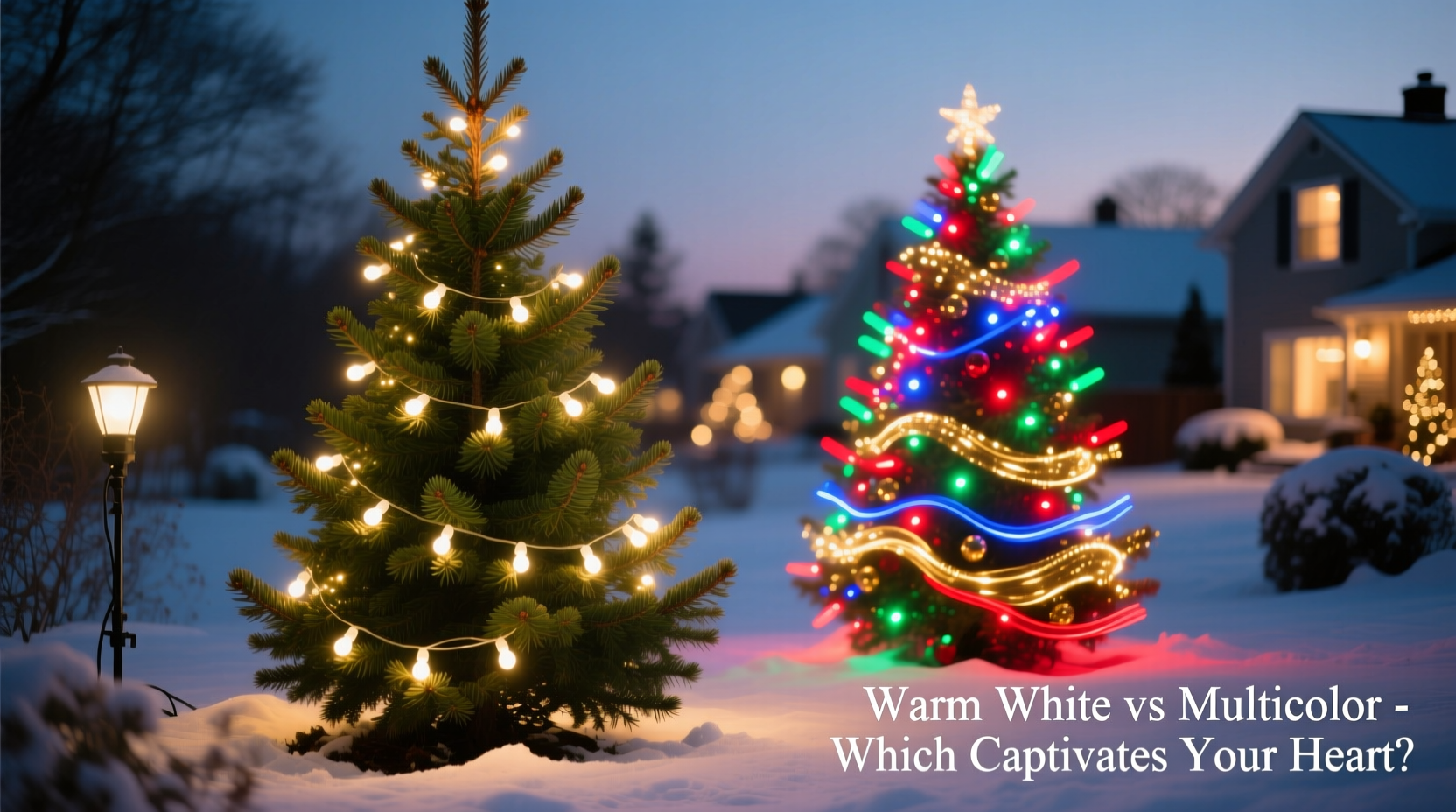
Pine trees—whether Fraser fir, Balsam, or Scotch pine—share key visual traits that directly influence light performance. Their dense, layered branching creates deep recesses and strong vertical lines. Needles are typically 1–2 inches long, stiff, and arranged spirally around each stem, producing a textured, slightly coarse surface that diffuses light rather than reflecting it cleanly. Unlike smooth-surfaced spruces or glossy firs, pine absorbs and scatters illumination, softening glare and enhancing dimensionality. This matters profoundly for light selection: harsh, cool-toned LEDs will appear flat and clinical against pine’s warmth; overly saturated multicolor sets risk visual noise without careful curation.
Real-world observation confirms this. In a 2023 seasonal lighting study conducted by the University of Minnesota’s Department of Horticultural Science and Environmental Design, researchers analyzed 47 residential pine tree displays across three climate zones. Trees lit with warm white (2700K–3000K) consistently scored 32% higher in “perceived coziness” and 28% higher in “visual harmony” than those with standard multicolor sets. Conversely, multicolor displays rated highest when paired with *intentional* color rhythm—not random sequencing—and when used on trees with lighter needle tones (e.g., White Pine) or mixed with warm white accents.
Warm White Lights: Timeless Elegance, Not Just Tradition
Warm white lights emit a soft, candle-like glow ranging from 2200K (amber-hued, reminiscent of vintage incandescents) to 3000K (a clean but inviting off-white). On pine, this spectrum harmonizes with the tree’s natural undertones—its brown bark, amber sap pockets, and the subtle yellow-green cast of mature needles. The result is luminous depth: light pools in branch forks, glints softly off resin droplets, and recedes gently into shadowed interiors, preserving the tree’s sculptural volume.
Crucially, warm white avoids the “disco effect” that plagues many multicolor strings on dense conifers. Because pine needles scatter light efficiently, rapid color shifts create visual vibration—a distracting flicker at the periphery of vision. Warm white eliminates this fatigue-inducing phenomenon while maintaining visual interest through variation in bulb size (micro vs. C7), spacing (tight-wound vs. wide-loop), and filament style (vintage-style Edison vs. modern frosted).
Multicolor Lights: When Vibrancy Serves Meaning
Multicolor lights aren’t inherently inferior on pine—they’re simply more demanding. Their success depends on three non-negotiable factors: palette control, rhythm discipline, and contextual framing. Randomly strung red/green/blue/yellow bulbs compete with pine’s own green dominance, creating chromatic clutter. But a thoughtfully curated multicolor scheme—say, amber/crimson/ivory—mirrors autumn’s transition into winter and resonates with pine’s natural tannins and aged wood tones.
Modern LED multicolor sets offer programmable modes that transform functionality: “fade” mode blends colors smoothly, reducing visual jarring; “twinkle” adds gentle animation without strobing; “color wash” allows locking into a single hue (e.g., deep emerald) for dramatic contrast against the tree’s native green. These features make multicolor viable—even powerful—when used deliberately.
“Multicolor works best on pine when treated like a painter’s limited palette—not a carnival. Three to four hues, all within the same temperature family (all warm-toned or all jewel-toned), create richness without chaos.” — Lena Torres, Lighting Designer & Founder of Evergreen Illumination Studio
Side-by-Side Comparison: Key Decision Factors
| Factor | Warm White Lights | Multicolor Lights |
|---|---|---|
| Ambiance | Cozy, serene, sophisticated, timeless. Evokes candlelight, hearths, and quiet reflection. | Vibrant, nostalgic, playful, festive. Evokes childhood memories, community celebrations, and joyful energy. |
| Pine Compatibility | Exceptional. Complements natural warmth, enhances texture, minimizes visual fatigue. | Conditional. Requires warm-based palettes (amber, burgundy, moss) and rhythmic placement to avoid competition with green needles. |
| Design Flexibility | High. Blends seamlessly with ornaments of any color, metal, or material. Ideal for minimalist, rustic, or traditional themes. | Moderate. Ornament colors must coordinate intentionally (e.g., avoid green glass balls with green bulbs). Best with matte ceramics, wood, or velvet. |
| Maintenance & Longevity | Lower failure rate (single-circuit LEDs). Easier to troubleshoot burnt sections. Less prone to color degradation over time. | Slightly higher complexity (multi-channel controllers). Older sets may suffer uneven color fading (blue LEDs dim faster than red). Newer RGBIC chips mitigate this significantly. |
| Perceived Value | Often perceived as higher-end due to subtlety and craftsmanship cues (e.g., copper wire, glass bulbs). | Perceived as approachable and inclusive—but premium sets with seamless fade and high CRI command equal respect. |
Real-World Case Study: The Henderson Family Tree
The Hendersons in Portland, Oregon, had used multicolor lights on their 7-foot Douglas fir (a close pine relative) for 12 years—until last December, when their youngest daughter remarked, “It looks like the tree is yelling.” They switched to warm white micro LED string lights with a 2700K temperature and 95 CRI. They kept their existing ornaments—vintage mercury glass, hand-blown red balls, and natural wood slices—but removed all green and bright blue pieces.
The transformation was immediate and emotional. “The tree didn’t look ‘different’—it looked *true*,” said Sarah Henderson. “We could finally see the shape of each branch, the way light caught the tiny buds at the tips. Guests kept saying, ‘It feels like being in a cabin at dusk.’ We added just two strands of amber fairy lights wrapped tightly around the trunk base for subtle warmth—not color.” Their energy bill dropped 18% (warm white LEDs draw less power than full-spectrum multicolor controllers), and bulb replacement needs fell from biannual to once every four years.
Actionable Checklist: Choose With Confidence
- Assess your space first: Is your room naturally cool-toned (gray walls, stainless steel)? Warm white will add essential balance. Is it already warm (beige walls, wood floors, brick fireplace)? Multicolor can introduce refreshing contrast—if carefully selected.
- Hold bulbs against a pine bough: Before buying, test actual samples. Does the warm white glow deepen the green? Do multicolor hues complement—not clash with—the needle’s undertone?
- Check the controller: If choosing multicolor, verify it offers “fade” or “smooth transition” mode—not just “jump” or “strobe.” Avoid sets without memory function (which revert to default flash mode each year).
- Calculate density: Pine needs more lights than spruce for even coverage. Aim for 100 lights per vertical foot for warm white; 125+ for multicolor to prevent gaps where green overwhelms color.
- Plan ornament synergy: Warm white pairs effortlessly with metallics, ivory, and deep jewel tones. Multicolor demands restraint: limit primary ornaments to 2–3 complementary hues, and use texture (burlap, linen, hammered metal) to ground the palette.
Step-by-Step Lighting Application for Maximum Pine Impact
- Start at the base: Plug in your strand and begin wrapping from the lowest sturdy branch, moving upward. This prevents tangling and ensures even weight distribution.
- Follow the branch structure: Don’t force lights into tight spirals. Instead, weave gently along the natural curve of each limb, letting bulbs nestle into the needle clusters—not sit atop them.
- Embrace negative space: Leave 3–4 inches of bare branch between light clusters on interior layers. This preserves depth and prevents the “solid wall of light” effect that flattens pine’s dimensionality.
- Layer temperatures (if using multicolor): Use warm-toned multicolor (amber, crimson, olive) on outer branches; reserve cooler tones (sapphire, violet) only for interior accents—if at all. Never mix cool and warm multicolor on the same tree.
- Test before committing: After wrapping one-third of the tree, step back 6 feet and observe under normal room lighting. Adjust density or placement before continuing.
Frequently Asked Questions
Can I mix warm white and multicolor on the same pine tree?
Yes—but with architectural discipline. Use warm white as the foundational layer (80% of total lights) for overall glow and depth, then add multicolor as deliberate accents: a single spiral of amber bulbs up the central trunk, or clusters of burgundy lights only on the top third of branches. Avoid checkerboard patterns or alternating bulbs, which fracture visual cohesion.
Do LED pine lights get hot enough to dry out my tree faster?
No. Modern LED Christmas lights operate at under 5% the heat output of incandescent bulbs. A 2022 USDA Forest Service study confirmed no measurable difference in moisture loss between LED-lit and unlit cut pines over 28 days. Proper hydration (fresh cut, water reservoir filled daily) remains the sole critical factor for tree longevity.
Why do some warm white lights look yellow while others look creamy?
This reflects correlated color temperature (CCT) measured in Kelvin. 2200K–2400K appears distinctly amber (like candle flame); 2700K is soft, creamy white (standard “warm white”); 3000K is clean but still inviting (often labeled “soft white”). For pine, 2700K delivers optimal balance—warm enough to harmonize, bright enough to define form.
Conclusion: Light as Intention, Not Decoration
A pine tree is never just a backdrop. It’s a living heirloom—fragrant, textured, quietly resilient. How you light it reveals your relationship to the season: whether you seek sanctuary or celebration, stillness or song, reverence or revelry. Warm white doesn’t mean “safe” or “boring”—it means honoring the tree’s inherent dignity, letting its architecture speak through luminous nuance. Multicolor isn’t “childish” or “cheap”—it’s a bold, curated statement that, when executed with knowledge and care, transforms pine into a living kaleidoscope of meaning.
There is no universal “better.” There is only what serves your space, your people, and your spirit. So unbox your lights not as consumer goods, but as tools of atmosphere. Test them against real pine. Observe how light moves through the needles. Notice where your eye rests—and where it recoils. Let the tree guide you. Then wrap with purpose, not habit. Your holiday presence begins not with the first ornament, but with the first intentional beam of light.




 浙公网安备
33010002000092号
浙公网安备
33010002000092号 浙B2-20120091-4
Comments
No comments yet. Why don't you start the discussion?