
Choosing the right sound system for your event or activity isn’t just about volume—it’s about context, audience size, portability, and long-term value. While waterproof Bluetooth speakers have become ubiquitous for casual use, portable PA systems offer amplified power for larger gatherings. But at what point does bringing a full PA system cross the line from practical to overkill? Understanding the functional differences, real-world applications, and logistical trade-offs helps ensure you’re not lugging around unnecessary gear—or worse, failing to project your voice when it matters.
Understanding the Core Differences
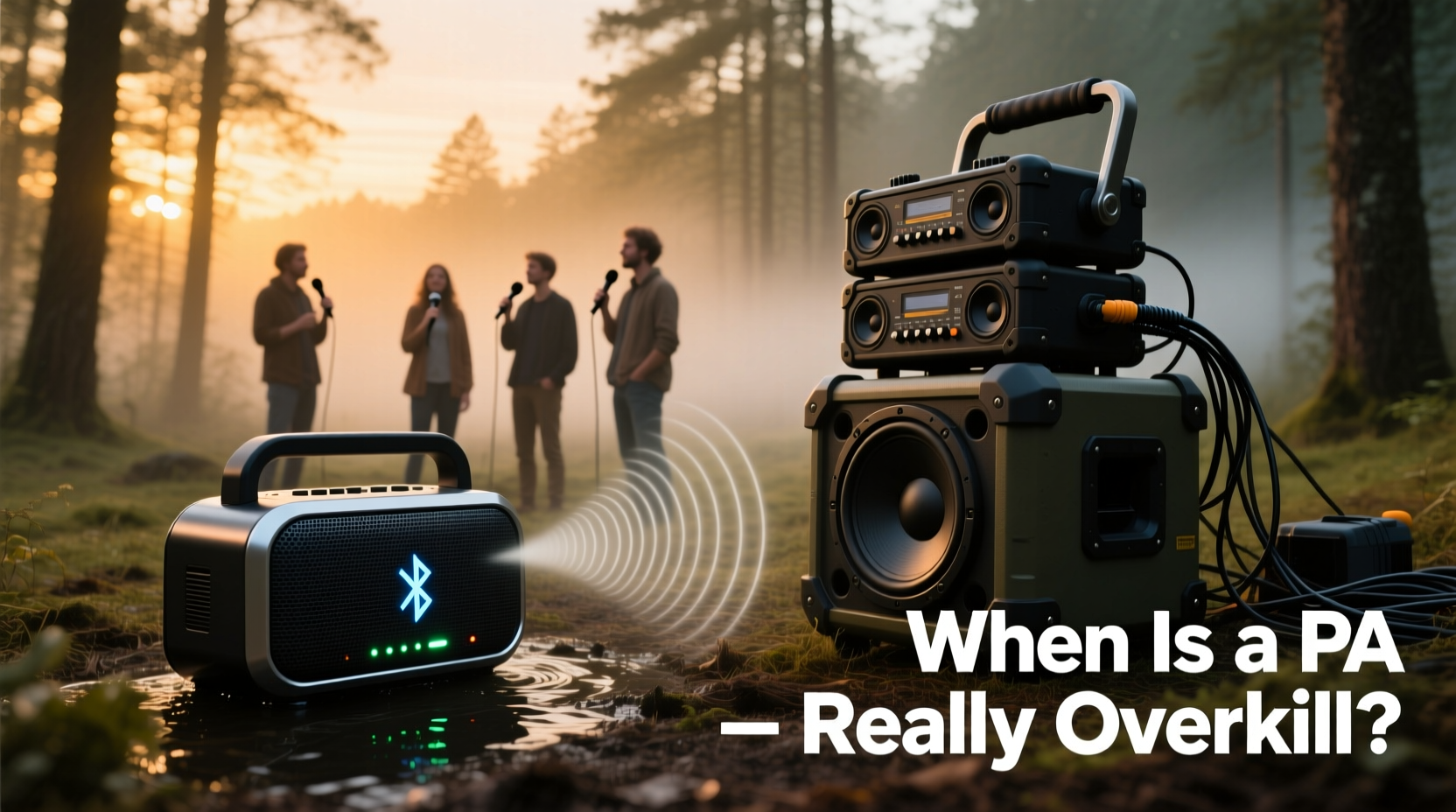
A waterproof Bluetooth speaker is designed for convenience, durability, and simplicity. These compact units are built to withstand splashes, rain, and even submersion in some cases. They connect wirelessly via Bluetooth, often support auxiliary input, and usually include built-in batteries that last several hours. Their output ranges from 10 to 50 watts, suitable for personal listening or small group settings.
In contrast, a portable PA (public address) system is engineered for projection. It typically includes a mixer, amplifier, one or more speakers, microphone inputs, and sometimes monitor outputs. Power output varies widely—from 60 watts in compact models to over 500 watts in professional-grade setups. Most portable PAs support wired microphones, instruments, and multiple audio sources, making them ideal for speeches, performances, and outdoor instruction.
Sizing Your Audience: The Deciding Factor
The number of people you're addressing is the most critical factor in determining whether a PA system is justified. As a rule of thumb:
- 1–15 people: A premium waterproof Bluetooth speaker (e.g., JBL Charge, Ultimate Ears Boom series) delivers clear sound with minimal setup.
- 15–50 people: Mid-range Bluetooth speakers may struggle, especially outdoors. A compact PA system begins to make sense if speech intelligibility is important.
- 50+ people: A portable PA system becomes necessary to maintain consistent volume and clarity across distances.
Environmental factors like wind, ambient noise (traffic, waves), and open space also affect performance. A Bluetooth speaker rated at 30 watts might sound loud in a quiet living room but get drowned out at a beach gathering with 30 attendees.
“Sound pressure drops by 6 dB every time you double the distance from the source. That means without amplification, half your audience won’t hear you clearly.” — Mark Tran, Audio Engineer & Live Sound Consultant
When a Portable PA Is Overkill: Real-World Scenarios
Bringing a PA system to an intimate setting doesn’t just waste effort—it can disrupt the atmosphere. Consider these common examples where a PA crosses into overkill territory:
Casual Outdoor Gatherings
A family picnic in the park with 10 people doesn’t require microphones and speaker stands. A rugged Bluetooth speaker placed centrally provides ample coverage and preserves the relaxed vibe.
Backyard Yoga or Fitness Classes (Small Groups)
If you’re leading a 12-person session on a quiet morning, a waterproof speaker with a good bass response and weather resistance is more than enough. A PA adds bulk, complexity, and potential feedback issues without benefit.
Boat Parties or Kayak Outings
Space and weight matter on watercraft. A floating Bluetooth speaker clips easily to a rail or inflates with a raft. A PA system introduces tripping hazards, moisture risks to electronics, and excessive volume that disturbs nearby boaters.
Comparison Table: Bluetooth Speaker vs. Portable PA System
| Feature | Waterproof Bluetooth Speaker | Portable PA System |
|---|---|---|
| Typical Power Output | 10–50 watts | 60–500+ watts |
| Portability | High – fits in backpack | Medium to Low – requires case or cart |
| Battery Life | 8–20 hours | 4–10 hours (varies by model) |
| Microphone Support | Rarely; no XLR inputs | Standard (XLR/1/4” inputs) |
| Setup Time | Under 1 minute | 5–15 minutes |
| Ideal Audience Size | 1–25 people | 30–200+ people |
| Best Use Cases | Picnics, pool parties, hiking, showers | Sports coaching, public speaking, live music |
Mini Case Study: The Community Garden Workshop
Lena organized a weekly gardening workshop in a local community garden. Attendance fluctuated between 12 and 22 participants. Initially, she brought a compact PA system with a wireless mic, believing it would help her be heard over rustling leaves and distant traffic.
After two sessions, attendees commented that the setup felt “too formal” and “like school.” One member noted, “We came to dig in the dirt, not sit through a lecture.” Lena switched to a JBL Xtreme 3—waterproof, loud enough, and easy to place on a bench. She found that walking among the group while speaking eliminated the need for amplification. Her change improved engagement and reduced setup time from 12 minutes to under 2.
This example illustrates how mismatched equipment can unintentionally alter group dynamics—even when technically functional.
Step-by-Step Guide: Choosing the Right System
- Estimate your audience size. Be realistic. Will people cluster closely or spread out?
- Assess the environment. Is it indoors, sheltered, windy, or noisy? Open spaces demand more power.
- Determine content type. Are you playing music, giving a talk, or leading a class? Speech requires clearer midrange and less bass than music.
- Evaluate portability needs. How far will you carry the system? Do you have vehicle access?
- Test before committing. Borrow or rent both options if possible. Play spoken word and music at expected volume levels.
- Consider future use. Will this setup serve multiple scenarios, or is it a one-off?
Frequently Asked Questions
Can I use a Bluetooth speaker as a PA system with a wireless mic?
Some newer models support external microphones via apps or dongles, but latency and low gain make them impractical for serious speaking. Dedicated PAs provide better mic preamps, feedback control, and mixing capabilities.
Are there hybrid systems that bridge the gap?
Yes. Compact PA systems like the Bose L1 Compact or Electro-Voice ETX-Compact combine portability with professional features. They weigh less than 30 lbs and offer Bluetooth streaming, mic inputs, and directional sound—ideal for medium-sized events without full-scale rigging.
Does weather resistance matter for PA systems?
Most portable PAs are not fully waterproof. While they can handle light rain, prolonged exposure damages electronics. If weather is unpredictable, use covers or opt for indoor-rated models with external protection.
Checklist: Before You Buy or Bring a PA System
- ☐ Audience exceeds 30 people
- ☐ Speech intelligibility is critical (e.g., instructions, announcements)
- ☐ Multiple audio sources needed (mic + music + instrument)
- ☐ Reliable power source available (outlet or long-life battery)
- ☐ Transport method accommodates size and weight
- ☐ Simpler alternatives tested and found insufficient
Conclusion: Match the Tool to the Task
There’s no universal answer to whether a PA system is overkill—only whether it’s appropriate. A waterproof Bluetooth speaker excels in mobility, ease of use, and subtlety. A portable PA delivers authority, reach, and versatility. The key is aligning your choice with actual needs, not perceived professionalism. Over-amplifying a small group creates discomfort; under-amplifying a large one leads to frustration. By evaluating audience size, environment, content, and logistics, you’ll avoid the pitfalls of excess gear while ensuring your message—or music—is heard clearly.




 浙公网安备
33010002000092号
浙公网安备
33010002000092号 浙B2-20120091-4
Comments
No comments yet. Why don't you start the discussion?