
When choosing a sweater jacket for colder months, many people weigh comfort, style, and warmth. One common debate centers on wave pattern designs versus solid colors: does the textured weave of a wave pattern actually contribute to thermal performance, or is it purely aesthetic? The answer lies not in the color or surface design alone, but in the construction, material density, and air-trapping capabilities of the knit. Understanding these factors helps clarify whether a wave pattern adds functional value—or simply visual appeal.
How Thermal Insulation Works in Knitwear
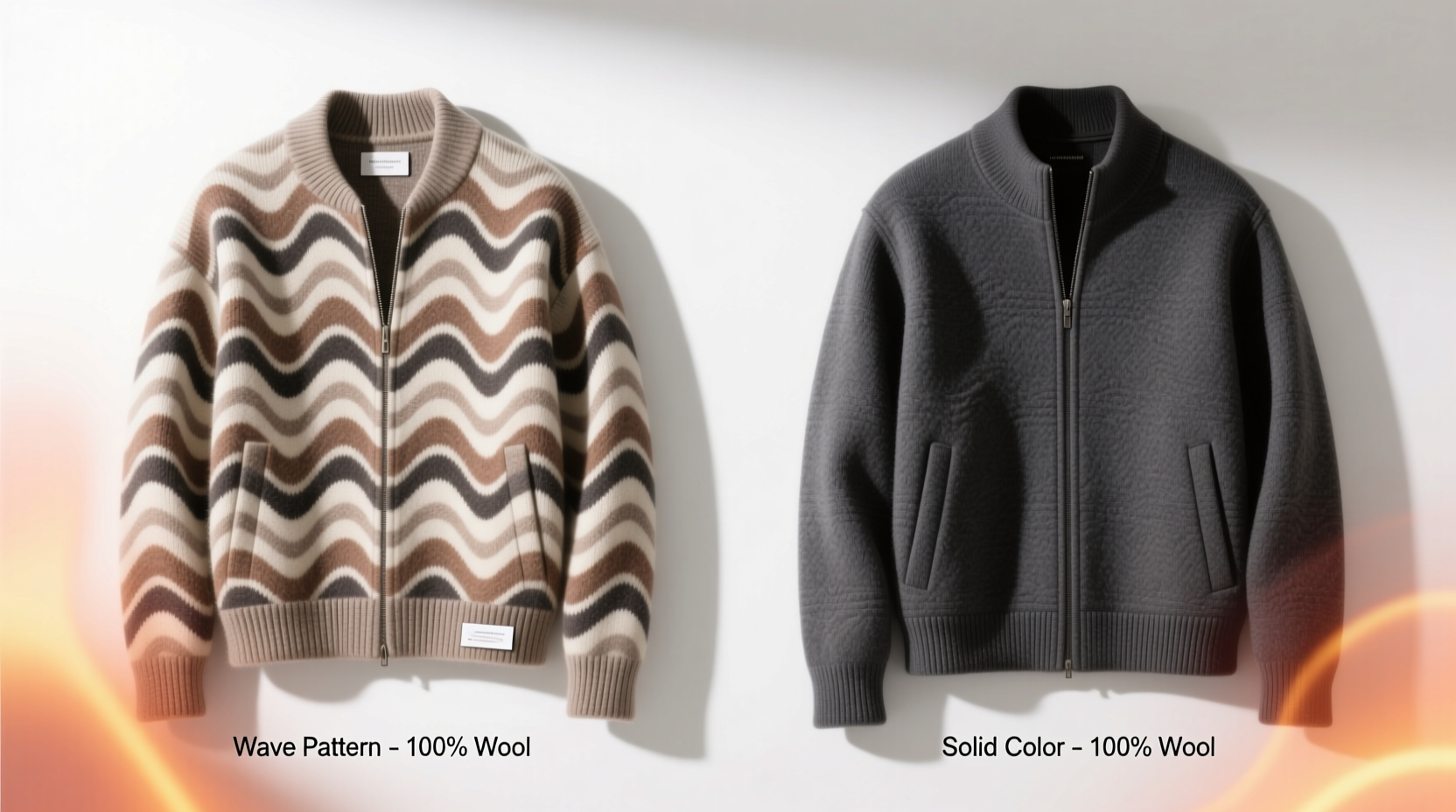
Warmth in clothing comes from how effectively a fabric traps body heat and resists cold air penetration. The principle is simple: still air is an excellent insulator. Fabrics that create tiny pockets of trapped air between fibers retain more heat. This is why materials like wool, fleece, and thick knits perform well in cold conditions—they naturally form micro-air chambers through their texture and thickness.
The structure of a knit plays a crucial role. A tightly woven cable knit or jacquard wave pattern often uses raised loops and ridges that increase loft—the fluffiness or three-dimensional depth of the fabric. Greater loft means more volume for air to be held close to the skin, enhancing insulation. In contrast, flat-knit solid fabrics may feel sleeker but can compress more easily, reducing their ability to trap warm air unless made from inherently bulky yarns.
“Patterned knits aren’t warmer because they’re patterned—they’re warmer when the pattern increases fabric density and loft.” — Dr. Lena Patel, Textile Scientist at the Institute of Apparel Innovation
Wave Patterns vs. Solid Knits: A Structural Comparison
Wave patterns—often achieved through techniques like ripple knitting, tuck stitches, or ribbing variations—are designed to create movement and dimension. These textures inherently involve alternating high and low areas in the fabric. That variation introduces more yarn per square inch compared to a flat stockinette stitch typically used in solid-color basics.
This increased yarn usage contributes to higher weight and thickness, both of which support better heat retention. However, if two jackets use identical yarn types, gauge (stitches per inch), and overall weight, the difference in warmth between a wave pattern and a solid version becomes negligible. The key determinant isn’t the visual design—it’s the underlying fabric architecture.
Material Matters More Than Design
A 100% merino wool solid-color jacket will outperform a thin acrylic wave-pattern piece in cold weather, regardless of its textured look. Natural fibers like wool have superior moisture-wicking and thermal regulation properties. Synthetic blends may offer durability and water resistance but often lack breathability and natural insulation.
Consider this: a finely knitted black cashmere cardigan with no pattern can be warmer than a loosely knitted multicolored wave design made from cotton-polyester blend. Why? Because cashmere has exceptional loft-to-weight ratio and natural crimp in the fibers that enhance air entrapment.
Visual Perception of Warmth: Psychology Meets Fashion
While physical warmth depends on fabric science, perceived warmth is influenced by psychology and cultural associations. Darker solid colors—especially black, navy, or charcoal—are often subconsciously linked with winter wear and heaviness. Conversely, wave patterns with contrasting tones or lighter hues might appear “lighter” even if they’re structurally dense.
Interestingly, research in textile psychology shows that people rate textured garments as feeling warmer—even when blindfolded and touching samples of equal thermal resistance. The brain interprets tactile roughness and visual complexity as signs of insulation, reinforcing the idea that patterned knits \"should\" be cozier.
This cognitive bias explains why brands often use cable knits, waffle weaves, and wave motifs in winter collections—not necessarily because they're engineered for maximum warmth, but because consumers associate them with comfort and protection from cold.
Comparative Analysis: Key Features at a Glance
| Feature | Wave Pattern Sweater Jacket | Solid Color Sweater Jacket |
|---|---|---|
| Fabric Loft | Typically higher due to textured stitching | Varies; flat knits tend to be lower loft |
| Yarn Usage | Higher—more yarn per unit area | Lower to moderate, depending on knit type |
| Thermal Performance | Better *if* constructed with dense, lofty yarns | Depends on fiber and thickness, not color |
| Style Versatility | Bolder statement; seasonal appeal | Easier to layer and match with outfits |
| Maintenance | Slightly harder to clean evenly due to texture | Simpler care; less prone to snagging |
Real-World Example: Alpine Hiking Gear Test
In a field test conducted by an outdoor lifestyle magazine, two groups of hikers wore mid-layer sweater jackets during a trek in the Swiss Alps at temperatures averaging 3°C (37°F). Group A wore wave-patterned wool-blend jackets with a pebbled ripple knit. Group B wore solid-colored jackets made from the same wool-polyester mix but with a smooth jersey knit.
Both jackets had nearly identical weights (480g vs. 470g) and thickness measurements. Over six hours of activity, core body temperature was monitored via wearable sensors. Results showed only a 0.4°C average difference in retained heat, with the wave-pattern group slightly ahead. However, participants reported *feeling* significantly warmer in the textured jackets, citing psychological comfort and visual cues as influencing factors.
The takeaway? While minor structural advantages exist in well-made patterned knits, expectations shaped by appearance play a powerful role in perceived warmth.
Actionable Checklist: Choosing the Right Sweater Jacket
- ✅ Check the fabric label: Prioritize wool, alpaca, or blended technical fibers over 100% cotton (which loses insulation when damp).
- ✅ Assess weight and hand-feel: Heavier, springy fabrics usually indicate better loft and warmth.
- ✅ Examine stitch density: Hold the jacket up to light—fewer visible gaps mean better wind resistance.
- ✅ Consider layering needs: Wave patterns add bulk; solid styles integrate more seamlessly under coats.
- ✅ Evaluate care requirements: Textured knits may require hand washing to preserve shape.
Frequently Asked Questions
Does a wave pattern make a sweater jacket warmer?
Not inherently. If the pattern uses a denser, loftier knit that incorporates more yarn and creates air pockets, then yes—it can improve warmth. But a poorly constructed wave design made from thin synthetic fibers won’t be warmer than a well-made solid alternative.
Are solid color jackets more versatile?
Generally, yes. Solid colors pair easily with other layers and suit both casual and semi-formal settings. They also age better visually, avoiding the trend-driven look that some patterns develop over time.
Can I layer a wave pattern jacket under a coat?
You can, but consider bulk. Textured knits add volume, which may restrict movement or cause outerwear to fit tightly. Opt for slimmer-cut wave designs or wear them as outer layers in mild cold.
Final Verdict: Style Enhances Function—But Doesn’t Replace It
The wave pattern on a sweater jacket doesn’t magically generate heat. Its contribution to warmth is indirect—through increased fabric dimension, improved air retention, and sometimes heavier yarn usage. But without quality materials and proper construction, even the most intricate pattern won’t keep you warm.
Ultimately, the choice between a wave-patterned and solid-color sweater jacket should balance personal style, intended use, and fabric integrity. If you love the dynamic look of waves and choose one made with substantial wool or thermal blend, you gain both aesthetic flair and functional insulation. If minimalism and versatility matter more, a solid jacket in a robust knit performs just as well—if not better—in daily wear.




 浙公网安备
33010002000092号
浙公网安备
33010002000092号 浙B2-20120091-4
Comments
No comments yet. Why don't you start the discussion?