
The word \"why\" is one of the most fundamental tools in human language. It appears in conversations, scientific inquiry, philosophical debates, and even casual social interactions. While it seems simple—a mere five-letter question—its depth and impact are far-reaching. Understanding what \"why\" stands for, how it functions, and where it’s commonly used can transform the way we think, learn, and communicate.
At its core, \"why\" is not just a question word—it's a gateway to reasoning, motivation, causality, and deeper understanding. This article explores the multiple dimensions of \"why,\" from linguistic structure to psychological significance, practical applications, and real-world examples that illustrate its power.
The Linguistic Role of \"Why\"
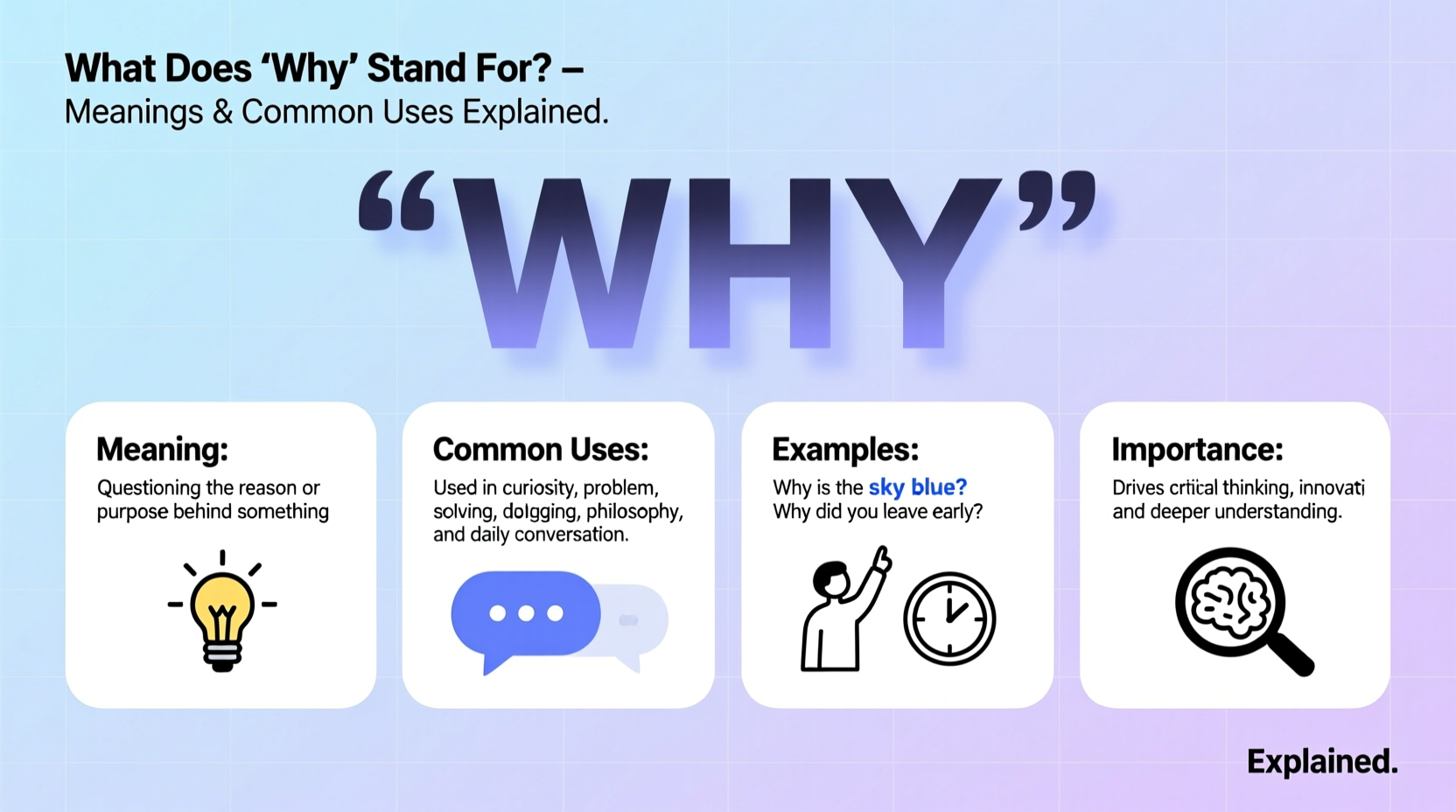
In English grammar, \"why\" is an interrogative adverb used to ask for reasons or explanations. It typically introduces questions that seek to uncover cause-and-effect relationships. For example:
- Why did the train arrive late?
- Why do plants need sunlight?
- Why are you upset?
Syntactically, \"why\" often precedes auxiliary verbs or forms part of indirect questions:
\"She asked why he hadn’t called.\"
Linguists categorize \"why\" as a wh-word, alongside \"what,\" \"where,\" \"when,\" \"who,\" and \"how.\" These words initiate open-ended inquiries that cannot be answered with a simple \"yes\" or \"no.\" Among them, \"why\" is unique because it targets intent, purpose, or underlying mechanisms rather than surface-level facts.
Psychological and Cognitive Significance
From early childhood, humans use \"why\" to make sense of their environment. A toddler might ask, \"Why is the sky blue?\" not merely to gather information but to build a mental model of how the world works. This curiosity-driven questioning is central to cognitive development.
Psychologist Jean Piaget observed that children between the ages of 3 and 7 enter a stage known as the \"preoperational stage,\" characterized by endless \"why\" questions. These aren't random—they reflect attempts to understand causality, morality, and social norms.
As adults, we retain this instinct, though our \"why\" questions become more complex:
- Why did I fail the interview?
- Why does this policy exist?
- Why am I feeling unmotivated?
According to Dr. Tania Lombrozo, a cognitive psychologist at Princeton University:
“People have a deep-seated drive to explain. The question 'why?' isn't just about gathering data—it's about creating coherent narratives that help us predict, justify, and control outcomes.” — Dr. Tania Lombrozo, Cognitive Psychologist
Common Uses of \"Why\" Across Contexts
The versatility of \"why\" makes it indispensable across disciplines. Below is a breakdown of how it functions in different areas:
| Context | Purpose of \"Why\" | Example |
|---|---|---|
| Science | To investigate causes and test hypotheses | Why does water boil at 100°C at sea level? |
| Education | To promote critical thinking and comprehension | Why did the character make that decision? |
| Business | To analyze decisions, strategies, and failures | Why did customer retention drop last quarter? |
| Therapy & Coaching | To explore emotions, behaviors, and motivations | Why do you feel anxious before meetings? |
| Philosophy | To examine existence, ethics, and meaning | Why are we here? |
In each case, \"why\" serves as a diagnostic tool. It peels back layers of action to reveal beliefs, assumptions, and root causes.
The Five Whys Technique in Problem Solving
A powerful application of the word \"why\" is found in the **Five Whys method**, developed by Sakichi Toyoda and later adopted by Toyota Motor Corporation in its manufacturing processes. The technique involves asking \"why\" repeatedly—typically five times—to drill down from a symptom to the root cause of a problem.
Step-by-step process:
- Identify a problem.
- Ask, “Why did this happen?”
- Take the answer and ask “Why?” again.
- Repeat until reaching a fundamental cause (usually around the fifth iteration).
- Implement a solution targeting that root cause.
Mini Case Study: Production Delay at a Tech Startup
A software team missed a product launch deadline. Using the Five Whys:
- Why? The final code wasn’t ready on time.
→ Because testing took longer than expected. - Why? Testing took longer.
→ Because bugs were discovered late in the cycle. - Why? Bugs were found late.
→ Because developers didn’t run unit tests during coding. - Why? Unit tests weren’t run.
→ Because there was no automated testing setup. - Why? No automated setup existed.
→ Because engineering leadership never prioritized DevOps infrastructure.
The root cause: lack of investment in development tools. The solution? Allocate budget and personnel to build an automated testing pipeline. By asking \"why\" five times, the team shifted focus from blaming individuals to fixing systemic issues.
When \"Why\" Can Be Counterproductive
Despite its value, \"why\" can sometimes hinder communication, especially in emotional or high-stakes situations. Because it often implies judgment, it may trigger defensiveness.
For example:
- \"Why didn’t you finish the report?\" → May sound accusatory.
- Versus: \"What got in the way of finishing the report?\" → Invites collaboration.
Coaches and mediators often recommend rephrasing \"why\" questions to reduce tension. Alternatives like \"what led to…\", \"help me understand…\", or \"what was your thinking behind…\" preserve curiosity without blame.
Checklist: Using \"Why\" Effectively
To harness the full potential of \"why\" while avoiding pitfalls, follow this checklist:
- ✅ Use \"why\" to seek understanding, not assign blame.
- ✅ Ask one \"why\" at a time—don’t rapid-fire questions.
- ✅ Listen fully to the response before asking the next \"why.\"
- ✅ In emotional settings, consider rewording to sound less confrontational.
- ✅ Apply the Five Whys systematically when solving complex problems.
- ✅ Encourage others to ask \"why\" to foster a culture of inquiry.
Frequently Asked Questions
Is \"why\" always necessary in problem-solving?
No. While \"why\" is excellent for identifying root causes, some situations require immediate action over analysis. In emergencies, asking \"how\" or \"what now?\" may be more effective. Reserve \"why\" for post-event reviews or strategic planning.
Can \"why\" have multiple correct answers?
Yes. Unlike factual questions, \"why\" often has several valid interpretations depending on context. For example, \"Why did the company fail?\" could be answered with financial mismanagement, poor leadership, market shifts, or any combination. Multiple perspectives enrich understanding.
Does every \"why\" need an answer?
Not necessarily. Some existential or philosophical \"why\" questions—like \"Why do we suffer?\"—may not have definitive answers. In such cases, the act of asking becomes valuable in itself, prompting reflection, empathy, or spiritual exploration.
Conclusion: Embrace the Power of Inquiry
\"Why\" is more than a word—it's a mindset. Whether you're debugging code, parenting a curious child, leading a team, or examining your own choices, the ability to ask \"why\" thoughtfully can lead to breakthroughs, clarity, and growth. It challenges assumptions, uncovers truths, and fosters deeper connections.
But like any powerful tool, it must be used wisely. Balance curiosity with empathy. Seek understanding, not justification. And remember: the best answers often begin with the right questions.




 浙公网安备
33010002000092号
浙公网安备
33010002000092号 浙B2-20120091-4
Comments
No comments yet. Why don't you start the discussion?